Research & Development World

  • R&D World Home
  • Topics
    • Aerospace
    • Automotive
    • Biotech
    • Careers
    • Chemistry
    • Environment
    • Energy
    • Life Science
    • Material Science
    • R&D Management
    • Physics
  • Technology
    • 3D Printing
    • A.I./Robotics
    • Software
    • Battery Technology
    • Controlled Environments
      • Cleanrooms
      • Graphene
      • Lasers
      • Regulations/Standards
      • Sensors
    • Imaging
    • Nanotechnology
    • Scientific Computing
      • Big Data
      • HPC/Supercomputing
      • Informatics
      • Security
    • Semiconductors
  • R&D Market Pulse
  • R&D 100
    • 2025 R&D 100 Award Winners
    • 2025 Professional Award Winners
    • 2025 Special Recognition Winners
    • R&D 100 Awards Event
    • R&D 100 Submissions
    • Winner Archive
  • Resources
    • Research Reports
    • Digital Issues
    • Educational Assets
    • Subscribe
    • Video
    • Webinars
    • Content submission guidelines for R&D World
  • Global Funding Forecast
  • Top Labs
  • Advertise
  • SUBSCRIBE

These microrobots can collect nanoplastics from water

By Julia Rock-Torcivia | May 1, 2026

Researchers at Brno University of Technology have developed magnetic microbots that can remove nanoplastics from water via electrostatic attraction. They published their findings in Environmental Science: Nano. 
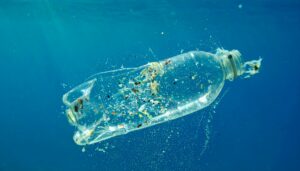
Adobe

Nanoplastics, plastic particles smaller than 100 nm, are considered more dangerous than microplastics because their size allows them to cross cell membranes. They have been detected in the human placenta, heart and brain. Exposure to nanoplastics is increasingly linked to various diseases, including cancer. 

Seek and destroy

Current water treatments often rely on passive adsorption, which is limited by how fast particles can naturally diffuse through water. In contrast to these methods, the new robots actively seek out plastic particles rather than collecting molecules that happen to drift close enough. They operate under a low-energy magnetic field and do not require any additives to operate. 

To make the robots, researchers created a series of thin rods from iron-based metal-organic frameworks (MOFs). The hexagonal rods have craters in their surfaces, which become sites for the nanoplastics to bind. The scientists carbonized the rods at 450 degrees Celsius, causing the iron to rearrange into magnetic compounds, which allows the bots to be controlled by magnets. The carbonization process also expanded the rods’ surface area, causing minuscule pores to open, where even more nanoplastics can attach. 

The researchers named their robots MILBots as they were derived from a framework called MIL-88(Fe). They have a maximum adsorption capacity of 229 mg of plastic per gram of robot. They can move at an average speed of 28 micrometers per second at their peak frequency of 25 Hz. The bots have a strong positive charge of 32 mV, which complements the negative 31 mV charge of polystyrene beads. 

MILBots collected 70% of nanoplastics in water

The scientists tested the robots in a small vial of distilled water with glowing nanoplastics. They activated a magnetic coil around the vial, generating a rotating magnetic field that causes the robots to move. The robots collided with the particles and snagged the nanoplastics via electrostatic force. After one hour, the robots captured 78% of the nanoplastics, about 60% more than if the bots were still. 

The robots were cleaned in an acid bath to release the plastic particles and restore their surfaces for reuse. However, their performance began to decline after four cycles as their pores were clogged with plastics and ions from the water. 

When the scientists tested the robots in simulated seawater and groundwater, they found that the bots collected 70% of the plastics, as dissolved ions such as sulfate, chloride and nitrate, were also picked up by the pores. The high ionic strength of seawater also compressed the electrical double layer around the particles, which weakened the electrostatic pull between the bots and the nanoplastics. 

The robots are also too small to make covering large volumes of water practical. Magnetic fields also decay with distance, making deep water unreachable by this method. The team is in talks with water treatment companies to explore where their technology might fit. They also help to send the robots to the International Space Station, where they could help remove contamination from the lab’s water filtration systems. 

Tell Us What You Think! Cancel reply

You must be logged in to post a comment.

Related Articles Read More >

Abstract of modern high tech internet data center room with rows of racks with network and server hardware. 3d rendering
A startup says it found hidden memory behavior in NVIDIA GPUs and is building a security layer around it
Study shows LLMs can diagnose ER patients more accurately than physicians
New Pistoia Alliance survey shows just 1% of professionals report AI’s value in the wet lab
The startup JustPaid drew inspiration from the sitcom Silicon Valley gag into an AI engineer
rd newsletter
EXPAND YOUR KNOWLEDGE AND STAY CONNECTED
Get the latest info on technologies, trends, and strategies in Research & Development.

R&D World Digital Issues

Fall 2025 issue

Browse the most current issue of R&D World and back issues in an easy to use high quality format. Clip, share and download with the leading R&D magazine today.

R&D 100 Awards
Research & Development World
  • Subscribe to R&D World Magazine
  • Sign up for R&D World’s newsletter
  • Contact Us
  • About Us
  • Drug Discovery & Development
  • Pharmaceutical Processing
  • Global Funding Forecast

Copyright © 2026 WTWH Media LLC. All Rights Reserved. The material on this site may not be reproduced, distributed, transmitted, cached or otherwise used, except with the prior written permission of WTWH Media
Privacy Policy | Advertising | About Us

Search R&D World

  • R&D World Home
  • Topics
    • Aerospace
    • Automotive
    • Biotech
    • Careers
    • Chemistry
    • Environment
    • Energy
    • Life Science
    • Material Science
    • R&D Management
    • Physics
  • Technology
    • 3D Printing
    • A.I./Robotics
    • Software
    • Battery Technology
    • Controlled Environments
      • Cleanrooms
      • Graphene
      • Lasers
      • Regulations/Standards
      • Sensors
    • Imaging
    • Nanotechnology
    • Scientific Computing
      • Big Data
      • HPC/Supercomputing
      • Informatics
      • Security
    • Semiconductors
  • R&D Market Pulse
  • R&D 100
    • 2025 R&D 100 Award Winners
    • 2025 Professional Award Winners
    • 2025 Special Recognition Winners
    • R&D 100 Awards Event
    • R&D 100 Submissions
    • Winner Archive
  • Resources
    • Research Reports
    • Digital Issues
    • Educational Assets
    • Subscribe
    • Video
    • Webinars
    • Content submission guidelines for R&D World
  • Global Funding Forecast
  • Top Labs
  • Advertise
  • SUBSCRIBE