Research & Development World

  • R&D World Home
  • Topics
    • Aerospace
    • Automotive
    • Biotech
    • Careers
    • Chemistry
    • Environment
    • Energy
    • Life Science
    • Material Science
    • R&D Management
    • Physics
  • Technology
    • 3D Printing
    • A.I./Robotics
    • Software
    • Battery Technology
    • Controlled Environments
      • Cleanrooms
      • Graphene
      • Lasers
      • Regulations/Standards
      • Sensors
    • Imaging
    • Nanotechnology
    • Scientific Computing
      • Big Data
      • HPC/Supercomputing
      • Informatics
      • Security
    • Semiconductors
  • R&D Market Pulse
  • R&D 100
    • 2025 R&D 100 Award Winners
    • 2025 Professional Award Winners
    • 2025 Special Recognition Winners
    • R&D 100 Awards Event
    • R&D 100 Submissions
    • Winner Archive
  • Resources
    • Research Reports
    • Digital Issues
    • Educational Assets
    • R&D Index
    • Subscribe
    • Video
    • Webinars
    • Content submission guidelines for R&D World
  • Global Funding Forecast
  • Top Labs
  • Advertise
  • SUBSCRIBE

A World-first: Location of Single Atom in Silicon Crystal IDed

By University of New South Wales | June 8, 2016

Researchers from the Centre for Quantum Computation and Communication Technology (CQC2T) have been able to identify the exact location of a single atom in a silicon crystal — an important technique for building a silicon-based quantum computer.

The study, by Centre researchers from UNSW and the University of Melbourne, is published in the journal Nature Nanotechnology.

Individual phosphorus atoms placed in a silicon crystal have great potential as quantum bits, or qubits — the core components of large-scale quantum processors. Being able to pinpoint the position of a qubit is critical for the design of accurate quantum logic operations, where calculations will be carried out between qubits of information.

The world-first approach for locating the introduced, or donor, atoms in the silicon crystal lattice involved a combination of theory and experimental images.

CQC2T Deputy Director, University of Melbourne Professor Lloyd Hollenberg, leads a large-scale theoretical program which also involves researchers from Purdue University in the U.S. This effort was combined with atomic-resolution scanning tunneling microscope (STM) images from the CQC2T laboratories at UNSW of Scientia Professor Sven Rogge and Scientia Professor Michelle Simmons.

“We were able to obtain high-resolution images of individual phosphorus and arsenic donors below the silicon surface,” says study co-author Dr. Juanita Bocquel of UNSW. “Close collaboration with theory successfully pinpointed donor atoms in the silicon lattice at positions that are relevant for quantum computation.”
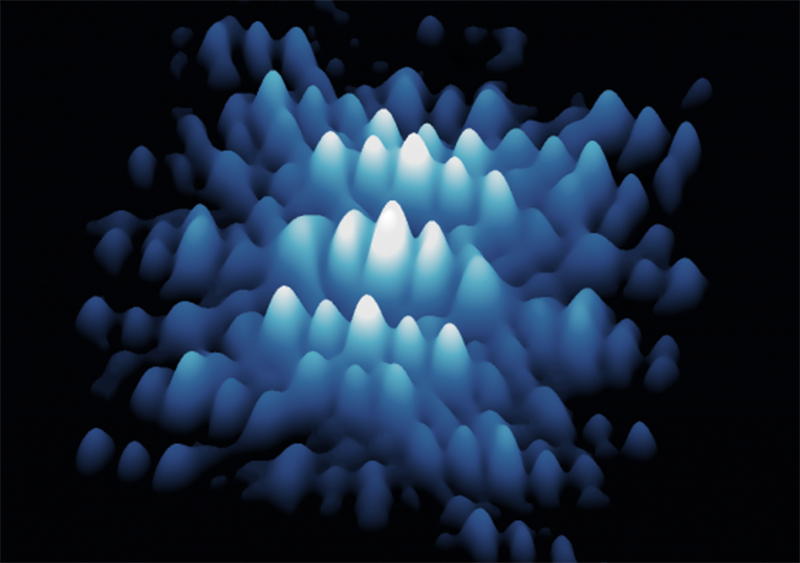
A scanning tunneling microscope image showing the atomic level detail of the electron wave function of a phosphorus atom in a silicon chip.

Study lead author, University of Melbourne’s Dr. Muhammad Usman, says: “The images showed a dazzling array of symmetries that seemed to defy explanation, but when the environment of the quantum state was explicitly taken into account in the theoretical treatment, suddenly the images made perfect sense.”

Hollenberg says, “The STM images have remarkable detail, showing the tendrils of the donor’s electron wave function protruding from the silicon surface interacting directly with the scanning STM tip.

“The final images are therefore highly sensitive to the absolute location of the donor atom.”

Rogge, who heads the low temperature STM imaging laboratory at UNSW, believes that the ability to exactly pinpoint the quantum bit is critical in understanding not only how these objects will be used to perform quantum logic gates in a quantum computer, but also how such donor atoms could affect other ultra-scaled nanoelectronic devices.

The Australian Research Council CQC2T, which is headquartered at UNSW, is a world-leading research organization focused on the demonstration of the fundamental building blocks of a silicon-based solid-state quantum processor and an optical processor.

In December 2015, the federal government announced a $26 million investment in the Centre’s ground-breaking quantum computing research as part of its National Innovation and Science Agenda. This was also supported by a combined $20 million commitment from the Commonwealth Bank of Australia and Telstra.

Source: University of New South Wales

Related Articles Read More >

New video series: Travel for engineers
Advanced Manufacturing and Process Innovation Special Report: When you can’t hire, you automate
Pancreas or pancreatic cancer with organs and tumors or cancerous cells 3D rendering illustration with male body. Anatomy, oncology, disease, medical, biology, science, healthcare concepts.
AI tool used to detect pancreatic cancer in routine CT scans in China 
R&D 100 Red Carpet: DuPont’s triple win
rd newsletter
EXPAND YOUR KNOWLEDGE AND STAY CONNECTED
Get the latest info on technologies, trends, and strategies in Research & Development.
RD 25 Power Index

R&D World Digital Issues

Fall 2025 issue

Browse the most current issue of R&D World and back issues in an easy to use high quality format. Clip, share and download with the leading R&D magazine today.

R&D 100 Awards
Research & Development World
  • Subscribe to R&D World Magazine
  • Sign up for R&D World’s newsletter
  • Contact Us
  • About Us
  • Drug Discovery & Development
  • Pharmaceutical Processing
  • Global Funding Forecast

Copyright © 2026 WTWH Media LLC. All Rights Reserved. The material on this site may not be reproduced, distributed, transmitted, cached or otherwise used, except with the prior written permission of WTWH Media
Privacy Policy | Advertising | About Us

Search R&D World

  • R&D World Home
  • Topics
    • Aerospace
    • Automotive
    • Biotech
    • Careers
    • Chemistry
    • Environment
    • Energy
    • Life Science
    • Material Science
    • R&D Management
    • Physics
  • Technology
    • 3D Printing
    • A.I./Robotics
    • Software
    • Battery Technology
    • Controlled Environments
      • Cleanrooms
      • Graphene
      • Lasers
      • Regulations/Standards
      • Sensors
    • Imaging
    • Nanotechnology
    • Scientific Computing
      • Big Data
      • HPC/Supercomputing
      • Informatics
      • Security
    • Semiconductors
  • R&D Market Pulse
  • R&D 100
    • 2025 R&D 100 Award Winners
    • 2025 Professional Award Winners
    • 2025 Special Recognition Winners
    • R&D 100 Awards Event
    • R&D 100 Submissions
    • Winner Archive
  • Resources
    • Research Reports
    • Digital Issues
    • Educational Assets
    • R&D Index
    • Subscribe
    • Video
    • Webinars
    • Content submission guidelines for R&D World
  • Global Funding Forecast
  • Top Labs
  • Advertise
  • SUBSCRIBE