Research & Development World

  • R&D World Home
  • Topics
    • Aerospace
    • Automotive
    • Biotech
    • Careers
    • Chemistry
    • Environment
    • Energy
    • Life Science
    • Material Science
    • R&D Management
    • Physics
  • Technology
    • 3D Printing
    • A.I./Robotics
    • Software
    • Battery Technology
    • Controlled Environments
      • Cleanrooms
      • Graphene
      • Lasers
      • Regulations/Standards
      • Sensors
    • Imaging
    • Nanotechnology
    • Scientific Computing
      • Big Data
      • HPC/Supercomputing
      • Informatics
      • Security
    • Semiconductors
  • R&D Market Pulse
  • R&D 100
    • 2026 R&D 100 Award Winners
    • 2026 Professional Award Winners
    • 2026 Special Recognition Winners
    • R&D 100 Awards Event
    • R&D 100 Submissions
    • Winner Archive
  • Resources
    • Research Reports
    • Digital Issues
    • Educational Assets
    • Subscribe
    • Video
    • Webinars
    • PharmSci360
    • Content submission guidelines for R&D World
  • Global Funding Forecast
  • Top Labs
  • Advertise
  • SUBSCRIBE

NASA Finds ‘Iceball’ Planet

By Kenny Walter | April 26, 2017

This artist’s concept shows OGLE-2016-BLG-1195Lb, a planet discovered through a technique called microlensing. Credits: NASA/JPL-Caltech

NASA scientists have found a new planet that may add to the understanding of the types of planetary systems that exist beyond the solar system.

The planet—OGLE-2016-BLG-1195lb—has roughly the same mass as Earth and is orbiting a star at the same distance that the Earth orbits the sun. However, because the star is so faint, NASA has concluded that the ‘iceball’ planet is likely too cold to be habitable for life.

“This ‘iceball’ planet is the lowest-mass planet ever found through microlensing,” Yossi Shvartzvald, a NASA postdoctoral fellow based at NASA’s Jet Propulsion Laboratory, Pasadena, California, and lead author of the study, said in a statement.

The scientists used microlensing—a technique that facilitates the discovery of distant objects by using background stars as flashlights where a star crosses precisely in front of a bright star in the background and the gravity of the foreground star focuses the light of the background star, making it appear brighter.

Also a planet orbiting the foreground object can cause an additional blip in the star’s brightness and for the ‘iceball’ planet—the blip lasted only a few hours but allowed NASA to view the distant exoplanet.

The discovery is expected to assist scientists in understanding the distribution of planets in our galaxy and answering whether there is a difference in the frequency of planets in the Milky Way’s central bulge compared to its disk.

The iceball planet, as well as two additional planets detected through microlensing by NASA’s Spitzer Space Telescope, are located in the disk.

“Although we only have a handful of planetary systems with well-determined distances that are this far outside our solar system, the lack of Spitzer detections in the bulge suggests that planets may be less common toward the center of our galaxy than in the disk,” Geoff Bryden, an astronomer at NASA’s Jet Propulsion Laboratory and co-author of the study, said in the statement.

The new exoplanet is about 13,000 light-years away and orbits a star significantly smaller than the sun. In fact, the star is so minuscule the scientists can’t say for sure that it is even a star as it is only 7.8 percent the mass of the Sun—placing it on the border of being classified a star and not being a star.

One theory is that the star is actually an ultra-cool dwarf star—similar to TRAPPIST-1—the host star to seven exoplanets discovered earlier this year.



Related Articles Read More >

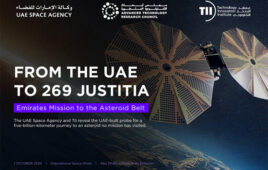
The UAE’s new space probe will crash into the asteroid it’s designed to study
Semiconductors, biomanufacturing and dual-use tech fill ISS National Lab’s startup cohort 
Eggshell-inspired shield cut projectile speed by 65% in simulation, but light-gas gun testing has not confirmed it 
The 100 most innovative companies of 2026: from NVIDIA and OpenAI to Eli Lilly and SpaceX
rd newsletter
EXPAND YOUR KNOWLEDGE AND STAY CONNECTED
Get the latest info on technologies, trends, and strategies in Research & Development.

R&D World Digital Issues

Fall 2026 issue

Browse the most current issue of R&D World and back issues in an easy to use high quality format. Clip, share and download with the leading R&D magazine today.

R&D 100 Awards
Research & Development World
  • Subscribe to R&D World Magazine
  • Sign up for R&D World’s newsletter
  • Contact Us
  • About Us
  • Drug Discovery & Development
  • Pharmaceutical Processing
  • Global Funding Forecast

Copyright © 2026 Arrowfly LLC. All Rights Reserved. The material on this site may not be reproduced, distributed, transmitted, cached or otherwise used, except with the prior written permission of Arrowfly
Privacy Policy | Advertising | About Us

Search R&D World

  • R&D World Home
  • Topics
    • Aerospace
    • Automotive
    • Biotech
    • Careers
    • Chemistry
    • Environment
    • Energy
    • Life Science
    • Material Science
    • R&D Management
    • Physics
  • Technology
    • 3D Printing
    • A.I./Robotics
    • Software
    • Battery Technology
    • Controlled Environments
      • Cleanrooms
      • Graphene
      • Lasers
      • Regulations/Standards
      • Sensors
    • Imaging
    • Nanotechnology
    • Scientific Computing
      • Big Data
      • HPC/Supercomputing
      • Informatics
      • Security
    • Semiconductors
  • R&D Market Pulse
  • R&D 100
    • 2026 R&D 100 Award Winners
    • 2026 Professional Award Winners
    • 2026 Special Recognition Winners
    • R&D 100 Awards Event
    • R&D 100 Submissions
    • Winner Archive
  • Resources
    • Research Reports
    • Digital Issues
    • Educational Assets
    • Subscribe
    • Video
    • Webinars
    • PharmSci360
    • Content submission guidelines for R&D World
  • Global Funding Forecast
  • Top Labs
  • Advertise
  • SUBSCRIBE