Research & Development World

  • R&D World Home
  • Topics
    • Aerospace
    • Automotive
    • Biotech
    • Careers
    • Chemistry
    • Environment
    • Energy
    • Life Science
    • Material Science
    • R&D Management
    • Physics
  • Technology
    • 3D Printing
    • A.I./Robotics
    • Software
    • Battery Technology
    • Controlled Environments
      • Cleanrooms
      • Graphene
      • Lasers
      • Regulations/Standards
      • Sensors
    • Imaging
    • Nanotechnology
    • Scientific Computing
      • Big Data
      • HPC/Supercomputing
      • Informatics
      • Security
    • Semiconductors
  • R&D Market Pulse
  • R&D 100
    • 2026 R&D 100 Award Winners
    • 2026 Professional Award Winners
    • 2026 Special Recognition Winners
    • R&D 100 Awards Event
    • R&D 100 Submissions
    • Winner Archive
  • Resources
    • Research Reports
    • Digital Issues
    • Educational Assets
    • Subscribe
    • Video
    • Webinars
    • PharmSci360
    • Content submission guidelines for R&D World
  • Global Funding Forecast
  • Top Labs
  • Advertise
  • SUBSCRIBE

Asteroids Tell the Story of the Universe

By Arizona State University | January 5, 2017

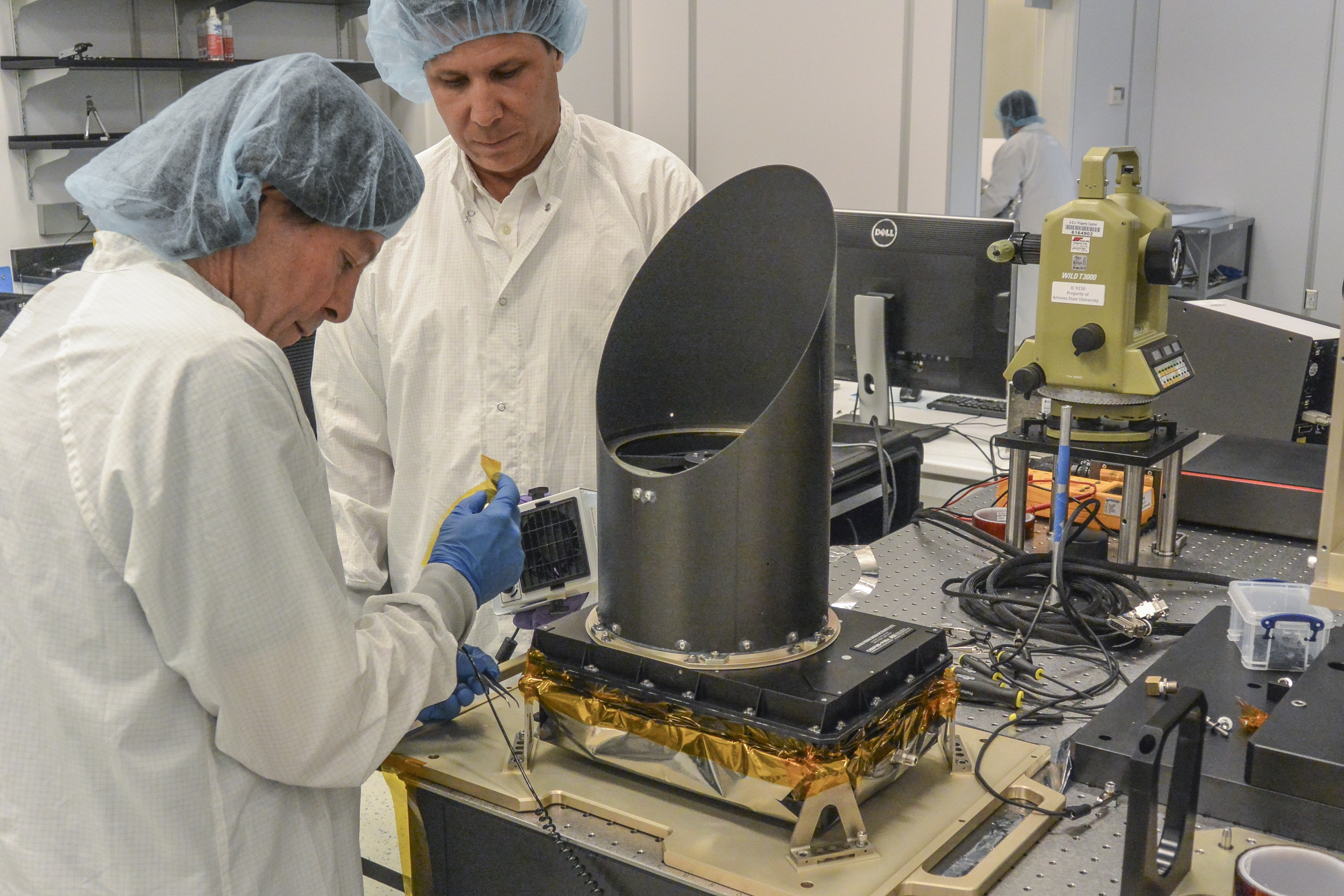
The Thermal Emission Spectrometer for the Lucy mission will be a close copy of the OSIRIS-REx Thermal Emission Spectrometer, seen here under construction in the cleanroom on the Tempe campus. Its task in the Lucy mission will be to measure surface temperatures of primitive asteroids as a way of determining their physical properties. Image: Philip Christensen/ASU

NASA has approved a mission to explore asteroids that scientists — including Arizona State University researchers behind a key component — hope will reveal details about the earliest history of the solar system.   

The Lucy mission will carry an ASU-designed and -developed thermal emission spectrometer, which will measure surface temperatures on each asteroid the spacecraft visits, said Philip Christensen of the university’s School of Earth and Space Exploration.

“I’m really excited about this instrument, the third to be built here at SESE,” says Christensen, thermal emission spectrometer designer and principal investigator.

The device continues a growing tradition of hands-on engineering for exploration that has become hallmark of the school, says Christensen, Regents’ Professor of geological sciences.

The announcement came as NASA also selected for development an ASU-led mission to a metallic asteroid.

Both projects were approved through NASA’s Discovery Program, a series of cost-capped exploratory missions into the solar system.

The Lucy mission was named for the iconic fossil skeleton, since it will investigate a particular collection of primitive asteroids that scientists hope may uncover fossils of planetary formation.

Its flight plan calls for a 2021 launch. Among the potential targets for an extended mission is asteroid 52246 Donaldjohanson, named for the discoverer of the Lucy fossil and director of ASU’s Institute of Human Origins in the School of Human Evolution and Social Change.

Originating at the Southwest Research Institute in Boulder, Colorado, the mission is under the direction of principal investigator Harold Levison of the Southwest Research Institute.

The target objects for the Lucy mission are asteroids that have never before been studied at close range. These minor planets circle the sun at same distance as Jupiter, roughly five times farther out than Earth, and in the same 12-year orbit as Jupiter. Through a quirk of orbital dynamics, they remain caught in two swarms, one leading and one trailing Jupiter as it orbits the sun.

The first of these asteroids was discovered in 1906 and named for the Greek warrior Achilles from Homer’s epic poem “The Iliad.”

As more asteroids were discovered in similar orbits, astronomers started naming them after Homeric Greek and Trojan warriors. Those with Greek names orbit ahead of Jupiter, the Trojan-named ones orbit behind. Collectively, however, both groups are called Trojans, and there are now nearly 6,200 known asteroids in Trojan orbits with Jupiter.

The mission should arrive among the Trojans in 2027 and visit six asteroids by 2033.

Because Jupiter’s Trojan asteroids orbit far from the sun, they all have very cold surfaces. The role in the mission for TES, Christensen said, is to measure temperatures with great precision all over each asteroid that the Lucy spacecraft visits.

“By mapping how temperatures vary by the local time of day,” Christensen explains, “we can map the surface properties of these previously unknown objects.”

That will help planetary scientists decipher their histories and how they have changed since the solar system’s early days.

“With each new mission,” Christensen says, “we’re expanding the types of solar system objects we’re studying here are ASU.”

Source: Arizona State University

Related Articles Read More >

The 100 most innovative companies of 2026: from NVIDIA and OpenAI to Eli Lilly and SpaceX
New observations contradict an earlier theory of how a binary star formed 
The Space Systems Division (05)-developed Parallelogram Synchronized Truss Assembly (PaSTA), seen Aug. 12, 2025, is a mechanism that will be integrated into the Life-Extension In-orbit Servicer (LEXI) and Astroscale Prototype Servicer for Refueling (APS-R) spacecrafts.
One SwRI R&D 100 winner turns buckled fiberglass into a spacecraft truss. The other models freight rail with 900 hours of BNSF field data
No propulsion, no problem: How CYGNSS’s solar panels will enable deorbit without propulsion 
rd newsletter
EXPAND YOUR KNOWLEDGE AND STAY CONNECTED
Get the latest info on technologies, trends, and strategies in Research & Development.

R&D World Digital Issues

Fall 2025 issue

Browse the most current issue of R&D World and back issues in an easy to use high quality format. Clip, share and download with the leading R&D magazine today.

R&D 100 Awards
Research & Development World
  • Subscribe to R&D World Magazine
  • Sign up for R&D World’s newsletter
  • Contact Us
  • About Us
  • Drug Discovery & Development
  • Pharmaceutical Processing
  • Global Funding Forecast

Copyright © 2026 Arrowfly LLC. All Rights Reserved. The material on this site may not be reproduced, distributed, transmitted, cached or otherwise used, except with the prior written permission of Arrowfly
Privacy Policy | Advertising | About Us

Search R&D World

  • R&D World Home
  • Topics
    • Aerospace
    • Automotive
    • Biotech
    • Careers
    • Chemistry
    • Environment
    • Energy
    • Life Science
    • Material Science
    • R&D Management
    • Physics
  • Technology
    • 3D Printing
    • A.I./Robotics
    • Software
    • Battery Technology
    • Controlled Environments
      • Cleanrooms
      • Graphene
      • Lasers
      • Regulations/Standards
      • Sensors
    • Imaging
    • Nanotechnology
    • Scientific Computing
      • Big Data
      • HPC/Supercomputing
      • Informatics
      • Security
    • Semiconductors
  • R&D Market Pulse
  • R&D 100
    • 2026 R&D 100 Award Winners
    • 2026 Professional Award Winners
    • 2026 Special Recognition Winners
    • R&D 100 Awards Event
    • R&D 100 Submissions
    • Winner Archive
  • Resources
    • Research Reports
    • Digital Issues
    • Educational Assets
    • Subscribe
    • Video
    • Webinars
    • PharmSci360
    • Content submission guidelines for R&D World
  • Global Funding Forecast
  • Top Labs
  • Advertise
  • SUBSCRIBE