[Image courtesy of Adobe Stock]
In many respects, we already are. “The average age of a machine shop owner or foundry owner… late 60s, mid-70s,” observes Madera. “Generationally, who are you going to hand that off to?”
This attrition risks creating industrial ghost towns unless something gives. Automation by itself isn’t always a complete solution. Madera recalls a scene in Japan: an automated but inefficient factory floor. “The machines are loaded with robotics. Hardly anyone on the floor,” he recalls. “Then I see… a stack-up of parts… ‘That’s your bottleneck.'” Inside, human inspectors examining turbine blades were the constraint. “Every single part… had to go through an X-ray or CT scan, but it still has to be reviewed by a human,” Madera explains. Inspectors didn’t just confirm defects but searched for missed ones, getting harder late in shifts. “Humans get tired,” he adds. But on the flip side, it isn’t exactly easy to automate everything.
From management consultant to manufacturing pioneer

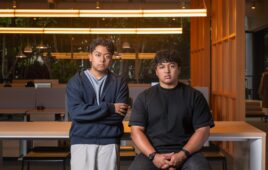
Ivan Madera
Madera speaks from experience, founding and leading Morf3D (now part of Nikon) from 2014–2024. He entered additive manufacturing (AM) consulting, discovering the challenge of building from scratch. “Morf3D was the hardest thing I’ve ever done,” he reflects. He describes AM’s low yields: often printing multiple parts “to hopefully get one you can ship.” This journey transformed “some management consulting guy” into a leading metal additive manufacturer, especially in the aerospace and defense sectors. That journey revealed how crucial, and difficult to scale, expert knowledge can be.
AI as a potential master mentor
The challenge isn’t just finding workers, but preserving expertise before elder workers retire. Madera sees AI helping preserve knowledge and amplify capability. “Imagine if my engineer is now mentored by AI,” he posits, suggesting “a system using historical data on design, workflow, and performance. Mentored by… super engineers.” It’s practical: one defense prime faced $300M in change orders from difficult downstream designs. An AI mentor, Madera argues, could flag risks or suggest alternatives using past project wisdom. “That’s the power of AI,” — embedding mastery into the workflow, shortening the learning curve.
This holistic view enables more than just rapid response; Madera is upbeat on the potential for AI to help companies metaphorically “see around corners,” anticipating problems before they escalate. Consider a behemoth that could detect and nimbly react to signs of disruption at the earliest phases, instead of getting locked out of a burgeoning market, a dynamic famously analyzed by Clayton Christensen in The Innovator’s Dilemma. But such capabilities take work, and here, Madera injects realism:
When I look at AI… We have an expectation that it’s a plug-and-play scenario… That’s not true.
Building effective AI systems requires observation periods, data preparation, and domain expertise integration. “You’re basically in a relationship, establishing a basis of trust,” Madera explains, emphasizing that manufacturers must commit to targeted implementation focused on pain points before expecting system-wide intelligence.
Rapid upskilling meets expert knowledge capture
AI mentorship can also bridge the gap between available workers and needed high-skill roles. Madera poses the challenge: “Upskill a workforce that was [doing minimum wage work] yesterday and machining parts tomorrow, how do you do that?” Traditional apprenticeships are too slow. “There’s a lot of ways to augment a skilled task with AI,” he states, describing systems guiding novices step-by-step. The goal: “‘give them the same tools and thought process that a master machinist… would have'”. Someone on “day one” could possess the effective “‘skill of 10 Ph.D.s or 10 mechanical engineers'” for specific tasks via AI. As users interact, the AI learns, capturing expertise. It is a bi-directional process.
The holistic factory brain
A “thinking” factory needs a shared digital brain connecting workers, understanding context, and breaking down silos. “What I’m seeing is a convergence of how do you take what a human does and capture human thought?” Madera asks. The AI looks beyond silos: “‘It’s looking at… the entire organization’s data stack and communicating across with our agents.'” Practical impact can be immediate once trained. He cites defect detection: AI can instantly halt production, cross-referencing data and eliminating human communication lag. “I’m sitting here asking a question to our platform… and our platform is coming up with responses. Just like, ‘How? How did it do that?'”
The physical embodiment of autonomy
As factory AI gains understanding, the next leap is physical action. Madera envisions this AI—’captain’—deploying resources like humanoids, not just alerting humans. “Imagine… ‘Huh, Brian needs support unloading a truck,'” he explains. “It already knows that… the dock is filling up, there are critical parts… and the droid shows up to help you.” This is context-aware, proactive assistance. “That’s pretty freaking cool,” Madera quips. But here again, the cool factor requires deep domain expertise and hard word, not just coding divorced from factory reality.
What I see is a lot of kids developing these tools… where’s the application?… They’ve never run a factory.
This gap between theoretical tools and practical factory needs underscores the significant leap required to achieve true autonomy, as Madera defines it: “That’s the level of difference between augmentation and automation… Autonomous is: I observed, I saw something, I’m going to go do it. That’s pretty crazy.”