[Cradle]
Elise de Reus, co-founder at the genAI-based protein engineering firm Cradle, is another proponent of the open-source ethos. A fan of the open source strains of software development, she sees transparency having ecosystem-level impacts in biotech. At Cradle, Amsterdam-headquartered protein engineering software company she co-founded, that philosophy shows up in the business model. “Customers pay for access to the Cradle software. They keep all their IP. It is very transparent. No hidden costs,” she said. The approach also shows up in their science. In March, Cradle published CRADLE-1, a preprint detailing its automated protein optimization system with pages of detail of wet lab protocols and a documented failure case alongside the successes.
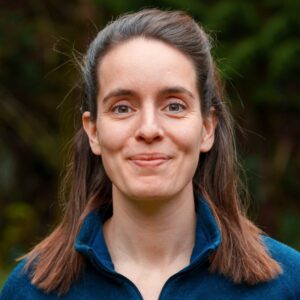
Elise de Reus
Cradle’s customer base spans pharma, agriculture, and industrial biotech. Bayer signed a three-year collaboration to deploy the platform across its therapeutic antibody pipeline. Novo Nordisk partnered with Cradle to accelerate development of next-generation therapeutic candidates. J&J, AbbVie, and Argenx also use the platform. Agricultural firms like Corteva and industrial enzyme makers including IFF and Novonesis have signed on as well. In total, Cradle says it serves six of the top 25 global pharma companies across more than 50 R&D programs.
Closing the loop between computation and the bench
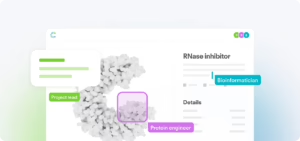
What connects those projects, de Reus said, is a feedback loop between computation and wet lab reality. A scientist uploads experimental data, trains a model on their specific protein’s sequence-function landscape, generates candidate variants, tests them, and feeds results back. “The wet lab lets you close the loop: you predict protein characteristics, test them, measure the delta, and feed the result back into the model to make it more accurate over time,” de Reus said. “If customers spend less time in each cycle, they get more learning iterations. … Shorter cycles create more chances for learning.”
In a March 2026 interview on the Grow Everything podcast, de Reus described a case where a client’s enzyme optimization campaign had stalled after years of diminishing returns. The team had picked the low-hanging fruit through rational design and was ready to call it. “Machine learning models were able to introduce mutations in parts of the protein that scientists rationally had advised against or couldn’t understand why that would even impact,” she said. “These are use cases where everyone sits back and goes, ‘Wow, that’s really cool that the model somehow came up with this.'”
The platform also addresses the opposite problem: knowing when further optimization will yield nothing. Cradle’s headroom prediction feature estimates the probability that a new round of variants will meaningfully improve on what already exists. “It’s really helpful to have a model say, ‘I’ve been running compute for the past two days and I’ve not found any variants that I think are worth testing in the wet lab,'” de Reus said. “And then it’s a business decision to say, ‘Okay, great. Let’s take the candidates that we have now into that next phase and call it a day.'”
Lab-in-the-loop goes mainstream
The approach, sometimes called “lab-in-the-loop,” has become the defining paradigm across AI-driven protein engineering. In February, Arc Institute published MULTI-evolve in Science, a framework that trained models on roughly 200 strategic variants and identified hyperactive multi-mutant proteins by testing as few as nine proposed candidates, then open-sourced the tool on GitHub. EVOLVEpro, from MIT and the Broad Institute, combined protein language models with active learning to improve six proteins across RNA production, genome editing and antibody binding, with gains reaching up to 100-fold in a T7 RNA polymerase example. Absci, now clinical-stage, built a 77,000-plus-square-foot wet lab and specializes in AI-designed antibodies and engineered cell therapies. Small amounts of targeted experimental data, fed iteratively into ML models, outperform either brute-force screening or pure computation alone. Where they differ is in who runs the loop. Absci and Generate Biomedicines, a protein design startup, built vertically integrated operations with their own labs and pipelines. Cradle sells the software layer to teams that already have their own wet labs.
Cradle has also moved beyond the startup proof-of-concept phase: the company raised a $73 million Series B led by IVP, bringing total funding to more than $100 million, and said its customers were already developing 31 proteins on the platform.
Bayer framed the appeal in operational terms. Anastasia Hager, global head of drug discovery sciences at Bayer’s pharmaceuticals division, said AI-driven molecule design would be “a key accelerator” of R&D productivity and called Cradle’s platform a “scalable scientist-centric” way to expand biologics work.
Why Cradle sends its engineers to the bench
Cradle also invests in closing a subtler gap: the one between its ML researchers and the biologists who use the platform. The company sends machine-learning researchers and software engineers into the wet lab for about a week each year so they can see firsthand how experimental data is generated. De Reus said the experience helps technical staff understand why biologists think in terms of 96, not 100: early microplates emerged from Gyula Takátsy’s work in 1950s Hungary, while the 96-well format was later refined by John Sever at the NIH and commercialized in the early 1960s. Standardized by ANSI and the Society for Laboratory Automation and Screening, it became the foundational unit of automated biology. Liquid handlers, plate readers, and high-throughput screening workflows are all built around that 8-by-12 grid. When an ML engineer designs a batch-size parameter or a data-ingestion pipeline without understanding that constraint, the tool fights the workflow instead of fitting it. “That empathy is part of how Cradle builds a product that works in scientists’ hands,” de Reus said.
De Reus sees a broader challenge facing the field. More pharma companies are training foundation models and hiring ML talent, but the hard part, she said, is moving from having a model to deploying it in an organization: how a researcher uses it, how it fits the team’s operating rhythm, and how the learning gets captured. “Humans plus models have to interact, and incentives have to align,” she said.
The constraint-negotiation process illustrates what that looks like in practice. A protein engineer might specify that a therapeutic antibody must maintain thermal stability above 65°C, bind its target with sub-nanomolar affinity, and express well in CHO cells. Those requirements often pull in opposite directions: mutations that boost binding affinity can destabilize the fold, and vice versa. A data scientist working from that constraint list needs to understand which thresholds are hard regulatory requirements and where the team has room to trade off. When the scientist rejoins the discussion, they may spot places where a modest concession on one property opens a much larger region of viable sequence space. The process has to support that dialogue throughout the project, de Reus said, because a model that optimizes the wrong objective wastes experimental cycles no matter how powerful the underlying ML is.
The case for staying out of the clinic
De Reus frames Cradle’s position using a metaphor from outside biology. Microsoft CEO Satya Nadella has argued that AI models will face commoditization and that durable value sits in the scaffolding: the platform where data, applications, and enterprise features live together. De Reus sees the same dynamic in protein science. Google DeepMind CEO Demis Hassabis disagrees, contending that leading labs are pulling away and that algorithmic invention will widen the gap. Cradle is betting on Nadella’s version of the future.
That bet also explains why Cradle chose to sell software rather than develop its own drug pipeline. “At some point you are going to concentrate resources somewhere, the R&D platform or the software,” de Reus said.