Research & Development World

  • R&D World Home
  • Topics
    • Aerospace
    • Automotive
    • Biotech
    • Careers
    • Chemistry
    • Environment
    • Energy
    • Life Science
    • Material Science
    • R&D Management
    • Physics
  • Technology
    • 3D Printing
    • A.I./Robotics
    • Software
    • Battery Technology
    • Controlled Environments
      • Cleanrooms
      • Graphene
      • Lasers
      • Regulations/Standards
      • Sensors
    • Imaging
    • Nanotechnology
    • Scientific Computing
      • Big Data
      • HPC/Supercomputing
      • Informatics
      • Security
    • Semiconductors
  • R&D Market Pulse
  • R&D 100
    • 2025 R&D 100 Award Winners
    • 2025 Professional Award Winners
    • 2025 Special Recognition Winners
    • R&D 100 Awards Event
    • R&D 100 Submissions
    • Winner Archive
  • Resources
    • Research Reports
    • Digital Issues
    • Educational Assets
    • R&D Index
    • Subscribe
    • Video
    • Webinars
    • Content submission guidelines for R&D World
  • Global Funding Forecast
  • Top Labs
  • Advertise
  • SUBSCRIBE

Crystals Formed from Nanoscale “Baking Tray”

By Kate Wighton, Imperial College London | June 2, 2016

Scientists from Imperial College London have created a type of nanoscale “baking tray” to help reveal the structure and shape of proteins.

The team, from the Departments of Surgery & Cancer, and Chemistry, hopes this technology will enable new drugs and treatments to be developed.

Proteins are crucial to numerous reactions in the body — yet scientists are still in the dark about what most of them look like, explains Professor Naomi Chayen, lead author of the research.

“Results released by Structural Genomics consortia worldwide, show that we only know the 3D structure of around 20 percent of the investigated proteins. Yet how can you target a protein that is involved in, say, cancer formation if you have no idea what it looks like? It’s like recognizing a face in a crowd — you need a picture.”
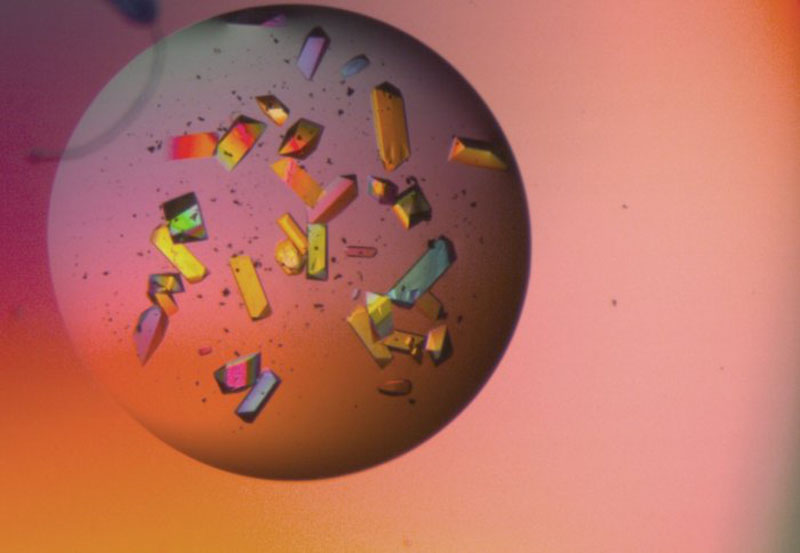
Colorful protein crystals viewed under a microscope. Each crystal is around 100 micrometers wide (similar width to human hair).

To obtain a picture of what a protein looks like, scientists need to persuade proteins — which are normally dissolved in liquid form, to grow into crystals. These crystals can then be examined with a beam of X-rays.

But triggering useful crystal formation is notoriously difficult — and this is the reason why we only know the structures of far fewer proteins than have been attempted, explains Professor Milo Shaffer: “All crystals start from a single point called a nucleation point. We see this is in many examples in life — for instance a snow flake starts at a single point, and it is why chains of bubbles in champagne or beer come from the same points on the glass — this is the nucleation point. After nucleation, the bubble or crystal can grow easily.”

But reaching this nucleation point is often difficult, adds Shaffer: “Reaching this starting point requires a critical arrangement of the molecules – and many proteins can’t overcome this hurdle, and so don’t form crystals.”

Once the molecules in the protein have arranged in a regular pattern, as a crystal, they can be analyzed with X-rays. For years, scientists been trying to find methods that will help proteins form crystals, but have struggled to find any technology or chemicals that is generally reliable and easy to apply.

In the latest technology, published in the journals Chemical Science and Nature Scientific Reports, the Imperial team harnessed the power of graphene. This so-called “wonder material” is formed of a single layer of atoms, and has been proposed for a wide range of technologies from touch screens to satellites.

In the new study, the team attached long molecules, called polymers, to the graphene. These appear to define small pockets on the graphene surface, a bit like a baking tray. These grafted molecules help attract the proteins, and confine them in small regular clusters. This helps them to nucleate a crystal which can grow large enough to analyze using X-ray diffraction.

Now the technology has been shown to work, the team are investigating how they can adapt the system to work for different sizes and shapes of proteins, explains Chayen.

“Now we know this technology works we are looking into making a type of universal crystallization solution that can work for all types of experiments — and all types of proteins.”

Source: Imperial College London

Related Articles Read More >

Nature’s 2024 Method of the Year has become $100M market and a lawsuit magnet
New study finds gene that can help repair the heart after failure
Verily integrates NVIDIA AI tools into precision health platform
Are AI agents skipping the trough? Early evidence from life sciences
rd newsletter
EXPAND YOUR KNOWLEDGE AND STAY CONNECTED
Get the latest info on technologies, trends, and strategies in Research & Development.
RD 25 Power Index

R&D World Digital Issues

Fall 2024 issue

Browse the most current issue of R&D World and back issues in an easy to use high quality format. Clip, share and download with the leading R&D magazine today.

Research & Development World
  • Subscribe to R&D World Magazine
  • Sign up for R&D World’s newsletter
  • Contact Us
  • About Us
  • Drug Discovery & Development
  • Pharmaceutical Processing
  • Global Funding Forecast

Copyright © 2025 WTWH Media LLC. All Rights Reserved. The material on this site may not be reproduced, distributed, transmitted, cached or otherwise used, except with the prior written permission of WTWH Media
Privacy Policy | Advertising | About Us

Search R&D World

  • R&D World Home
  • Topics
    • Aerospace
    • Automotive
    • Biotech
    • Careers
    • Chemistry
    • Environment
    • Energy
    • Life Science
    • Material Science
    • R&D Management
    • Physics
  • Technology
    • 3D Printing
    • A.I./Robotics
    • Software
    • Battery Technology
    • Controlled Environments
      • Cleanrooms
      • Graphene
      • Lasers
      • Regulations/Standards
      • Sensors
    • Imaging
    • Nanotechnology
    • Scientific Computing
      • Big Data
      • HPC/Supercomputing
      • Informatics
      • Security
    • Semiconductors
  • R&D Market Pulse
  • R&D 100
    • 2025 R&D 100 Award Winners
    • 2025 Professional Award Winners
    • 2025 Special Recognition Winners
    • R&D 100 Awards Event
    • R&D 100 Submissions
    • Winner Archive
  • Resources
    • Research Reports
    • Digital Issues
    • Educational Assets
    • R&D Index
    • Subscribe
    • Video
    • Webinars
    • Content submission guidelines for R&D World
  • Global Funding Forecast
  • Top Labs
  • Advertise
  • SUBSCRIBE