During the 2018 to 2020 Ebola outbreak in the Democratic Republic of the Congo (DRC), the U.S. was the largest single-country donor to the response, investing over $516 million in various mitigation measures. Similarly, in the 2014 to 2015 outbreak in West Africa, the U.S. government allocated approximately $2.4 billion to the response.
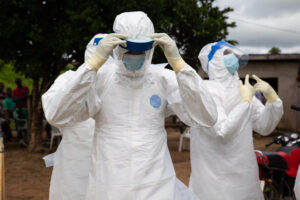
Health care workers in Sierra Leone during the 2018 Ebola outbreak. Credit: Adobe
So far, the U.S. has mobilized $23 million in emergency funding for the current Ebola outbreak in the DRC and Uganda. While this is more than the initial $8 million invested at the beginning of the 2018 outbreak, it is accompanied by the dissolution of USAID and a general freeze on foreign assistance as part of the Trump administration’s America First philosophy. Experts worry these cuts are affecting the response.
Lawrence Gostin, director of the O’Neill Institute for National and Global Health law and Georgetown University, told Newsweek that the CDC’s global health capacities “have been decimated, which is evident in its very weak response to the Ebola crisis.”
In the past, the U.S. has funded disease surveillance networks that acted as early warning systems for outbreaks. The cancellation of approximately 80% of USAID global health awards led to the termination of thousands of community health workers who acted as disease sentinels.
The loss of these surveillance networks, as well as the U.S. leaving the WHO, was part of why American officials did not learn of the current outbreak until it had already spread across international borders.
Historically, the U.S. would have set up border surveillance immediately, Courtney Blake, a former USAID official, told The New York Times. “In case there is spillover, we would want to make sure that we’re able to capture it very quickly,” she said. “But our ability to do that swiftly has been eliminated.”
Instead, doctors are paying for the costs associated with disease surveillance from their own pockets. A doctor in the DRC told PHR that “this outbreak is occurring at a time when we are no longer truly able to carry out proper epidemiological surveillance because of the disruption in USAID funding. To continue this surveillance, we are forced to rely on our own personal resources, including purchasing phone credit, fuel and paying transportation costs. This is extremely difficult given the current level of need.”
The lack of funding is also hindering the availability of equipment, which usually would have been transported using U.S. funds. In previous outbreaks, personal protective equipment (PPE) was immediately available. By day two of the current outbreak, it was still missing. The Africa CDC Director General Jean Kaseya told press on Saturday that his team did not have PPE supply.
Normally, a CDC team would have already been deployed, the State Department would have prepared for the transportation of infected Americans and HHS would have reached out to the pharmaceutical manufacturers of Ebola countermeasures to confirm supply. According to an article written by Alain Casseus, the division chief and principal investigator in the infectious diseases division for the PEPFAR Project, none of this appeared to have happened as of May 20.