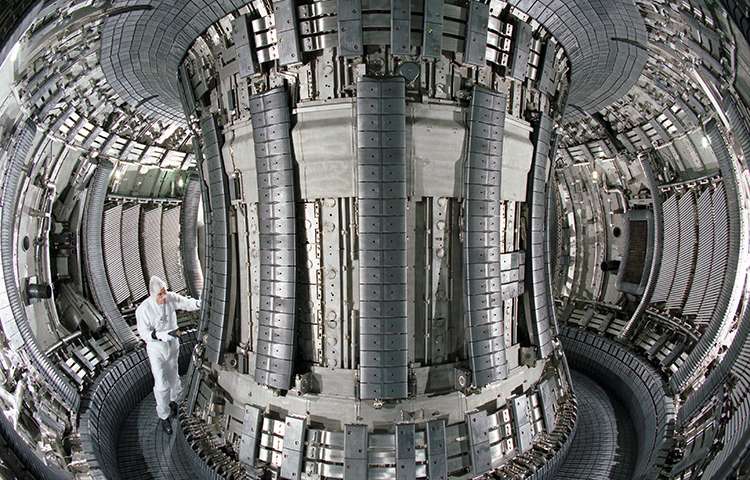
Although the vacuum chamber in the British fusion reactor JET has a wall made of solid metal, it can melt if it gets hit by a beam of runaway electrons. It is these runaway elementary particles that doctoral students Linnea Hesslow and Ola Embréus have successfully identified and decelerated. (Credit: Eurofusion)
Fusion power has the potential to provide clean and safe energy that is free from carbon dioxide emissions. However, imitating the solar energy process is a difficult task to achieve. Two young plasma physicists at Chalmers University of Technology have developed a technology model that could lead to better methods for decelerating runaway electrons that could destroy a future reactor without warning.
It takes high pressure and temperatures of about 150 million degrees to get atoms to fuse. Additionally, runaway electrons wreak havoc in the fusion reactors that are currently being developed. In tokamak reactors, unwanted electric fields could jeopardise the entire process. Electrons with extremely high energy can suddenly accelerate to speeds so high that they destroy the reactor wall.
It is these runaway electrons that doctoral students Linnea Hesslow and Ola Embréus have successfully identified and decelerated. Together with their advisor, Professor Tünde Fülöp at the Chalmers Department of Physics, they have effectively decelerated runaway electrons by injecting so-called heavy ions of neon or argon in the form of gas or pellets.
When the electrons collide with the high charge in the nuclei of the ions, they encounter resistance and lose speed. The many collisions make the speed controllable and enable the fusion process to continue. Using mathematical descriptions and plasma simulations, it is possible to predict the electrons’ energy—and how it changes under different conditions.
“When we can effectively decelerate runaway electrons, we are one step closer to a functional fusion reactor. Considering there are so few options for solving the world’s growing energy needs in a sustainable way, fusion energy is incredibly exciting, since it derives its fuel from ordinary seawater,” says Linnea Hesslow.
She and her colleagues recently had their article published in the reputed journal Physical Review Letters. “The interest in this work is enormous. The knowledge is needed for future large-scale experiments and provides hope for solving difficult problems. We expect the work to make a big impact going forward,” says Professor Tünde Fülöp.
Despite the great progress made in fusion energy research over the past fifty years, there is still no commercial fusion power plant in existence. Right now, all eyes are on the international research collaboration related to the ITER reactor in southern France.
“Many believe it will work, but it’s easier to travel to Mars than it is to achieve fusion. You could say that we are trying to harvest stars here on Earth, and that can take time. It takes incredibly high temperatures, hotter than the center of the sun, for us to successfully achieve fusion here on earth. That’s why I hope research is given the resources needed to solve the energy issue in time,” says Linnea Hesslow.
Facts: Fusion energy and runaway electrons
Fusion energy occurs when light atomic nuclei are combined using high pressure and extremely high temperatures of about 150 million degrees Celsius. The energy is created the same way as in the sun. Fusion power is a much safer alternative to nuclear power, which is based on the splitting (fission) of heavy atoms. If something goes wrong in a fusion reactor, the entire process stops and it grows cold. Unlike with a nuclear accident, there is no risk of the surrounding environment being affected. The fuel in a fusion reactor weighs no more than a stamp, and the raw materials come from ordinary seawater.