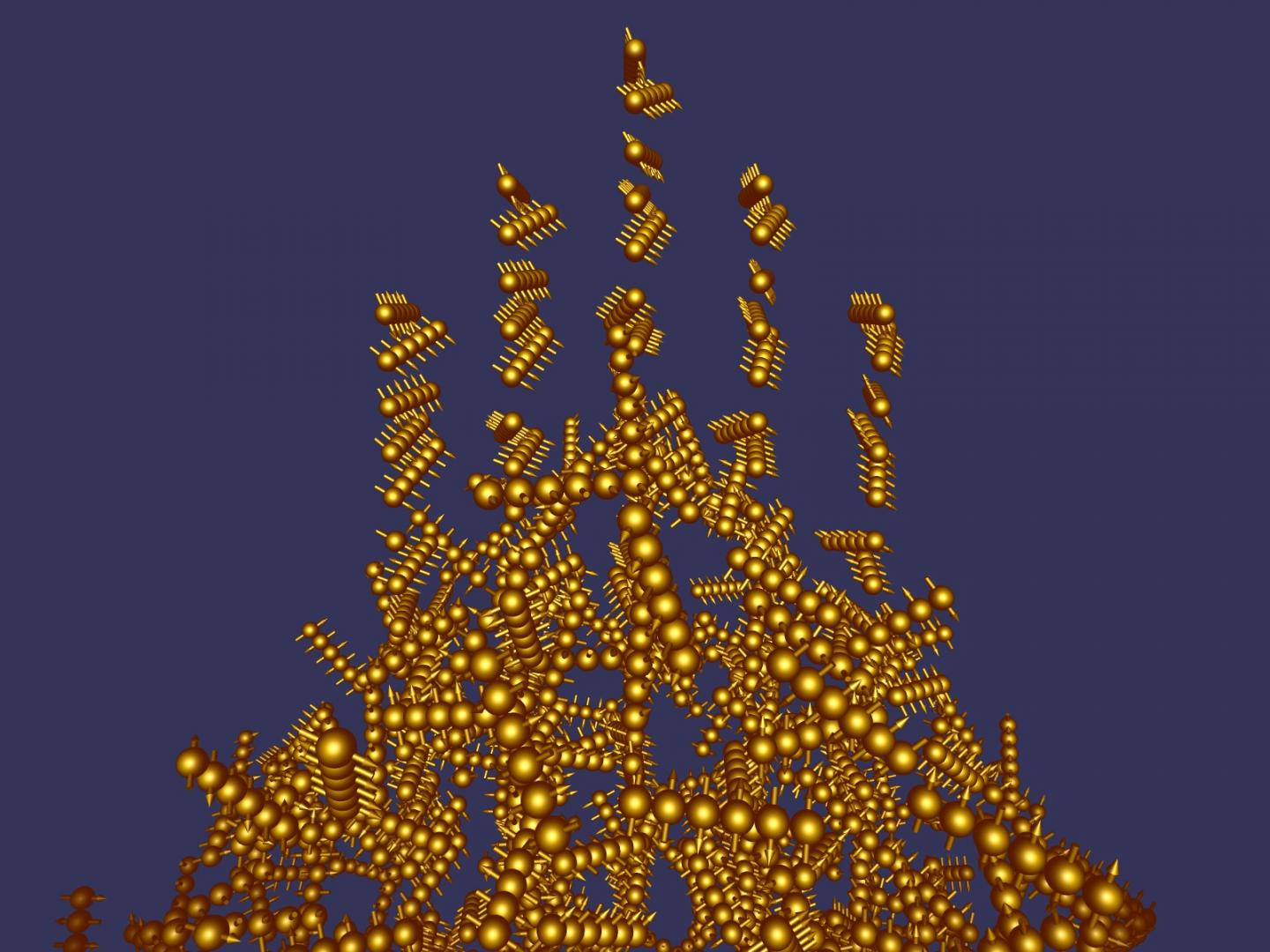
Quantum systems can exist in many possible states, here illustrated by groups of spins, each pointing along a certain direction. Thermalization occurs when a system evenly explores all allowed configurations. Instead, when a “quantum scar” forms (as shown in the figure), some configurations emerge as special. This feature allows scarred systems to sustain memory of the initial state despite thermalization. Credit: Zlatko Papic, University of Leeds
New research gives insight into a recent experiment that was able to manipulate an unprecedented number of atoms through a quantum simulator. This new theory could provide another step on the path to creating the elusive quantum computers.
An international team of researchers, led by the University of Leeds and in cooperation with the Institute of Science and Technology Austria and the University of Geneva, has provided a theoretical explanation for the particular behaviour of individual atoms that were trapped and manipulated in a recent experiment by Harvard University and MIT. The experiment used a system of finely tuned lasers to act as “optical tweezers” to assemble a remarkably long chain of 51 atoms.
When the quantum dynamics of the atom chain were measured, there were surprising oscillations that persisted for much longer than expected and which couldn’t be explained.
Study co-author, Dr Zlatko Papic, Lecturer in Theoretical Physics at Leeds, said: “The previous Harvard-MIT experiment created surprisingly robust oscillations that kept the atoms in a quantum state for an extended time. We found these oscillations to be rather puzzling because they suggested that atoms were somehow able to “remember” their initial configuration while still moving chaotically.
“Our goal was to understand more generally where such oscillations could come from, since oscillations signify some kind of coherence in a chaotic environment – and this is precisely what we want from a robust quantum computer. Our work suggests that these oscillations are due to a new physical phenomenon that we called ‘quantum many-body scar’.”
In everyday life, particles will bounce off one another until they explore the entire space, settling eventually into a state of equilibrium. This process is called thermalisation. A quantum scar is when a special configuration or pathway leaves an imprint on the particles’ state that keeps them from filling the entire space. This prevents the systems from reaching thermalisation and allows them to maintain some quantum effects.
Dr Papic said: “We are learning that quantum dynamics can be much more complex and intricate than simply thermalisation. The practical benefit is that extended periods of oscillations are exactly what is needed if quantum computers are to become a reality. The information processed and stored on these computers will be dependent on keeping the atoms in more than one state at any time, it is a constant battle to keep the particles from settling into an equilibrium.”
Study lead author, Christopher Turner, doctoral researcher at the School of Physics and Astronomy at Leeds, said: “Previous theories involving quantum scars have been formulated for a single particle. Our work has extended these ideas to systems which contain not one but many particles, which are all entangled with each other in complicated ways. Quantum many-body scars might represent a new avenue to realise coherent quantum dynamics.”
The quantum many-body scars theory sheds light on the quantum states that underpin the strange dynamics of atoms in the Harvard-MIT experiment. Understanding this phenomenon could also pave the way for protecting or extending the lifetime of quantum states in other classes of quantum many-body systems.