Research & Development World

  • R&D World Home
  • Topics
    • Aerospace
    • Automotive
    • Biotech
    • Careers
    • Chemistry
    • Environment
    • Energy
    • Life Science
    • Material Science
    • R&D Management
    • Physics
  • Technology
    • 3D Printing
    • A.I./Robotics
    • Software
    • Battery Technology
    • Controlled Environments
      • Cleanrooms
      • Graphene
      • Lasers
      • Regulations/Standards
      • Sensors
    • Imaging
    • Nanotechnology
    • Scientific Computing
      • Big Data
      • HPC/Supercomputing
      • Informatics
      • Security
    • Semiconductors
  • R&D Market Pulse
  • R&D 100
    • 2025 R&D 100 Award Winners
    • 2025 Professional Award Winners
    • 2025 Special Recognition Winners
    • R&D 100 Awards Event
    • R&D 100 Submissions
    • Winner Archive
  • Resources
    • Research Reports
    • Digital Issues
    • Educational Assets
    • Subscribe
    • Video
    • Webinars
    • Content submission guidelines for R&D World
  • Global Funding Forecast
  • Top Labs
  • Advertise
  • SUBSCRIBE

Drug Discovery Researchers Awarded Grant to Refine Malaria Drug

By Virginia Tech | February 7, 2017

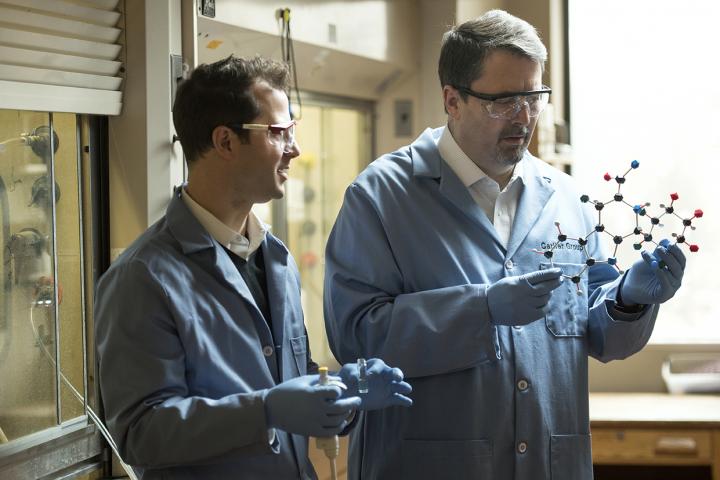
Daniel Slade (left), an assistant professor of biochemistry in the College of Agriculture and Life Sciences, and Paul Carlier, a professor of chemistry in the College of Science, are developing new malaria therapeutics. Source: Logan Wallace/Virginia Tech

As long as parasites continue to mount resistance to malaria drugs, scientists will be faced with the task of developing new, improved pharmaceuticals.

A research team from the Virginia Tech Center for Drug Discovery has received a $431,126 two-year grant from the National Institutes of Health to make improved versions of a promising compound called MMV008138, or 8138 for short.

The compound was first identified by Paul Carlier, a professor of chemistry in the College of Science, and Belen Cassera, a former Virginia Tech faculty member now at the University of Georgia.

Now, a team that includes Carlier, Cassera, and Daniel Slade, an assistant professor of biochemistry in the College of Agriculture and Life Sciences, is attempting to make an improved, more potent version of 8138 to test against malaria in animal models.

“Specifically, this compound targets the parasite’s ability to produce isopentenyl pyrophosphate (IPP), the key chemical building block that is used to make lipids and steroid hormones, which are essential for cellular life,” said Carlier. “Without IPP, the parasite will die.”

A major benefit of a compound like 8138 is that side effects in humans are expected to be low. Humans need IPP, but make it through a different biochemical pathway than the parasites do, Carlier explained.

Carlier will synthesize improved versions of the compound in his laboratory, and Cassera will test these potential drugs for their ability to reduce growth of the malaria parasite Plasmodium falciparum in blood. Meanwhile, Slade, an expert in protein crystallography, will determine X-ray crystal structures of IspD, the target enzyme of these anti-malarial compounds.

“Knowing the three-dimensional structure of the enzyme bound to inhibitors will help the chemists to design increasingly potent drugs that inhibit IPP synthesis,” said Slade.

The team is also collaborating with Max Totrov, a computational biologist at Molsoft L.L.C. in San Diego, California, who will use computational methods to help improve the potency and selectivity of the drug.

“Development of new malaria therapeutics is challenging, but this talented multidisciplinary team gives us a great advantage,” said Carlier.

Related Articles Read More >

AI image firm Midjourney spins up health division, unveils ‘Ultrasonic CT’
Q&A: Owkin’s five-year Sanofi deal bets on ‘purpose-built’ AI agents
Genetically modified hookworms could produce and deliver therapeutics within a host
Five costly mistakes when scaling spray drying from lab to commercial production
rd newsletter
EXPAND YOUR KNOWLEDGE AND STAY CONNECTED
Get the latest info on technologies, trends, and strategies in Research & Development.

R&D World Digital Issues

Fall 2025 issue

Browse the most current issue of R&D World and back issues in an easy to use high quality format. Clip, share and download with the leading R&D magazine today.

R&D 100 Awards
Research & Development World
  • Subscribe to R&D World Magazine
  • Sign up for R&D World’s newsletter
  • Contact Us
  • About Us
  • Drug Discovery & Development
  • Pharmaceutical Processing
  • Global Funding Forecast

Copyright © 2026 WTWH Media LLC. All Rights Reserved. The material on this site may not be reproduced, distributed, transmitted, cached or otherwise used, except with the prior written permission of WTWH Media
Privacy Policy | Advertising | About Us

Search R&D World

  • R&D World Home
  • Topics
    • Aerospace
    • Automotive
    • Biotech
    • Careers
    • Chemistry
    • Environment
    • Energy
    • Life Science
    • Material Science
    • R&D Management
    • Physics
  • Technology
    • 3D Printing
    • A.I./Robotics
    • Software
    • Battery Technology
    • Controlled Environments
      • Cleanrooms
      • Graphene
      • Lasers
      • Regulations/Standards
      • Sensors
    • Imaging
    • Nanotechnology
    • Scientific Computing
      • Big Data
      • HPC/Supercomputing
      • Informatics
      • Security
    • Semiconductors
  • R&D Market Pulse
  • R&D 100
    • 2025 R&D 100 Award Winners
    • 2025 Professional Award Winners
    • 2025 Special Recognition Winners
    • R&D 100 Awards Event
    • R&D 100 Submissions
    • Winner Archive
  • Resources
    • Research Reports
    • Digital Issues
    • Educational Assets
    • Subscribe
    • Video
    • Webinars
    • Content submission guidelines for R&D World
  • Global Funding Forecast
  • Top Labs
  • Advertise
  • SUBSCRIBE