Research & Development World

  • R&D World Home
  • Topics
    • Aerospace
    • Automotive
    • Biotech
    • Careers
    • Chemistry
    • Environment
    • Energy
    • Life Science
    • Material Science
    • R&D Management
    • Physics
  • Technology
    • 3D Printing
    • A.I./Robotics
    • Software
    • Battery Technology
    • Controlled Environments
      • Cleanrooms
      • Graphene
      • Lasers
      • Regulations/Standards
      • Sensors
    • Imaging
    • Nanotechnology
    • Scientific Computing
      • Big Data
      • HPC/Supercomputing
      • Informatics
      • Security
    • Semiconductors
  • R&D Market Pulse
  • R&D 100
    • 2025 R&D 100 Award Winners
    • 2025 Professional Award Winners
    • 2025 Special Recognition Winners
    • R&D 100 Awards Event
    • R&D 100 Submissions
    • Winner Archive
  • Resources
    • Research Reports
    • Digital Issues
    • Educational Assets
    • R&D Index
    • Subscribe
    • Video
    • Webinars
    • Content submission guidelines for R&D World
  • Global Funding Forecast
  • Top Labs
  • Advertise
  • SUBSCRIBE

Electricity-Conducting Bacteria Yield Secret to Tiny Batteries, Big Medical Advances

By University of Virginia Health System | April 4, 2019

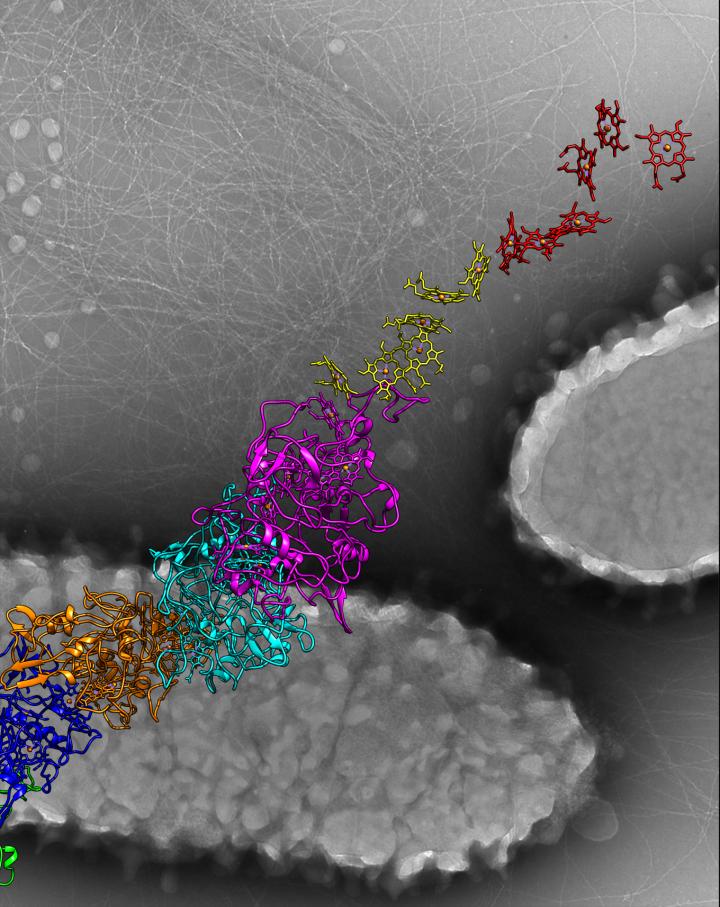
An atomic model for the microbial nanowires that conduct electricity is in the foreground, while two bacteria are seen in the electron micrograph in the background, surrounded by the nanowires. Credit: Edward H. Egelman

Scientists have made a surprising discovery about how strange bacteria that live in soil and sediment can conduct electricity. The bacteria do so, the researchers determined, through a seamless biological structure never before seen in nature – a structure scientists can co-opt to miniaturize electronics, create powerful-yet-tiny batteries, build pacemakers without wires and develop a host of other medical advances.

Scientists had believed Geobacter sulfurreducens conducted electricity through common, hair-like appendages called pili. Instead, a researcher at the University of Virginia School of Medicine and his collaborators have determined that the bacteria transmit electricity through immaculately ordered fibers made of an entirely different protein. These proteins surround a core of metal-containing molecules, much like an electric cord contains metal wires. This “nanowire,” however, is 100,000 times smaller than the width of a human hair.

This tiny-but-tidy structure, the researchers believe, could be tremendously useful for everything from harnessing the power of bioenergy to cleaning up pollution to creating biological sensors. It could actually serve as the bridge between electronics and living cells.

“There are all sorts of implanted medical devices that are connected to tissue, like pacemakers with wires, and this could lead to applications where you have miniature devices that are actually connected by these protein filaments,” said UVA’s Edward H. Egelman, PhD. “We can now imagine the miniaturization of many electronic devices generated by bacteria, which is pretty amazing.”

Small but Effective

Geobacter bacteria play important roles in the soil, including facilitating mineral turnover and even cleaning up radioactive waste. They survive in environments without oxygen, and they use nanowires to rid themselves of excess electrons in what can be considered their equivalent to breathing. These nanowires have fascinated scientists, but it is only now that researchers at UVA, Yale and the University of California, Irvine, have been able to determine how G. sulfurreducens uses these organic wires to transmit electricity.

“The technology [to understand nanowires] didn’t exist until about five years ago, when advances in cryo-electron microscopy allowed high resolution,” said Egelman, of UVA’s Department of Biochemistry and Molecular Genetics. “We have one of these instruments here at UVA, and, therefore, the ability to actually understand at the atomic level the structure of these filaments. … So this is just one of the many mysteries that we’ve now been able to solve using this technology, like the virus that can survive in boiling acid, and there will be others.”

He noted that by understanding the natural world, including at the smallest scales, scientists and manufacturers can get many valuable insights and useful ideas. “One example that comes to mind is spider silk, which is made from proteins just like these nanowires, but is stronger than steel,” he said. “Over billions of years of evolution, nature has evolved materials that have extraordinary qualities, and we want to take advantage of that.”
Related Articles Read More >

Solving the EV charger problem with streetlights
New scalable supercapacitors store more energy using graphene
Probiotics power a bioresorbable battery that can run from 4 to 100+ minutes
MIT’s new sodium fuel cell beats lithium three-to-one for regional aviation
rd newsletter
EXPAND YOUR KNOWLEDGE AND STAY CONNECTED
Get the latest info on technologies, trends, and strategies in Research & Development.
RD 25 Power Index

R&D World Digital Issues

Fall 2024 issue

Browse the most current issue of R&D World and back issues in an easy to use high quality format. Clip, share and download with the leading R&D magazine today.

Research & Development World
  • Subscribe to R&D World Magazine
  • Sign up for R&D World’s newsletter
  • Contact Us
  • About Us
  • Drug Discovery & Development
  • Pharmaceutical Processing
  • Global Funding Forecast

Copyright © 2025 WTWH Media LLC. All Rights Reserved. The material on this site may not be reproduced, distributed, transmitted, cached or otherwise used, except with the prior written permission of WTWH Media
Privacy Policy | Advertising | About Us

Search R&D World

  • R&D World Home
  • Topics
    • Aerospace
    • Automotive
    • Biotech
    • Careers
    • Chemistry
    • Environment
    • Energy
    • Life Science
    • Material Science
    • R&D Management
    • Physics
  • Technology
    • 3D Printing
    • A.I./Robotics
    • Software
    • Battery Technology
    • Controlled Environments
      • Cleanrooms
      • Graphene
      • Lasers
      • Regulations/Standards
      • Sensors
    • Imaging
    • Nanotechnology
    • Scientific Computing
      • Big Data
      • HPC/Supercomputing
      • Informatics
      • Security
    • Semiconductors
  • R&D Market Pulse
  • R&D 100
    • 2025 R&D 100 Award Winners
    • 2025 Professional Award Winners
    • 2025 Special Recognition Winners
    • R&D 100 Awards Event
    • R&D 100 Submissions
    • Winner Archive
  • Resources
    • Research Reports
    • Digital Issues
    • Educational Assets
    • R&D Index
    • Subscribe
    • Video
    • Webinars
    • Content submission guidelines for R&D World
  • Global Funding Forecast
  • Top Labs
  • Advertise
  • SUBSCRIBE