Research & Development World

  • R&D World Home
  • Topics
    • Aerospace
    • Automotive
    • Biotech
    • Careers
    • Chemistry
    • Environment
    • Energy
    • Life Science
    • Material Science
    • R&D Management
    • Physics
  • Technology
    • 3D Printing
    • A.I./Robotics
    • Software
    • Battery Technology
    • Controlled Environments
      • Cleanrooms
      • Graphene
      • Lasers
      • Regulations/Standards
      • Sensors
    • Imaging
    • Nanotechnology
    • Scientific Computing
      • Big Data
      • HPC/Supercomputing
      • Informatics
      • Security
    • Semiconductors
  • R&D Market Pulse
  • R&D 100
    • 2025 R&D 100 Award Winners
    • 2025 Professional Award Winners
    • 2025 Special Recognition Winners
    • R&D 100 Awards Event
    • R&D 100 Submissions
    • Winner Archive
  • Resources
    • Research Reports
    • Digital Issues
    • Educational Assets
    • R&D Index
    • Subscribe
    • Video
    • Webinars
    • Content submission guidelines for R&D World
  • Global Funding Forecast
  • Top Labs
  • Advertise
  • SUBSCRIBE

Future Weather Forecasting: It’s all in the “MRI” of Clouds

By Stony Brook University | January 15, 2018

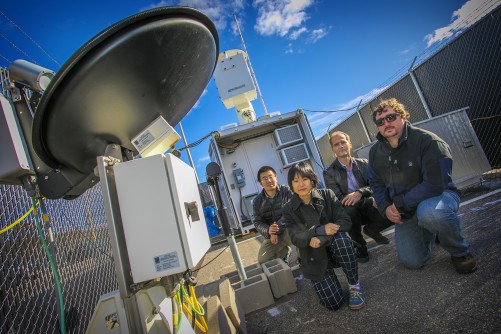
Professor Pavlos Kollias, center/back, and colleagues at Stony Brook’s Radar Observatory. From left: Zeen Zhu, SoMAS graduate student; Mariko Oue, postdoctoral research associate, SoMAS; and Alexander Sneddon, SoMAS engineer. Credit: Stony Brook University

Analyzing and determining the structure of clouds remains a challenge for scientists trying to forecast weather. A team of researchers at the Stony Brook University School of Marine and Atmospheric Sciences (SoMAS), led by Professor Pavlos Kollias, is using news types or radar in combination with current meteorology technology to take an “MRI” of clouds. In the same way an MRI and other imaging techniques help physicians visualize and understand what is happening within human body parts, and MRI of clouds helps scientists better understand what happens inside clouds.

Clouds are complex, fast evolving, occur over vast areas and as such are difficult to characterize using current technologies. But with these new radar technologies and forecasting techniques, Kollias and colleagues at Stony Brook University and Brookhaven National Laboratory are completing cloud and precipitation research at the SoMAS Radar Observatory that may evolve into a new way to better forecast weather.

“Using these technologies, we can pinpoint and highlight different components of the interior of clouds,” says Kollias. “We can see how precipitation forms and grows in clouds and better predict not only if it will rain or snow, but how much rain or snow may accumulate on the ground.”

He says the goal of the research is to use data from MRIs of clouds to improve the ability of weather modeling to forecast the type of precipitation and amount on the ground with a level of accuracy and precision not reached previously by meteorologists.

The SoMAS Radar Observatory contains a large array of sensors with different viewing perspectives and different sensitivities allowing observation of the horizontal distribution as well as vertical structure of clouds and precipitation. Moreover, the Observatory is uniquely geographically positioned in the center of the Northeast and coastal for study of winter storms.

For more details about Stony Brook’s use of radar and the MRI of clouds, see this video.

Related Articles Read More >

PFAS Contamination - Alertness about dangerous PFAS per-and polyfluoroalkyl substances into the sea waters - They are now everywhere, so much so that they have even been found in marine aerosol - Concept with magnifying glass
New method breaks down up to 99% of PFAS
New method achieves 89% defluorination of PFOA in lab tests
LLNL’s multi-ignition wildfire models could help predict and prevent, catastrophic fire events
Scientists release sodium hydroxide into the ocean to combat acidification
rd newsletter
EXPAND YOUR KNOWLEDGE AND STAY CONNECTED
Get the latest info on technologies, trends, and strategies in Research & Development.
RD 25 Power Index

R&D World Digital Issues

Fall 2025 issue

Browse the most current issue of R&D World and back issues in an easy to use high quality format. Clip, share and download with the leading R&D magazine today.

R&D 100 Awards
Research & Development World
  • Subscribe to R&D World Magazine
  • Sign up for R&D World’s newsletter
  • Contact Us
  • About Us
  • Drug Discovery & Development
  • Pharmaceutical Processing
  • Global Funding Forecast

Copyright © 2026 WTWH Media LLC. All Rights Reserved. The material on this site may not be reproduced, distributed, transmitted, cached or otherwise used, except with the prior written permission of WTWH Media
Privacy Policy | Advertising | About Us

Search R&D World

  • R&D World Home
  • Topics
    • Aerospace
    • Automotive
    • Biotech
    • Careers
    • Chemistry
    • Environment
    • Energy
    • Life Science
    • Material Science
    • R&D Management
    • Physics
  • Technology
    • 3D Printing
    • A.I./Robotics
    • Software
    • Battery Technology
    • Controlled Environments
      • Cleanrooms
      • Graphene
      • Lasers
      • Regulations/Standards
      • Sensors
    • Imaging
    • Nanotechnology
    • Scientific Computing
      • Big Data
      • HPC/Supercomputing
      • Informatics
      • Security
    • Semiconductors
  • R&D Market Pulse
  • R&D 100
    • 2025 R&D 100 Award Winners
    • 2025 Professional Award Winners
    • 2025 Special Recognition Winners
    • R&D 100 Awards Event
    • R&D 100 Submissions
    • Winner Archive
  • Resources
    • Research Reports
    • Digital Issues
    • Educational Assets
    • R&D Index
    • Subscribe
    • Video
    • Webinars
    • Content submission guidelines for R&D World
  • Global Funding Forecast
  • Top Labs
  • Advertise
  • SUBSCRIBE