Research & Development World

  • R&D World Home
  • Topics
    • Aerospace
    • Automotive
    • Biotech
    • Careers
    • Chemistry
    • Environment
    • Energy
    • Life Science
    • Material Science
    • R&D Management
    • Physics
  • Technology
    • 3D Printing
    • A.I./Robotics
    • Software
    • Battery Technology
    • Controlled Environments
      • Cleanrooms
      • Graphene
      • Lasers
      • Regulations/Standards
      • Sensors
    • Imaging
    • Nanotechnology
    • Scientific Computing
      • Big Data
      • HPC/Supercomputing
      • Informatics
      • Security
    • Semiconductors
  • R&D Market Pulse
  • R&D 100
    • 2025 R&D 100 Award Winners
    • 2025 Professional Award Winners
    • 2025 Special Recognition Winners
    • R&D 100 Awards Event
    • R&D 100 Submissions
    • Winner Archive
  • Resources
    • Research Reports
    • Digital Issues
    • Educational Assets
    • R&D Index
    • Subscribe
    • Video
    • Webinars
    • Content submission guidelines for R&D World
  • Global Funding Forecast
  • Top Labs
  • Advertise
  • SUBSCRIBE

Graphene Flakes Boost Solar Cell Efficiency

By King Abdullah University of Science & Technology | June 30, 2016

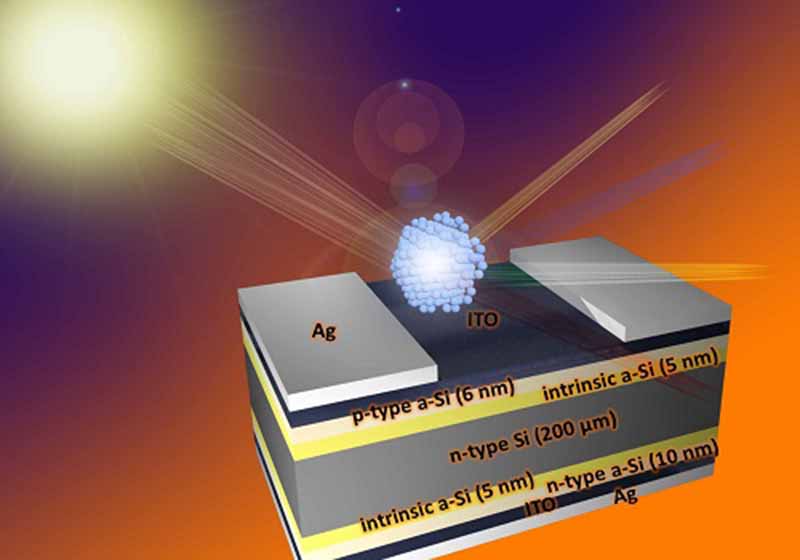
A graphene quantum dot (white) on top of a solar cell formed by silicon (Si) insulating (ITO) and metal (Au) layers. Source: Reproduced with permission from Tsai, M.-L., Tu, W.-C., Tang, L., Wei, T.-C., Wei, W.-R., Lau, S.P., Chen, L.-J. & He, J.-H. © 2016 American Chemical Society

Small flakes of graphene could expand the usable spectral region of light in silicon solar cells to boost their efficiency, new research from King Abdullah University of Science and Technology (KAUST) shows.

Solar cell materials have become significantly cheaper to produce in recent years, yet further cost savings are needed to make solar technologies commercially attractive. The prevalence of silicon in solar cells makes them a good target for efficiency enhancement.

“By improving the efficiency of silicon solar cells, we can provide a more cost-effective way for energy production,” says Jr-Hau He, KAUST associate professor of electrical engineering, who also led the research team.

Graphene quantum dots are small flakes of graphene that are useful because of their interaction with light. One of these interactions is optical downconversion, which is a process that transforms light of high energies into lower energy (for example, from the ultraviolet to the visible).

Downconversion can be used to boost solar cells. Silicon absorbs light very efficiently in the visible part of the spectrum, and therefore appears black. However, the absorption strength of silicon for ultraviolet light is much smaller, meaning that less of this light is absorbed, reducing the efficiency of solar cells in that part of the spectrum. One way to circumvent this problem is the downconversion of ultraviolet light to energies where silicon is a more efficient absorber.

Graphene quantum dots are ideal candidates for this purpose. They are easy to manufacture using readily-available materials such as sugar and by then heating them with microwave radiation. While the dots are almost transparent to visible light, which is important to pass that light through to the solar cell, they are efficient in converting UV light to lower energies.

The researchers integrated the quantum dots on a silicon solar cell device. The efficiency of the solar cells increased in comparison to control samples. For a mature technology to show a clear improvement in efficiency is promising, because it can be produced using an easy manufacturing process.

The test sample solar cells measured so far have not yet been optimized to be closer to the record-breaking performances seen in silicon. The researchers therefore plan to combine some other enhancement technologies previously achieved in similar devices, He noted.

“We have been successfully utilized surface engineering treatments, including fabricating nanostructures and passivation layers, to improve the light harvesting and the electrical properties of solar cells. By integrating these techniques all together, we hope that in the next few years the world record can be broken at KAUST,” he says.
Source: King Abdullah University of Science and Technology

Related Articles Read More >

The emerging materials shaping next-generation semiconductor electronics
24 R&D trends that redefined 2024
Graphene-based flowmeter sensor measures nano-rate fluid flows, Part 3: The sensor
Graphene-based flowmeter sensor measures nano-rate fluid flows, Part 2: The graphene context
rd newsletter
EXPAND YOUR KNOWLEDGE AND STAY CONNECTED
Get the latest info on technologies, trends, and strategies in Research & Development.
RD 25 Power Index

R&D World Digital Issues

Fall 2025 issue

Browse the most current issue of R&D World and back issues in an easy to use high quality format. Clip, share and download with the leading R&D magazine today.

R&D 100 Awards
Research & Development World
  • Subscribe to R&D World Magazine
  • Sign up for R&D World’s newsletter
  • Contact Us
  • About Us
  • Drug Discovery & Development
  • Pharmaceutical Processing
  • Global Funding Forecast

Copyright © 2026 WTWH Media LLC. All Rights Reserved. The material on this site may not be reproduced, distributed, transmitted, cached or otherwise used, except with the prior written permission of WTWH Media
Privacy Policy | Advertising | About Us

Search R&D World

  • R&D World Home
  • Topics
    • Aerospace
    • Automotive
    • Biotech
    • Careers
    • Chemistry
    • Environment
    • Energy
    • Life Science
    • Material Science
    • R&D Management
    • Physics
  • Technology
    • 3D Printing
    • A.I./Robotics
    • Software
    • Battery Technology
    • Controlled Environments
      • Cleanrooms
      • Graphene
      • Lasers
      • Regulations/Standards
      • Sensors
    • Imaging
    • Nanotechnology
    • Scientific Computing
      • Big Data
      • HPC/Supercomputing
      • Informatics
      • Security
    • Semiconductors
  • R&D Market Pulse
  • R&D 100
    • 2025 R&D 100 Award Winners
    • 2025 Professional Award Winners
    • 2025 Special Recognition Winners
    • R&D 100 Awards Event
    • R&D 100 Submissions
    • Winner Archive
  • Resources
    • Research Reports
    • Digital Issues
    • Educational Assets
    • R&D Index
    • Subscribe
    • Video
    • Webinars
    • Content submission guidelines for R&D World
  • Global Funding Forecast
  • Top Labs
  • Advertise
  • SUBSCRIBE