Federal funding cuts are affecting scientists across the country. In academia, cuts are causing budget reductions, termination of ongoing research and disruption to the talent pipeline.
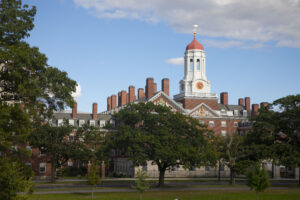
Credit: Harvard University
Universities are facing a 15% cap on facilities and administrative cost reimbursements. Usually, the government reimburses universities for about 60% of these indirect costs. Now, universities like UConn expect to lose at least $35 million annually as they are forced to take on those costs. The university has warned that it may have to increase tuition to deal with the cuts.
Due to funding uncertainty, many schools are admitting fewer students. MIT recently reported that new graduate enrollments are down almost 20%. The institution also said that campus-sponsored research activity is 10% smaller than a year ago.
How higher education is dealing with the cuts
At the University of Washington, the response to funding cuts has focused on building a resilient infrastructure that can shield researchers from federal volatility. UW is using a shared services administrative pod that connects over 130 researchers and staff in environmental science to centralized resources that help researchers rapidly pivot and find new resources when funding is terminated.
The university is also focusing on local and tribal partnerships that do not rely on federal support. UW is increasingly relying on private donations to sustain programs like their Summer Internship Program.
MIT has implemented budget currents across the institution to deal with federal funding cuts. The university is also “aggressively pursuing” new funding from industry, including with the MIT IBM Computing Research Lab for AI and quantum computing, according to a video from MIT President Sally Kornbluth.
Additionally, MIT is using its Washington office to lobby Congress and raise awareness of the damage caused by the new 8% tax on endowment returns. The tax was signed into law in July 2025 has part of the One Big Beautiful Bill. It applies to private nonprofit institutions with endowment assets exceeding $2 million per enrolled student.
At Harvard University, which is facing more than $2.2 billion in cuts, professors are turning away students asking to work in their lab as scholars search for jobs abroad. The university allocated an emergency $250 million to support campus research.
Seeking litigation
The UC system successfully sought preliminary injunctions in federal court after UCLA alone saw $500 million worth of grants frozen. The judge ordered the restoration of hundreds of grants.
Universities that are part of the Association of American Universities (AAU) and the Council on Governmental Relations (COGR) are currently engaging in litigation, filing amicus briefs in federal court to challenge the termination of grants. They argue that the administration lacks the authority to cancel awards based on a sudden shift in agency priorities.
As schools admit fewer students and hike up tuition, the talent pipeline may begin to erode. Some institutions, such as the University of Massachusetts, have rescinded PhD program acceptances. As advanced students serve as mentors to undergraduates, this could cause a cyclical effect for years to come.