Problem: Elemental analysis forms a necessary component of the analytical workflows of many laboratories. The quantification of elemental carbon, hydrogen, nitrogen, sulfur and oxygen (CHNS/O) in laboratory samples can provide a vital means of assessing product purity.
However, to analyze the full range of elements that may be present in a sample, laboratories are required to invest in multiple elemental analyers. This is because carbon, hydrogen, nitrogen, sulfur, and oxygen analysis conventionally cannot be carried out within one integrated instrument. Not only does this pose an issue for smaller lab facilities where space is at a premium, but the implementation of multiple analytical workflows increases sample preparation and data acquisition time, reducing efficiency.
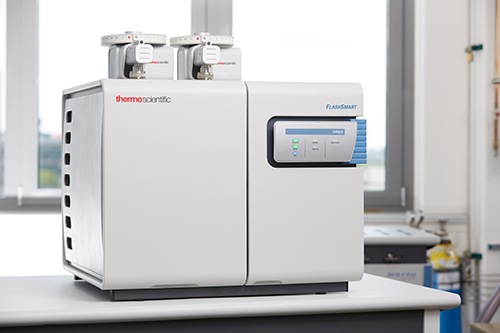
Solution: The Thermo Scientific FlashSmart Elemental Analyzer offers an innovative solution to these challenges by providing comprehensive elemental analysis capability in a single, automated, bench-top instrument. The instrument is equipped with two independent furnaces, accessed by separate analytical circuits that are fully automated through the Thermo Scientific MultiValve Control (MVC) Module. This enables the analyzer to switch automatically from one analytical circuit to another, permitting CHNS/O determination in a single automated workflow.
For CHNS analysis, samples are introduced from the autosampler into the combustion reactor along with oxygen. Following combustion, the product gases are conveyed by helium flow to a reduction layer filled with copper, and passed through a gas chromatography (GC) column that separates the combustion products before being analyzed by a Thermal Conductivity Detector (TCD). The GC column integrated in the FlashSmart Analyzer ensures reliable product separation, providing operators increased confidence in the quality of their data. The CHNS analytical workflow possesses a run time of less than 10 minutes per Automated, Compact Solution for Comprehensive Elemental Analysis sample. For oxygen determination, the instrument’s pyrolysis reactor filled with nickel coated carbon, maintained at a temperature of 1060 degrees C, is utilized. The oxygen in the sample combines with carbon to form carbon monoxide, which is separated from the other products by GC and detected by the TCD Detector.
The instrument can also be programmed to perform other combinations of elemental analysis, such as N/Protein determinations. The instrument’s simple sample preparation workflow means that, unlike alternative approaches for nitrogen determination such as the Kjeldahl method, no additional reagents are required.
The single instrument set-up also reduces preparation and analysis time, allowing the operator to perform in significantly less time. The ability of the FlashSmart Analyzer to perform unsupervised 24/7 automation can increase laboratory throughput by allowing multiple samples to be queued and analyzed in a single day. Thermo Scientific EagerSmart Data Handling Software simplifies workflow automation and produces customizable user-friendly analysis reports, making the system easy to use from start to finish.
The MVC Module ensures very low helium consumption by automatically switching from helium to nitrogen or argon gas when the instrument is in stand-by mode, reducing analysis costs. Using the EagerSmart Data Handling Software, the system can be programmed to wakeup and prepare for analysis the following day, further boosting lab efficiency. The FlashSmart Elemental Analyzer offers a compact, automated, and highly accurate approach to elemental analysis that can improve workflow efficiency and reduce running costs.
For more information about this product, visit www.thermofisher.com/oea.