At the National Energy Technology Laboratory (NETL), we are undertaking integrated research aligned with U.S. Department of Energy (DOE) priorities and industrial needs to increase the recovery of hydrocarbons from challenging subsurface formations and enable the development of secure, efficient, and low-impact oil and gas systems.
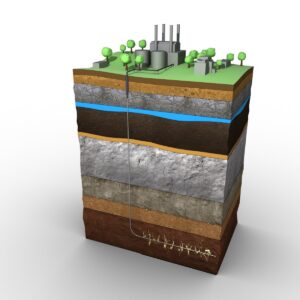
EOR via Wettability Alteration: The addition of additives to water, natural gas, or CO2 alters shale properties, allowing trapped oil to detach from rock surfaces and flow to the wellbore. [Image: NETL]
- The United States has an abundance of oil-rich shale formations, which are predominantly composed of fine-grained sedimentary rocks that have undergone substantial geological processes over millions of years. Technologies are needed to extract oil and gas trapped within these tight formations.
- EOR in unconventional formations is especially challenging due to the extremely low permeability and mixed wettability of shale that prevent oil from flowing naturally.
- During primary recovery in oil-rich formations, hydraulic fracturing with water typically recovers only between 3% and 10% of oil in place, forcing operators to adopt secondary or tertiary (enhanced) techniques to recover the oil left behind.
- Much of the easy-to-produce oil in U.S. oil fields has already been recovered. Therefore, it is critical to find affordable solutions to extract the remaining oil and increase production from unconventional formations.
EOR works by injecting substances into oil reservoirs to extract additional hydrocarbons that remain after primary and secondary recovery methods have been exhausted. EOR methods alter physical properties to make hydrocarbons flow more easily through the reservoir to production wells.
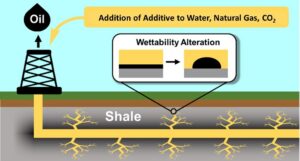
Primary recovery with fracturing as shown here normally extracts only a small percentage of hydrocarbons in place. NETL researchers are working on nuclear magnetic resonance to improve recovery rates in such unconventional formations. [Image: NETL]
Water-based EOR is the standard, low-cost approach to reduce interfacial tension between oil and water. Surfactants can be added to the water to alter shale properties from oil-wet (oil sticks to rock surfaces, reducing recovery efficiency) to water-wet (water coats the solid mineral grains, leaving the oil free in pore centers to be easily displaced and recovered).
Compared to water, nonaqueous fluids possess lower viscosity and more favorable thermodynamic interactions with oil. These qualities make it easier for nonaqueous fluids to access shale nanopores, which are thousands of times smaller than the width of a human hair, and drive oil or natural gas toward the wellbore.
Today, NETL researchers are using nuclear magnetic resonance (NMR) spectroscopy in the laboratory to study how to improve oil recovery.
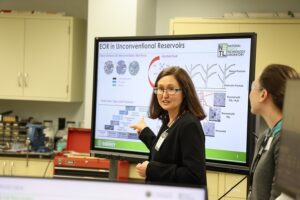
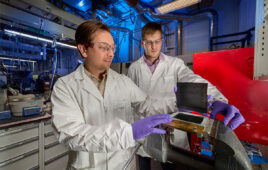
Angela Goodman speaking in a lab at NETL, Pittsburgh. [Image: NETL]
Relaxation times provide information about in-situ porosity (percentage of void space within a rock indicating how much water, oil, or gas it can hold), pore size distribution (size of pores within a rock), permeability (a measure of how easily fluids can flow through the interconnected pore spaces), and fluid saturation of the rock.
The NMR unit can analyze rock cores placed in a pressure vessel to simulate extreme pressures of up to 10,000 psi and temperatures of 100 degrees Celsius, which are found in the subsurface, and study how fluids flow through rock cores.
During these experiments, digital scans are generated to create maps of the distribution of fluids in the rock and show how injected fluids move oil and water throughout the rock nanopores. NMR can also map oil already contained in the rock core and quantify how much of the oil can be extracted during dynamic processes that occur during oil recovery.
The application of EOR techniques has the potential to have significant impact.
Technical collaborations and project reviews of the Bakken Formation, which spans portions of Montana, South Dakota, North Dakota, and parts of Canada, estimate original oil in place (OOIP) at 300 billion to 900 billion barrels. However, OOIP recovery factors are estimated at 10% or less, making it crucial to advance EOR in the Bakken.
Furthermore, the Assumptions to the Annual Energy Outlook, Oil and Gas Supply Module, which is produced by the U.S. Energy Information Administration, puts total unproved technically recoverable tight and shale crude oil at 190.7 billion barrels.
A modest 10% recovery rate from those challenging formations using EOR would generate 19.07 billion barrels of additional oil to protect the energy, economic, and national security of the United States.
NETL chemist Angela Goodman is an internationally recognized expert in her field with 25 years of experience in geologic systems. She is ranked among the top 2% of highly influential scientists globally by Stanford University and Elsevier, based on single year and career citations.
Editor’s note: Additional detail on the NMR work described here appears in NETL’s May 19, 2026 news release, “NETL Research To Boost Oil and Gas Production by Maximizing Production in Tight Formations.”