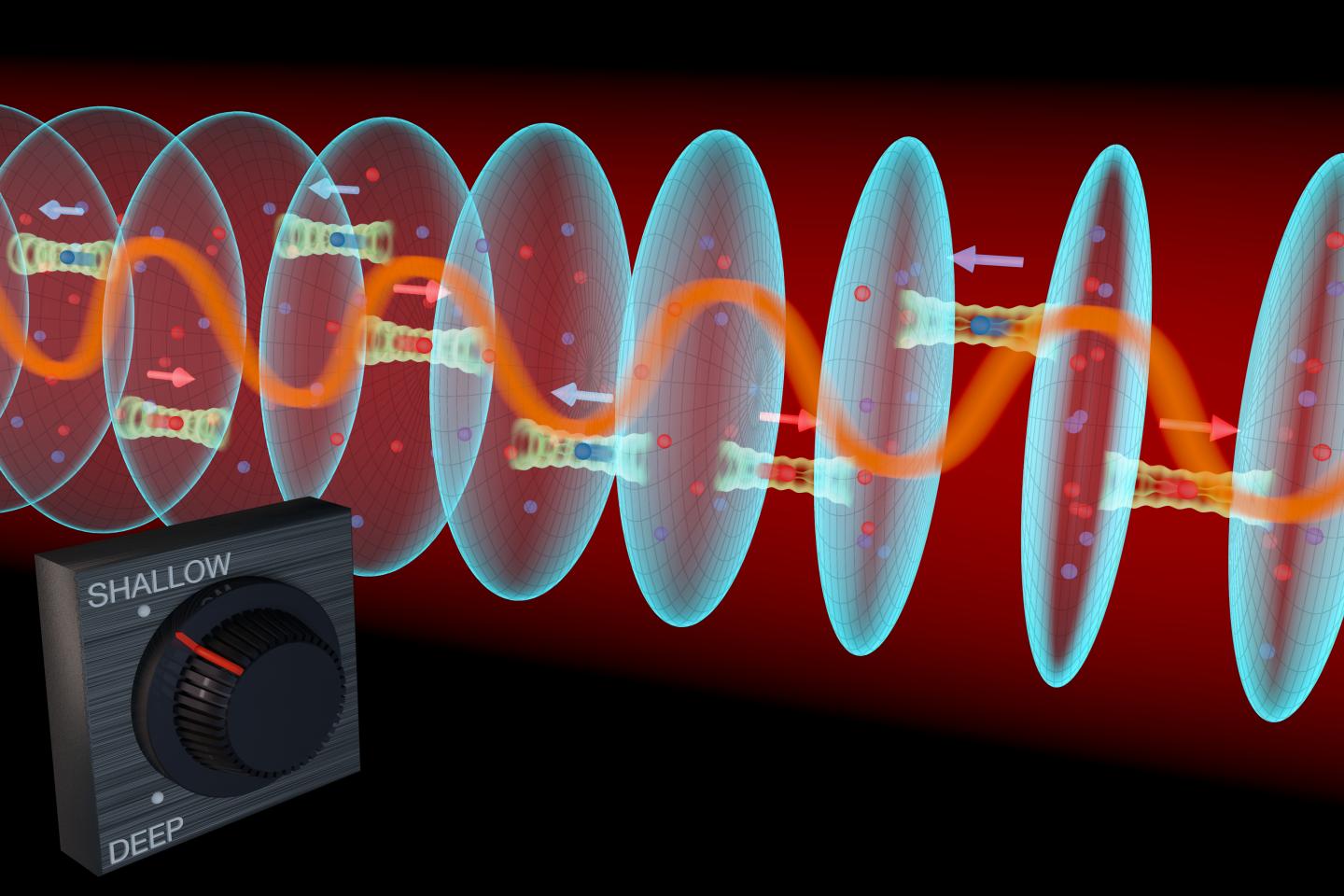
JILA physicists used a strontium lattice atomic clock to simulate magnetic properties long sought in solid materials. The atoms are confined in an optical lattice, shown as an array of disk-shaped traps set at shallow depths. A laser (yellow wave) probes the atoms to couple the atoms’ spins and motions. The two atomic spin states (red and blue), which are also the clock. Source: Steven Burrows and Ye Group/JILA
Using their advanced atomic clock to mimic other desirable quantum systems, JILA physicists have caused atoms in a gas to behave as if they possess unusual magnetic properties long sought in harder-to-study solid materials. Representing a novel “off-label” use for atomic clocks, the research could lead to the creation of new materials for applications such as “spintronic” devices and quantum computers.
JILA’s record-setting atomic clock, in which strontium atoms are trapped in a laser grid known as an optical lattice, turns out to be an excellent model for the magnetic behavior of crystalline solids at the atomic scale. Such models are valuable for studying the counterintuitive rules of quantum mechanics.
To create “synthetic” magnetic fields, the JILA team locked together two properties of the clock atoms to create a quantum phenomenon known as spin-orbit coupling. The long lifetime and precision control of the clock atoms enabled researchers to overcome a common problem in other gas-based spin-orbit coupling experiments, namely heating and loss of atoms due to spontaneous changes in atomic states, which interferes with the effects researchers are trying to achieve.
The best-known type of spin-orbit coupling refers to an electron inside a single atom, where an electron’s spin (the direction of its momentum, like a tiny arrow pointing up or down) is locked to its orbit around the nucleus to give rise to a rich internal atomic structure. In the JILA work, spin-orbit coupling locks an atom’s spin, which is like a tiny internal bar magnet, with the atom’s external motion through the optical lattice. The JILA team precisely manipulated the spin and motion of thousands of strontium atoms in the clock, measured the resulting synthetic magnetic field, and observed key signatures of spin-orbit coupling such as changes in atom motion rippling through the lattice based on their spin.
The experiments are described in a Nature paper published online Dec. 21, 2016. JILA is jointly operated by the National Institute of Standards and Technology (NIST) and the University of Colorado Boulder.
“Spin-orbit coupling is useful for studying novel quantum materials,” NIST/JILA Fellow Jun Ye said. “By using our atomic clock for quantum simulation, we hope to stimulate new insights and shed new light on emerging behaviors of topological systems that are useful for robust quantum information processing and spintronics.”
Spin-orbit coupling is a key feature of topological materials–the subject of theoretical work honored in this year’s Nobel Prize in physics–which conduct electricity on the surface but act as insulators on the inside. This characteristic could be used to make novel devices based on electron spin instead of the usual electric charge, and topological quantum computers, which in theory could make powerful calculations in new ways. But real materials like this are hard to make and study–atomic gases are purer and easier to control.
This area of research is fairly new. The first demonstration of spin-orbit coupling in a gas of atoms was achieved in 2011 by a NIST physicist at the Joint Quantum Institute.
The JILA clock has several features that make it a good mimic for crystalline solids. Researchers used lasers to probe the clock “ticks,” the atoms’ transition between two energy levels. The atoms’ behavior then resembled that of electrons in a solid material in the presence of an external magnetic field, where the electrons have two spin states (“spin up” and “spin down”). When an atom was excited to a higher-energy state, the laws of physics required that energy and momentum be conserved, so the atom’s momentum slowed.
The end result was a regular pattern of switching back and forth between the atoms’ spin and momentum. The pattern occurred across thousands of atoms regularly spaced in the laser grid, or optical lattice, an analogy to the lattice structure of solid crystals. Because the excited atomic state lasted for 160 seconds, the researchers had ample time to make measurements without atom losses or heating.
The use of an atomic clock as a quantum simulator offers the prospect for real-time, nondestructive, measurements of atom dynamics in an optical lattice. The current clock and simulations have the atoms arranged in one dimension. However, in the future, the researchers hope to couple multiple types of synthetic atomic spin states to create exotic behavior at more complex levels. Ye’s team is developing a 3-D version of the atomic clock by adding more laser beams to form more lattices, which are expected to enable spin-orbit coupling in multiple dimensions.