Research & Development World

  • R&D World Home
  • Topics
    • Aerospace
    • Automotive
    • Biotech
    • Careers
    • Chemistry
    • Environment
    • Energy
    • Life Science
    • Material Science
    • R&D Management
    • Physics
  • Technology
    • 3D Printing
    • A.I./Robotics
    • Software
    • Battery Technology
    • Controlled Environments
      • Cleanrooms
      • Graphene
      • Lasers
      • Regulations/Standards
      • Sensors
    • Imaging
    • Nanotechnology
    • Scientific Computing
      • Big Data
      • HPC/Supercomputing
      • Informatics
      • Security
    • Semiconductors
  • R&D Market Pulse
  • R&D 100
    • 2025 R&D 100 Award Winners
    • 2025 Professional Award Winners
    • 2025 Special Recognition Winners
    • R&D 100 Awards Event
    • R&D 100 Submissions
    • Winner Archive
  • Resources
    • Research Reports
    • Digital Issues
    • Educational Assets
    • Subscribe
    • Video
    • Webinars
    • PharmSci360
    • Content submission guidelines for R&D World
  • Global Funding Forecast
  • Top Labs
  • Advertise
  • SUBSCRIBE

Lasers Carve Path to Tissue Engineering

By Ecole Polytechnique Federale de Lausanne | June 23, 2016

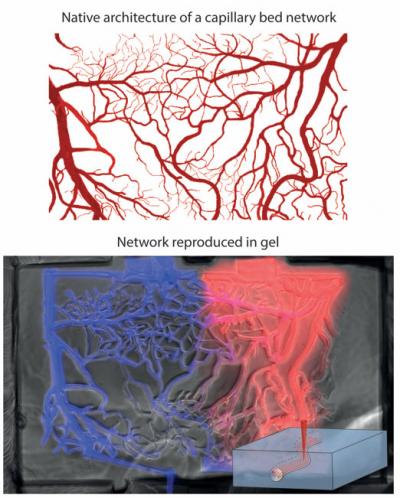
A diagram showing how the architecture of a capillary bed can be reproduced in a 3-D cell culture hydrogel using short-pulse lasers. Source: Matthias Lütolf/EPFL

Future medicine is bound to include extensive tissue-engineering technologies such as organs-on-chips and organoids – miniature organs grown from stem cells. But all this is predicated on a simple yet challenging task: controlling cellular behavior in three dimensions. So far, most cell culture approaches are limited to two-dimensional environments (e.g. a Petri dish or a chip), but that neither matches real biology nor helps us sculpt tissues and organs. Two EPFL scientists have now developed a new method that uses lasers to carve out paths inside biocompatible gels to locally influence cell function and promote tissue formation. The work is published in Advanced Materials.

In the body, cells grow in 3D microspaces that are specific to each type of tissue – liver, kidney, lung, heart, brain etc. These microenvironments are important because they control the behavior of the cells, e.g. how they interact with other parts of the tissue to help it develop, function, and repair. In addition, the microenvironments themselves are very dynamic and adaptable, sending the cells various biochemical signals to adapt their behavior to physiological changes.

This means that any successful merging of biology and engineering must first be able to grow cells in custom-built yet biologically active 3D spaces. Working at EPFL’s Institute of Bioengineering, Matthias Lütolf and his PhD student Nathalie Brandenberg have developed a method that uses a laser to cut three-dimensional pathways and networks for cells inside a hydrogel scaffold that matches their natural environment.

The method combines lasers with microfluidics – the science of controlling fluids in micrometer-sized spaces. The scientists used focalized short-pulsed lasers, which can generate enough power to create tiny tunnels in different gels already used in cell biology and tissue engineering. The laser can be applied before or even during 3D cell culture, meaning that the cells can be controlled in “real time” to match their natural growth.

Meanwhile, microfluidics have become the key to tissue engineering. The technology offers unprecedented control over the cells’ microenvironment, as it can emulate the complex adaptability of biological microenvironments, allowing behavior-adjusting signals to be delivered to the cells in the form of drugs or other compounds.

As such, microfluidics are extensively used to build cell culture systems for growing cells. However, microfluidics have been largely limited to 2D cell culture applications, and are not easy to apply for long-term cell culture. Some efforts to use microfluidics in 3D cultures have proven successful, but they involve multiple labor-intensive steps that render them inefficient for standardized applications. But by combining microfluidics with the flexibility of laser carving (or “photoablation”), Brandenberg and Lütolf have brought ease, robustness and versatility to the approach.

“Our method addresses the limitations of previous approaches,” says Lütolf. “It is fully compatible with 3D cell cultures, and can be applied with a wide range of materials, different geometries, and can introduce or change existing microfluidic networks during the course of an experiment to control cells in an unprecedented way.”


Related Articles Read More >

As AI floods drug discovery with designs, Twist uses DNA chips to tackle the wet-lab bottleneck
Purple Glowing Spiral Fractal Background Image, Illustration - Vortex repeating spiral patterns, Symmetrical repeating geometric patterns. Abstract design, black background
Recursion says its Norstella-backed real-time simulation can expand trial eligibility by up to 40%
NIH employees warn of ‘institutionalized destruction’ one year after Bethesda Declaration
Cradle’s CEO on the AI agent boom and the reality of experimental feedback in life sciences
rd newsletter
EXPAND YOUR KNOWLEDGE AND STAY CONNECTED
Get the latest info on technologies, trends, and strategies in Research & Development.

R&D World Digital Issues

Fall 2025 issue

Browse the most current issue of R&D World and back issues in an easy to use high quality format. Clip, share and download with the leading R&D magazine today.

R&D 100 Awards
Research & Development World
  • Subscribe to R&D World Magazine
  • Sign up for R&D World’s newsletter
  • Contact Us
  • About Us
  • Drug Discovery & Development
  • Pharmaceutical Processing
  • Global Funding Forecast

Copyright © 2026 Arrowfly LLC. All Rights Reserved. The material on this site may not be reproduced, distributed, transmitted, cached or otherwise used, except with the prior written permission of Arrowfly
Privacy Policy | Advertising | About Us

Search R&D World

  • R&D World Home
  • Topics
    • Aerospace
    • Automotive
    • Biotech
    • Careers
    • Chemistry
    • Environment
    • Energy
    • Life Science
    • Material Science
    • R&D Management
    • Physics
  • Technology
    • 3D Printing
    • A.I./Robotics
    • Software
    • Battery Technology
    • Controlled Environments
      • Cleanrooms
      • Graphene
      • Lasers
      • Regulations/Standards
      • Sensors
    • Imaging
    • Nanotechnology
    • Scientific Computing
      • Big Data
      • HPC/Supercomputing
      • Informatics
      • Security
    • Semiconductors
  • R&D Market Pulse
  • R&D 100
    • 2025 R&D 100 Award Winners
    • 2025 Professional Award Winners
    • 2025 Special Recognition Winners
    • R&D 100 Awards Event
    • R&D 100 Submissions
    • Winner Archive
  • Resources
    • Research Reports
    • Digital Issues
    • Educational Assets
    • Subscribe
    • Video
    • Webinars
    • PharmSci360
    • Content submission guidelines for R&D World
  • Global Funding Forecast
  • Top Labs
  • Advertise
  • SUBSCRIBE