Research & Development World

  • R&D World Home
  • Topics
    • Aerospace
    • Automotive
    • Biotech
    • Careers
    • Chemistry
    • Environment
    • Energy
    • Life Science
    • Material Science
    • R&D Management
    • Physics
  • Technology
    • 3D Printing
    • A.I./Robotics
    • Software
    • Battery Technology
    • Controlled Environments
      • Cleanrooms
      • Graphene
      • Lasers
      • Regulations/Standards
      • Sensors
    • Imaging
    • Nanotechnology
    • Scientific Computing
      • Big Data
      • HPC/Supercomputing
      • Informatics
      • Security
    • Semiconductors
  • R&D Market Pulse
  • R&D 100
    • 2025 R&D 100 Award Winners
    • 2025 Professional Award Winners
    • 2025 Special Recognition Winners
    • R&D 100 Awards Event
    • R&D 100 Submissions
    • Winner Archive
  • Resources
    • Research Reports
    • Digital Issues
    • Educational Assets
    • Subscribe
    • Video
    • Webinars
    • PharmSci360
    • Content submission guidelines for R&D World
  • Global Funding Forecast
  • Top Labs
  • Advertise
  • SUBSCRIBE

Layered Chambers Open the Drug Release Window

By A*STAR | November 1, 2018

Implantable arrays of microchambers show potential capacity for holding and releasing precisely controlled quantities of drugs on command, report A*STAR researchers with colleagues in Singapore, Russia, and the United Kingdom.

A near-infrared laser beam acts to break open selected microchambers at the required time.

“This near-infrared light is the perfect way to trigger drug release as it has the maximum penetration into biological tissues,” says Maxim Kiryukhin of the A*STAR Institute of Materials Research and Engineering.

The required wavelengths fall within the ‘therapeutic window’ that allows light for medical uses to reach safely into the body.

The team make the microchambers from composites of polymers and graphene oxide.

“My research group pioneered the manufacture of microchamber arrays using techniques called nanoimprint lithography and layer-by-layer assembly,” says Kiryukhin.

The lithography step makes templates with a desired pattern of microwells imprinted into their surface. Layers of polymers and graphene oxide are then built up on the templates to make a composite material.

The templates can be dissolved or peeled away, creating the polymer/graphene-oxide chambered arrays that can be sealed with a layer of plastic.

If they are to contain drugs for delivery into the body, the chambers need to be mechanically robust.

“Failure, followed by sudden release of the entire drug payload, could be catastrophic,” Kiryukhin points out.

Incorporating graphene oxide layers into the polymer layers is the critical innovation that makes the chambers sufficiently stable and responsive to near-infrared light.
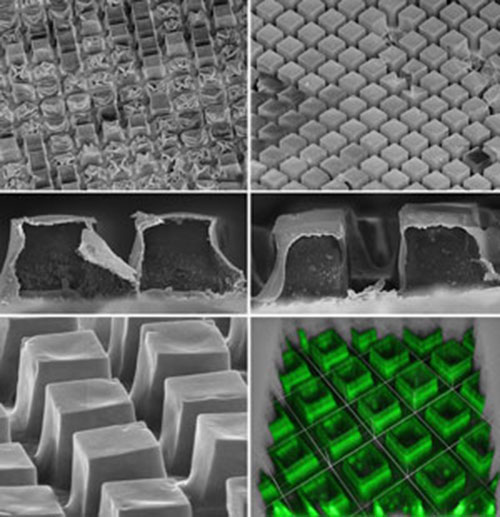
The top and middle rows show microchambers without (left) and with (right) incorporated graphene oxide after dissolution of the templates. The bottom row shows microchambers with graphene oxide after peeling away the template, both scanning electron microscopy (left) and confocal laser scanning microscopy (right) images. Image: Reprinted from Ref 1. © 2018 Wiley-VCH Verlag GmbH & Co. KGaA, Weinheim

The researchers have already developed techniques that can be used to load the chambers with a range of chemical solutions; selected chambers can then be disrupted using targeted laser light. This would give clinicians fine control over the rate of drug release to suit different patients and conditions.

This proof-of-concept work lays the foundations for moving to tests with real drugs in animals and then humans. Kiryukhin explains that the team are relying on their collaborating research groups in the UK, China, and Russia to address this challenge.

Meanwhile the A*STAR researchers are pursuing wider possibilities.

“We are interested in using the chambered arrays in sensing technologies, such as detecting the level of freshness of food or diagnosing the condition of wounds and diseased tissues,” Kiryukhin explains.

The microchambers could release a signal, such as fluorescence, in response to the changes being sensed, for example.

The A*STAR-affiliated researchers contributing to this research are from the Institute of Materials Research and Engineering.

Source: A*STAR
Related Articles Read More >

The emerging materials shaping next-generation semiconductor electronics
24 R&D trends that redefined 2024
Graphene-based flowmeter sensor measures nano-rate fluid flows, Part 3: The sensor
Graphene-based flowmeter sensor measures nano-rate fluid flows, Part 2: The graphene context
rd newsletter
EXPAND YOUR KNOWLEDGE AND STAY CONNECTED
Get the latest info on technologies, trends, and strategies in Research & Development.

R&D World Digital Issues

Fall 2025 issue

Browse the most current issue of R&D World and back issues in an easy to use high quality format. Clip, share and download with the leading R&D magazine today.

R&D 100 Awards
Research & Development World
  • Subscribe to R&D World Magazine
  • Sign up for R&D World’s newsletter
  • Contact Us
  • About Us
  • Drug Discovery & Development
  • Pharmaceutical Processing
  • Global Funding Forecast

Copyright © 2026 Arrowfly LLC. All Rights Reserved. The material on this site may not be reproduced, distributed, transmitted, cached or otherwise used, except with the prior written permission of Arrowfly
Privacy Policy | Advertising | About Us

Search R&D World

  • R&D World Home
  • Topics
    • Aerospace
    • Automotive
    • Biotech
    • Careers
    • Chemistry
    • Environment
    • Energy
    • Life Science
    • Material Science
    • R&D Management
    • Physics
  • Technology
    • 3D Printing
    • A.I./Robotics
    • Software
    • Battery Technology
    • Controlled Environments
      • Cleanrooms
      • Graphene
      • Lasers
      • Regulations/Standards
      • Sensors
    • Imaging
    • Nanotechnology
    • Scientific Computing
      • Big Data
      • HPC/Supercomputing
      • Informatics
      • Security
    • Semiconductors
  • R&D Market Pulse
  • R&D 100
    • 2025 R&D 100 Award Winners
    • 2025 Professional Award Winners
    • 2025 Special Recognition Winners
    • R&D 100 Awards Event
    • R&D 100 Submissions
    • Winner Archive
  • Resources
    • Research Reports
    • Digital Issues
    • Educational Assets
    • Subscribe
    • Video
    • Webinars
    • PharmSci360
    • Content submission guidelines for R&D World
  • Global Funding Forecast
  • Top Labs
  • Advertise
  • SUBSCRIBE