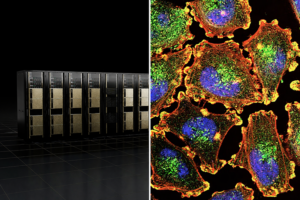
At the J.P. Morgan Healthcare Conference, NVIDIA and Eli Lilly announced a Bay Area co-innovation AI lab, with the two companies planning to invest up to $1 billion over five years in talent, infrastructure and compute to support the effort. Left, GPU supercomputing system (NVIDIA DGX SuperPOD). Right, metastatic melanoma cells, National Cancer Institute.
At the J.P. Morgan Healthcare Conference, NVIDIA and Eli Lilly announced a co-innovation AI lab in South San Francisco, with the two companies planning to invest up to $1 billion over five years in talent, infrastructure and compute to support the effort. Separately, Lilly is building what it calls pharma’s most powerful AI supercomputer, announced in October 2025. The company is also planning a push toward automated “agentic” labs.
Lilly’s computing infrastructure for research was at something of a formative stage when he joined in 2024, Chief AI Officer Thomas Fuchs told R&D World. “I think we had about eight GPUs for research, then 100, and now with the supercomputer we finally have something where we can start building models at the scale we want and need.”
That supercomputer, the first NVIDIA DGX SuperPOD with DGX B300 systems, is built with 1,016 NVIDIA Blackwell Ultra GPUs and delivers over 9,000 petaflops of AI performance. For the sake of comparison, Lilly’s build is enormous by pharma standards, but smaller than the biggest AI training clusters.
Fuchs juxtaposes the investment against the backdrop of enormous investments in AI in recent years. “Compared to the number of data centers being built, even though we have the biggest supercomputer in pharma, it’s still quite modest,” he told R&D World. But he sees investment in compute infrastructure dedicated to healthcare as lagging relative to other key areas. “Most compute is used for things that don’t improve the human condition, like optimizing social media,” he said.
He argues the real question is not the scale of computing within pharma currently, but how much of the world’s compute gets pointed at health. “Imagine just 10% of all compute would be actually used for human health to build better medicines or improve healthcare, right? We would be in a totally different place.”
The co-innovation lab

Thomas Fuchs, Ph.D.
Lilly’s supercomputer, announced in October, is aimed at that ambition. But the JP Morgan announcement centered on something harder to replicate: a physical co-innovation lab in South San Francisco where Lilly scientists will work shoulder-to-shoulder with NVIDIA engineers.
The lab will be just a few dozen miles from NVIDIA’s Santa Clara headquarters, opening up more possibilities for in-person collaboration between the two firms. “There’s nothing more powerful than sitting together and solving problems truly together,” Fuchs said. “What NVIDIA brings are model builders who are used to building very large foundational frontier models. What we bring is deep expertise in AI for discovery.”
The lab, expected to open in early 2026, is designed to make the collaboration continuous rather than episodic: The lab will involve a “continuous learning system” that tightly connects computational dry labs with agentic wet labs, enabling around-the-clock AI-assisted experimentation.
Toward the tokenization of biology at scale
Fuchs said one limiting factor in drug-discovery AI is still data. Despite huge datasets ranging from genomics to perturbational cell profiling, biomedicine is in a different position than language AI, where teams can train on web-scale corpora built on a shared, standardized substrate: human language. Unlike language models that can train on the entire internet, drug discovery has no equivalent corpus. “One reason why language is easier is that besides it’s structured, it’s discrete. We have the whole internet to train on,” he said.
Though massive biological datasets are available, it is also fundamentally more complex and difficult to learn causal, mechanistic rules from them. “The reason we can capture language so nicely is that it’s produced by our brain,” Fuchs said in a separate interview with NYSE’s Ice House podcast. “It’s 100,000 years old. It’s structured. It’s discrete. But then if you go to robotics and digit manipulation, that’s already millions of years of evolution, much more difficult. And then if you go down to a single cell, you have machinery after billions of years of evolution that are so complex that our human language even fails to describe them.”
That gap helps explain why language models can be genuinely useful in pharma, but fall short of being an end-to-end solution for the sector. “You need dedicated models,” Fuchs said of pharma. In practice that means purpose-built systems for hit finding and hit-to-lead, small-molecule and large-molecule design, target identification and validation, ADMET and toxicity prediction, and trial planning and analysis, plus newer efforts like virtual cell models and organoid-based approaches.
To unlock more progress, pharma needs to build what he called “data factories,” high-throughput labs producing in vitro results at scale. “That artisanal approach has to be replaced by something much more industrialized. It’s really the tokenization of biology at scale.”
The sheer scale of the search space compounds the data challenge. “There are more potential drug-like small molecules than there are particles in the known universe,” Fuchs noted. It is a search space so vast that no amount of compute alone can explore it. That’s where trained models become essential: not to exhaustively search, but to make intelligent predictions about which molecular structures are worth pursuing.
What AI can and can’t accelerate
Biology sets the tempo for much of drug development. “You cannot accelerate a cancer trial or a neuro trial,” Fuchs told R&D World. “Because there the bottleneck is biology.”
But what excites him is AI’s capacity to generate genuinely novel chemistry. “What’s much more exciting is that you can actually come up with new things,” he said. He cited cases where “the AI came up with a new motif, a new fragment, part of that molecule that improved the properties.”
Fuchs compared AI-generated molecules to the surprising plays that emerged from DeepMind’s game systems. In Go, AlphaGo’s Move 37 in Game 2 of its 2016 match against Lee Sedol was so unconventional that commentators initially read it as a mistake, and AlphaGo later estimated a human pro would choose it about one time in ten thousand. Fuchs argued the broader pattern carries over: systems can surface structures that experienced practitioners do not expect.
“These creative moments give us confidence that AI can be used as a positive multiplier for human ingenuity,” DeepMind researchers wrote at the time. Fuchs sees the same potential in drug discovery: AI surfacing molecular configurations that decades of medicinal chemistry intuition might never have considered.
Learning from failure
Fuchs offered a grounding note on what the work actually looks like in practice. “Machine learning is the art of failing,” he said. In other words, running numerous experiments, most of which don’t work, to find the few that do.
Learning from failure is intrinsic to how machine learning works, and many modeling attempts do not yield a useful model. Still, such failure can be valuable by clarifying what the data and problem can support. “You try to model something, you fail. You try to model something, you fail,” Fuchs said. “And you do that over and over and over again. And very often, after months of work, you have a better understanding of the problem.”