Research & Development World

  • R&D World Home
  • Topics
    • Aerospace
    • Automotive
    • Biotech
    • Careers
    • Chemistry
    • Environment
    • Energy
    • Life Science
    • Material Science
    • R&D Management
    • Physics
  • Technology
    • 3D Printing
    • A.I./Robotics
    • Software
    • Battery Technology
    • Controlled Environments
      • Cleanrooms
      • Graphene
      • Lasers
      • Regulations/Standards
      • Sensors
    • Imaging
    • Nanotechnology
    • Scientific Computing
      • Big Data
      • HPC/Supercomputing
      • Informatics
      • Security
    • Semiconductors
  • R&D Market Pulse
  • R&D 100
    • 2025 R&D 100 Award Winners
    • 2025 Professional Award Winners
    • 2025 Special Recognition Winners
    • R&D 100 Awards Event
    • R&D 100 Submissions
    • Winner Archive
  • Resources
    • Research Reports
    • Digital Issues
    • Educational Assets
    • R&D Index
    • Subscribe
    • Video
    • Webinars
    • Content submission guidelines for R&D World
  • Global Funding Forecast
  • Top Labs
  • Advertise
  • SUBSCRIBE

Magnetic Stem Cells for Gene Engineering

By Tomsk Polytechnic University | January 4, 2017

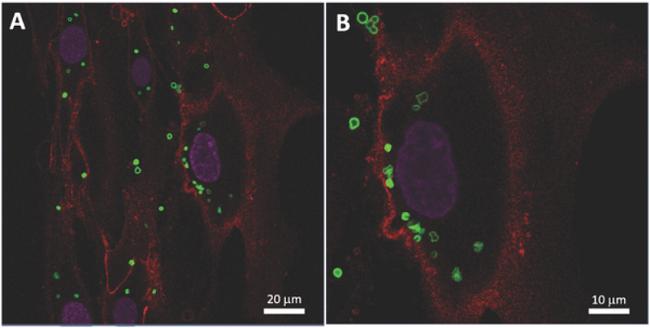
These are CLSM images of successful internalization of magnetic microcapsules by MSCs. Source: Tomsk Polytechnic University

Scientists from the Tomsk Polytechnic University’s Laboratory of Novel Dosage are developing a technology to control mesenchymal stem cells of patients. The technology will allow treating cancer more effective. To fight cancer cells the scientists suggest using the patient’s own magnet controlled cells. Native body cells won’t be rejected by its immune system and can deliver medication directly into the center of the disease.

The development of magnetic cells is jointly carried out by Tomsk Polytechnic University (TPU) and colleagues from Pavlov State Medical University of St. Petersburg and Queen Mary University of London.

The novel technology implies that mesenchymal stem cells (MSCs) of the patient’s body with the size of about 10 microns are internationalized with magnetic controlled microcapsules with drug inside. External trigging (magnet) targets cells to tumor; make microcontainers open and release encapsulated compound. Thus, drug is precisely delivered affecting cancer cells and without causing harm to health.

“Mesenchymal stem cells are inherently able to migrate toward tumors. They also can differentiate under control into mesodermal cell types of bone, fat, cartilage, muscle or connective tissue in vivo and in vitro. Therefore, MSCs are very attractive for researchers and practical physicians to apply them in substitute therapy, gene or cell engineering,” says one of the development’s co-authors Alexander Timin, JRF at the Novel Dosage Laboratory, RASA Center at TPU.

For the first time, the scientists have demonstrated the efficiency of internationalization of magnetic microcapsules by MSCs to functionalize cells and to design magnetic controlled cells and tissue engineering systems.

“It is interesting to note MSCs exhibit a high capability to internationalize (capture) microcapsules without significant toxicity compared to other cell lines described in the literature. As a result of magnetic capsules internalization by MSCs we create a new cell engineering platform which is responsive to external magnetic field to control cell migration. This way magnetization of MSCs enables magnetic sorting of cells and form a cell spheroid out of tens of thousands of MSCs. Also, the obtained results can be further used to create a next generation cell-modified platform for efficient targeted delivery ex vivo,” the authors note.


Related Articles Read More >

Who’s building in pharma, and who would be spared from 100% tariffs, if enacted
2025 R&D layoffs tracker: hardware and chips lead the year’s biggest cuts while biopharma pares pipelines
Skin’s built-in “stretch sensor” helps tissue grow in mouse study
Meissner launches rotary impeller mixing solutions (RMS) portfolio for biocontainer mixing
rd newsletter
EXPAND YOUR KNOWLEDGE AND STAY CONNECTED
Get the latest info on technologies, trends, and strategies in Research & Development.
RD 25 Power Index

R&D World Digital Issues

Fall 2025 issue

Browse the most current issue of R&D World and back issues in an easy to use high quality format. Clip, share and download with the leading R&D magazine today.

R&D 100 Awards
Research & Development World
  • Subscribe to R&D World Magazine
  • Sign up for R&D World’s newsletter
  • Contact Us
  • About Us
  • Drug Discovery & Development
  • Pharmaceutical Processing
  • Global Funding Forecast

Copyright © 2025 WTWH Media LLC. All Rights Reserved. The material on this site may not be reproduced, distributed, transmitted, cached or otherwise used, except with the prior written permission of WTWH Media
Privacy Policy | Advertising | About Us

Search R&D World

  • R&D World Home
  • Topics
    • Aerospace
    • Automotive
    • Biotech
    • Careers
    • Chemistry
    • Environment
    • Energy
    • Life Science
    • Material Science
    • R&D Management
    • Physics
  • Technology
    • 3D Printing
    • A.I./Robotics
    • Software
    • Battery Technology
    • Controlled Environments
      • Cleanrooms
      • Graphene
      • Lasers
      • Regulations/Standards
      • Sensors
    • Imaging
    • Nanotechnology
    • Scientific Computing
      • Big Data
      • HPC/Supercomputing
      • Informatics
      • Security
    • Semiconductors
  • R&D Market Pulse
  • R&D 100
    • 2025 R&D 100 Award Winners
    • 2025 Professional Award Winners
    • 2025 Special Recognition Winners
    • R&D 100 Awards Event
    • R&D 100 Submissions
    • Winner Archive
  • Resources
    • Research Reports
    • Digital Issues
    • Educational Assets
    • R&D Index
    • Subscribe
    • Video
    • Webinars
    • Content submission guidelines for R&D World
  • Global Funding Forecast
  • Top Labs
  • Advertise
  • SUBSCRIBE