Research & Development World

  • R&D World Home
  • Topics
    • Aerospace
    • Automotive
    • Biotech
    • Careers
    • Chemistry
    • Environment
    • Energy
    • Life Science
    • Material Science
    • R&D Management
    • Physics
  • Technology
    • 3D Printing
    • A.I./Robotics
    • Software
    • Battery Technology
    • Controlled Environments
      • Cleanrooms
      • Graphene
      • Lasers
      • Regulations/Standards
      • Sensors
    • Imaging
    • Nanotechnology
    • Scientific Computing
      • Big Data
      • HPC/Supercomputing
      • Informatics
      • Security
    • Semiconductors
  • R&D Market Pulse
  • R&D 100
    • 2025 R&D 100 Award Winners
    • 2025 Professional Award Winners
    • 2025 Special Recognition Winners
    • R&D 100 Awards Event
    • R&D 100 Submissions
    • Winner Archive
  • Resources
    • Research Reports
    • Digital Issues
    • Educational Assets
    • Subscribe
    • Video
    • Webinars
    • PharmSci360
    • Content submission guidelines for R&D World
  • Global Funding Forecast
  • Top Labs
  • Advertise
  • SUBSCRIBE

Membrane-Busting Compound Fights MRSA

By American Chemical Society | March 20, 2017

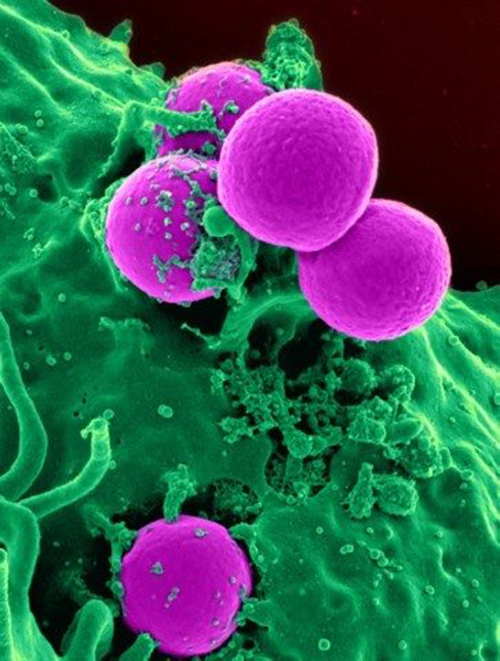
A class of compounds called LANA safely treated MRSA (purple) skin infections in mice. Image: National Institute of Allergy and Infectious Diseases, National Institutes of Health

Public health officials are increasingly concerned over methicillin-resistant Staphylococcus aureus (MRSA). The bacteria have developed resistance to a number of treatments, even antibiotics of last resort in some cases. Now researchers report in ACS’ journal Bioconjugate Chemistry that a new class of compounds can treat MRSA skin infections in mice with no signs of acute toxicity, and no signs that the bacteria would develop resistance to them after many applications.

According to the U.S. Centers for Disease Control and Prevention, every year at least 2 million people in America become infected by bacteria resistant to antibiotics, and 23,000 people die from such infections. Researchers have been working to combat this major public health threat for years. One of the latest fronts in this fight involves antimicrobial peptides and lipopeptides, which can destroy bacterial membranes. But translating these molecules into clinical products has been difficult. More recently, researchers have developed a new class of membrane-busting compounds called lysine-conjugated aliphatic norspermidine analogues (LANAs) that have been effective at killing certain bacteria and the Ebola virus in lab tests. Mohini Mohan Konai and Jayanta Haldar wanted to see if these compounds could also work against MRSA.

The researchers found that LANAs were effective against four MRSA strains in lab experiments. Testing on mice showed that the compounds could eliminate MRSA skin infections, which form notoriously difficult-to-treat biofilms. Even after 20 passages, the MRSA bacteria failed to develop resistance to the compounds. The results suggest that LANAs could be strong contenders for treating MRSA skin infections, the researchers say.

The authors cite funding from the Jawaharlal Nehru Centre for Advanced Scientific Research. They also acknowledge the Council of Scientific and Industrial Research (India) for support via a senior research fellowship.

Source: American Chemical Society
Related Articles Read More >

As AI floods drug discovery with designs, Twist uses DNA chips to tackle the wet-lab bottleneck
Interphex 2026 awards honor technologies focused on flexibility, automated workflows and ease of use
What every regulated lab should plan before building a cleanroom
6 essentials for seismic rated cleanrooms
rd newsletter
EXPAND YOUR KNOWLEDGE AND STAY CONNECTED
Get the latest info on technologies, trends, and strategies in Research & Development.

R&D World Digital Issues

Fall 2025 issue

Browse the most current issue of R&D World and back issues in an easy to use high quality format. Clip, share and download with the leading R&D magazine today.

R&D 100 Awards
Research & Development World
  • Subscribe to R&D World Magazine
  • Sign up for R&D World’s newsletter
  • Contact Us
  • About Us
  • Drug Discovery & Development
  • Pharmaceutical Processing
  • Global Funding Forecast

Copyright © 2026 Arrowfly LLC. All Rights Reserved. The material on this site may not be reproduced, distributed, transmitted, cached or otherwise used, except with the prior written permission of Arrowfly
Privacy Policy | Advertising | About Us

Search R&D World

  • R&D World Home
  • Topics
    • Aerospace
    • Automotive
    • Biotech
    • Careers
    • Chemistry
    • Environment
    • Energy
    • Life Science
    • Material Science
    • R&D Management
    • Physics
  • Technology
    • 3D Printing
    • A.I./Robotics
    • Software
    • Battery Technology
    • Controlled Environments
      • Cleanrooms
      • Graphene
      • Lasers
      • Regulations/Standards
      • Sensors
    • Imaging
    • Nanotechnology
    • Scientific Computing
      • Big Data
      • HPC/Supercomputing
      • Informatics
      • Security
    • Semiconductors
  • R&D Market Pulse
  • R&D 100
    • 2025 R&D 100 Award Winners
    • 2025 Professional Award Winners
    • 2025 Special Recognition Winners
    • R&D 100 Awards Event
    • R&D 100 Submissions
    • Winner Archive
  • Resources
    • Research Reports
    • Digital Issues
    • Educational Assets
    • Subscribe
    • Video
    • Webinars
    • PharmSci360
    • Content submission guidelines for R&D World
  • Global Funding Forecast
  • Top Labs
  • Advertise
  • SUBSCRIBE