Research & Development World

  • R&D World Home
  • Topics
    • Aerospace
    • Automotive
    • Biotech
    • Careers
    • Chemistry
    • Environment
    • Energy
    • Life Science
    • Material Science
    • R&D Management
    • Physics
  • Technology
    • 3D Printing
    • A.I./Robotics
    • Software
    • Battery Technology
    • Controlled Environments
      • Cleanrooms
      • Graphene
      • Lasers
      • Regulations/Standards
      • Sensors
    • Imaging
    • Nanotechnology
    • Scientific Computing
      • Big Data
      • HPC/Supercomputing
      • Informatics
      • Security
    • Semiconductors
  • R&D Market Pulse
  • R&D 100
    • 2025 R&D 100 Award Winners
    • 2025 Professional Award Winners
    • 2025 Special Recognition Winners
    • R&D 100 Awards Event
    • R&D 100 Submissions
    • Winner Archive
  • Resources
    • Research Reports
    • Digital Issues
    • Educational Assets
    • Subscribe
    • Video
    • Webinars
    • Content submission guidelines for R&D World
  • Global Funding Forecast
  • Top Labs
  • Advertise
  • SUBSCRIBE

Mini Magnetic Sensors Could Operate Without Power Supply

By University of Hamburg | March 11, 2019

Schematic iillustration of the experimental setup: The tip of the scanning tunneling microscope is heated by a laser beam, resulting in a voltage that is used to read information from magnetic atoms. Image: Informationsdienst Wissenschaft

Scientists of the Department of Physics at the University of Hamburg, Germany, detected the magnetic states of atoms on a surface using only heat. The respective study is published in a recent volume of Science.

A magnetic needle heated by a laser beam was placed in close proximity to a magnetic surface with a gap of only a few atoms width. The temperature difference between the needle and the surface generates an electric voltage.

Scanning the needle across the surface, the scientists showed that this thermovoltage depends on the magnetic orientation of the individual atom below the needle.

“With this concept, we determined the surface magnetism with atomic accuracy without directly contacting or strongly interacting with the surface,” says Cody Friesen, the main author of the study.

Conventional techniques require an electric current for this, which causes undesirable heating effects. In contrast, the new approach does not depend on a current.

In the future, miniaturized magnetic sensors in integrated circuits may operate without a power supply and without generating waste heat. Instead, heat generated inside a device is directed toward the sensor, which thermally senses the magnetic orientation of an atom and translates it into digital information.

“Our investigations show that the process heat generated in integrated circuits can be used for very energy-efficient computing,” says Dr. Stefan Krause, who supervised the project within the research group of Professor Roland Wiesendanger.

Today, the ever increasing amount of data generation and the enhancement of processing speeds demand a constant miniaturization of devices, which leads to higher current densities and strong heat generation inside the devices.

The new technique from Hamburg could make information technology more energy efficient and thus environmentally friendly. Apart from ecological aspects, it would have meaningful implications for everyday life: For instance, smartphones would need less frequent recharging because of their reduced power consumption.
Related Articles Read More >

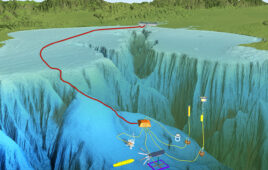
MBARI's Monterey Accelerated Research System (MARS) connects seafloor instruments to shore through a roughly 51-kilometer power and fiber-optic cable (red line) ending at a node about 891 meters down. The Geo-Sense system described in the new paper takes the opposite approach: a portable, battery-powered cable that records locally with no link to shore. Researchers used MARS's own fiber data to cross-check Geo-Sense's earthquake detections. Credit: MBARI
How lightweight AI startup Lightscline helped turn one to two years of seafloor data analysis into a two-month sprint
UC Riverside’s $5 fake drug detector uses toy robot sensors to catch counterfeit medications
R&D 100 winner flags even unknown fentanyl analogs
New nanopore sensor paves the way for fast, accurate, low-cost DNA sequencing
rd newsletter
EXPAND YOUR KNOWLEDGE AND STAY CONNECTED
Get the latest info on technologies, trends, and strategies in Research & Development.

R&D World Digital Issues

Fall 2025 issue

Browse the most current issue of R&D World and back issues in an easy to use high quality format. Clip, share and download with the leading R&D magazine today.

R&D 100 Awards
Research & Development World
  • Subscribe to R&D World Magazine
  • Sign up for R&D World’s newsletter
  • Contact Us
  • About Us
  • Drug Discovery & Development
  • Pharmaceutical Processing
  • Global Funding Forecast

Copyright © 2026 WTWH Media LLC. All Rights Reserved. The material on this site may not be reproduced, distributed, transmitted, cached or otherwise used, except with the prior written permission of WTWH Media
Privacy Policy | Advertising | About Us

Search R&D World

  • R&D World Home
  • Topics
    • Aerospace
    • Automotive
    • Biotech
    • Careers
    • Chemistry
    • Environment
    • Energy
    • Life Science
    • Material Science
    • R&D Management
    • Physics
  • Technology
    • 3D Printing
    • A.I./Robotics
    • Software
    • Battery Technology
    • Controlled Environments
      • Cleanrooms
      • Graphene
      • Lasers
      • Regulations/Standards
      • Sensors
    • Imaging
    • Nanotechnology
    • Scientific Computing
      • Big Data
      • HPC/Supercomputing
      • Informatics
      • Security
    • Semiconductors
  • R&D Market Pulse
  • R&D 100
    • 2025 R&D 100 Award Winners
    • 2025 Professional Award Winners
    • 2025 Special Recognition Winners
    • R&D 100 Awards Event
    • R&D 100 Submissions
    • Winner Archive
  • Resources
    • Research Reports
    • Digital Issues
    • Educational Assets
    • Subscribe
    • Video
    • Webinars
    • Content submission guidelines for R&D World
  • Global Funding Forecast
  • Top Labs
  • Advertise
  • SUBSCRIBE