As part of a national research collaboration, Spanish researchers including the ICN2 have made uniformly nanoporous graphene a practicable reality. A major milestone in graphene research, this brings us one step closer to unlocking this wonder material’s full potential not only in electronics, but also in filtration and sensing applications. Presented at a press conference at the Barcelona Institute of Science and Technology, the work is published in Science.
Researchers at the Catalan Institute of Nanoscience and Nanotechnology (ICN2), the CiQUS research centre at the University of Santiago de Compostela (USC) and the Donostia International Physics Center (DIPC) have successfully synthesized a graphene membrane with pores whose size, shape and density can be tuned with atomic precision at the nanoscale. Led by ICREA Professor Aitor Mugarza from the ICN2 and Professor Diego Peña from CiQUS, their work brings us one step closer to unlocking the potential of this much lauded material in electronics, and in filtration and sensing applications. Published this week in Science with ICN2 researcher Dr. César Moreno as first author, a press conference was held at the Barcelona Institute of Science and Technology (BIST), with additional presence of Professor Aran Garcia-Lekue representing the DIPC.
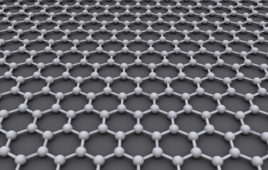
Engineering pores at the nanoscale in graphene can change the fundamental properties of this material. For a start it becomes permeable or sieve-like. This change alone, combined with graphene’s intrinsic strength and nano-slimness, points to its future use as the most resilient, energy-efficient and selective filter for extremely small substances, from greenhouse gases to salt, to biomolecules.
But a second, perhaps less intuitive change also takes place when the spacing between pores is similarly reduced to a few atoms. Doing so transforms the graphene from semimetal to semiconductor, opening the door for its use in electronic applications, where it could be used to replace the bulkier, more rigid silicon components used today.
However, while all of this is true in theory, producing such a material requires a precision that current fabrication methods have yet to achieve, and look unlikely to ever do so. The problem is the approach: punching holes in or otherwise manipulating a material that is just one atom thick is an incredibly fiddly task. In the work described here, the team takes a “bottom up” approach based on the principles of molecular self-assembly and 2D polymerization, effectively growing the graphene from scratch with the nanopores already built-in.
For this approach to work, you first need a very specific precursor molecule to use as the initial building blocks, designed such that they will behave as intended when subjected to different stimuli. In this work these precursors were designed and produced by synthetic chemistry specialists at CiQUS, before being taken to the ICN2 for the abovementioned “bottom-up” assembly of nanoporous graphene. Here they were submitted to several rounds of heating at high temperatures while placed on a gold surface, which serves to catalyze the reactions by which the molecules are first polymerized, to form long, lace-like “nanoribbons”, and then bonded laterally, to create the desired 2D “nanomesh” structure complete with evenly spaced, evenly sized pores.
Simulated at the DIPC and tested experimentally at the ICN2 in collaboration with ICREA Professor Sergio O. Valenzuela, the result is a new kind of graphene that exhibits electrical properties akin to those of silicon which can also act as a highly-selective molecular sieve. Applied in conjunction, these two properties are predicted to allow the development of combined filter and sensor devices which will not only sort for specific molecules, but will alternatively block or monitor their passage though the nanopores using an electric field. Such electrical readings would provide additional information as to precisely what concentrations of which molecule are passing through the pores and when, something which also points to possible applications in more efficient DNA sequencing.
Indeed, the real-world applications of such a tunable, uniformly nanoporous graphene membrane are manifold. They range from pollution monitoring and mitigation, to water desalinization, and even applications in biomedicine, where such a slim, flexible, biocompatible membrane could be used to support failing organs like the kidney, one of the body’s natural filters.
A patent for the resulting nanoporous graphene membrane has also been filed, with the researchers currently looking for opportunities to test their material in different applications.