Research & Development World

  • R&D World Home
  • Topics
    • Aerospace
    • Automotive
    • Biotech
    • Careers
    • Chemistry
    • Environment
    • Energy
    • Life Science
    • Material Science
    • R&D Management
    • Physics
  • Technology
    • 3D Printing
    • A.I./Robotics
    • Software
    • Battery Technology
    • Controlled Environments
      • Cleanrooms
      • Graphene
      • Lasers
      • Regulations/Standards
      • Sensors
    • Imaging
    • Nanotechnology
    • Scientific Computing
      • Big Data
      • HPC/Supercomputing
      • Informatics
      • Security
    • Semiconductors
  • R&D Market Pulse
  • R&D 100
    • 2025 R&D 100 Award Winners
    • 2025 Professional Award Winners
    • 2025 Special Recognition Winners
    • R&D 100 Awards Event
    • R&D 100 Submissions
    • Winner Archive
  • Resources
    • Research Reports
    • Digital Issues
    • Educational Assets
    • Subscribe
    • Video
    • Webinars
    • Content submission guidelines for R&D World
  • Global Funding Forecast
  • Top Labs
  • Advertise
  • SUBSCRIBE

New Maps Reveal Safe Locations for Wastewater Injections

By Stanford's School of Earth, Energy & Environmental Sciences | November 28, 2016

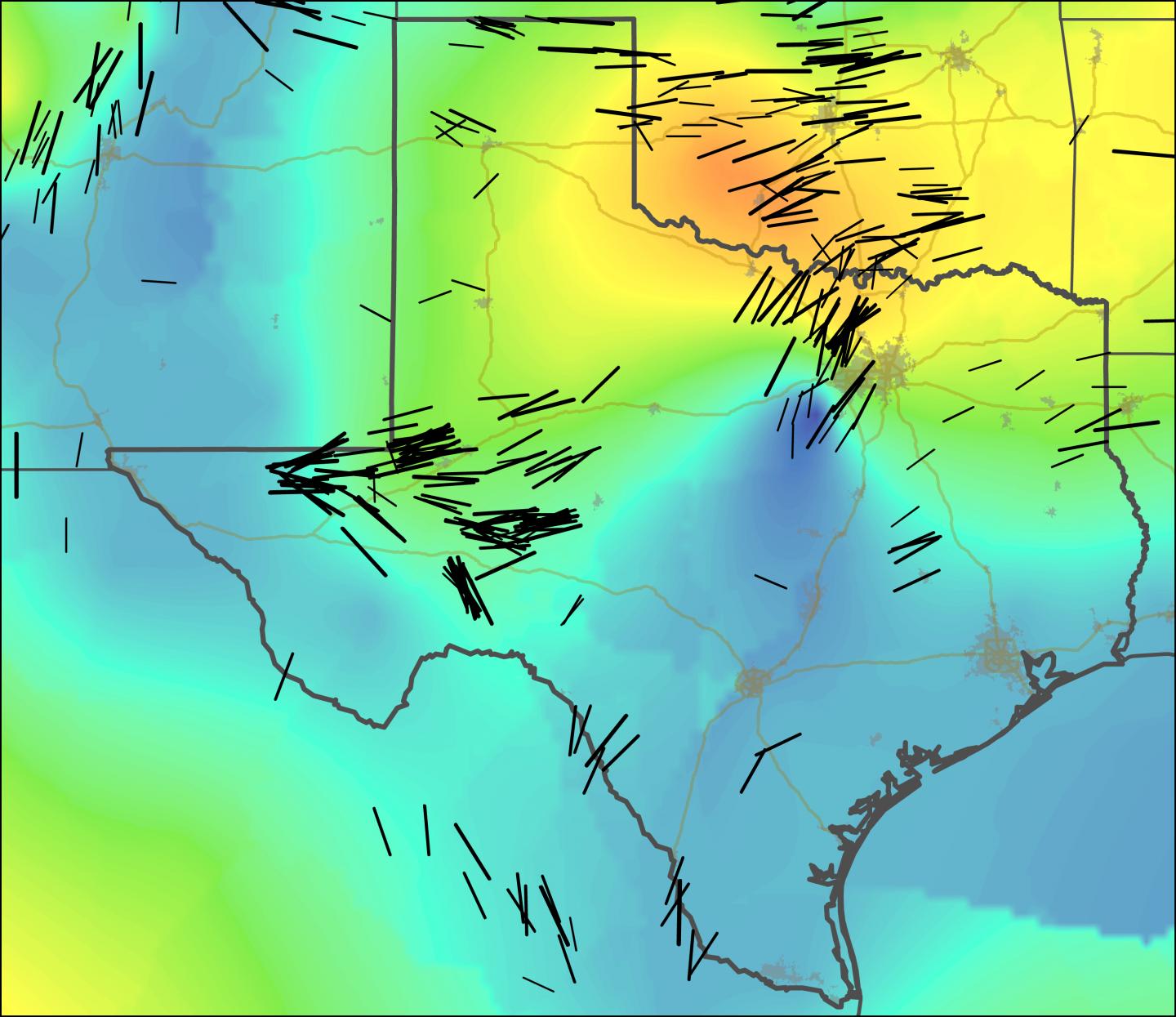
New stress maps of Texas and Oklahoma, with black lines indicating stress orientation. Blue-green colors indicate regions of extension in the crust, while yellow-orange areas are indicative of crustal compression. Source: Jens-Erik Lund Snee

Stanford geophysicists have compiled the most detailed maps yet of the geologic forces controlling the locations, types and magnitudes of earthquakes in Texas and Oklahoma.

These new “stress maps,” published in the journals Geophysical Research Letters and Bulletin of the Seismological Society of America, provide insight into the nature of the faults associated with recent temblors, many of which appear to have been triggered by the injection of wastewater deep underground.

“These maps help explain why injection-induced earthquakes have occurred in some areas, and provide a basis for making quantitative predictions about the potential for seismic activity resulting from fluid injection,” said study co-author Mark Zoback, the Benjamin M. Page Professor of Geophysics in Stanford’s School of Earth, Energy & Environmental Sciences.

To create these stress maps, Zoback and his graduate students Jens-Erik Lund Snee and Richard Alt interpreted data from different parts of Texas and Oklahoma donated by oil and gas companies. “Companies routinely collect data that can be used for assessing the state of stress in the Earth as part of their normal oil and gas operations,” Lund Snee said.

When combined with information about the faults present in a given area, the scientists were able to assess which faults are likely to be problematic and why. In the areas where induced earthquakes have occurred in Texas and Oklahoma, the Stanford scientists show that a relatively small increase of pore pressure – the pressure of fluids within the fractures and cavities of rocks – would have been sufficient to trigger slip.

In a related paper published recently in the journal Geology, graduate student F. Rall Walsh and Zoback present a methodology for assessing which faults are susceptible for earthquake triggering and which are not.

The Stanford scientists also found that many of the recent earthquakes in Texas that have been suspected as being triggered by wastewater injection occurred on faults that – according to the new map – have orientations that are nearly ideal for producing earthquakes. Hence, doing this kind of study in advance of planned injection activities could be very helpful.

“By identifying which faults are potentially active in advance, companies and regulators can avoid problematic faults during fluid injection and prevent the induced earthquakes from happening before they do,” Zoback said.
Related Articles Read More >

Who has access to Claude Mythos-tier models (and beyond) will redefine cybersecurity, including in R&D
Abstract of modern high tech internet data center room with rows of racks with network and server hardware. 3d rendering
A startup says it found hidden memory behavior in NVIDIA GPUs and is building a security layer around it
NTT Research launches Scale Academy with SaltGrain, a zero-trust data security suite
LabWare advances SaaS LIMS strategy at Pittcon 2026, one year after ASSURE launch
rd newsletter
EXPAND YOUR KNOWLEDGE AND STAY CONNECTED
Get the latest info on technologies, trends, and strategies in Research & Development.

R&D World Digital Issues

Fall 2025 issue

Browse the most current issue of R&D World and back issues in an easy to use high quality format. Clip, share and download with the leading R&D magazine today.

R&D 100 Awards
Research & Development World
  • Subscribe to R&D World Magazine
  • Sign up for R&D World’s newsletter
  • Contact Us
  • About Us
  • Drug Discovery & Development
  • Pharmaceutical Processing
  • Global Funding Forecast

Copyright © 2026 WTWH Media LLC. All Rights Reserved. The material on this site may not be reproduced, distributed, transmitted, cached or otherwise used, except with the prior written permission of WTWH Media
Privacy Policy | Advertising | About Us

Search R&D World

  • R&D World Home
  • Topics
    • Aerospace
    • Automotive
    • Biotech
    • Careers
    • Chemistry
    • Environment
    • Energy
    • Life Science
    • Material Science
    • R&D Management
    • Physics
  • Technology
    • 3D Printing
    • A.I./Robotics
    • Software
    • Battery Technology
    • Controlled Environments
      • Cleanrooms
      • Graphene
      • Lasers
      • Regulations/Standards
      • Sensors
    • Imaging
    • Nanotechnology
    • Scientific Computing
      • Big Data
      • HPC/Supercomputing
      • Informatics
      • Security
    • Semiconductors
  • R&D Market Pulse
  • R&D 100
    • 2025 R&D 100 Award Winners
    • 2025 Professional Award Winners
    • 2025 Special Recognition Winners
    • R&D 100 Awards Event
    • R&D 100 Submissions
    • Winner Archive
  • Resources
    • Research Reports
    • Digital Issues
    • Educational Assets
    • Subscribe
    • Video
    • Webinars
    • Content submission guidelines for R&D World
  • Global Funding Forecast
  • Top Labs
  • Advertise
  • SUBSCRIBE