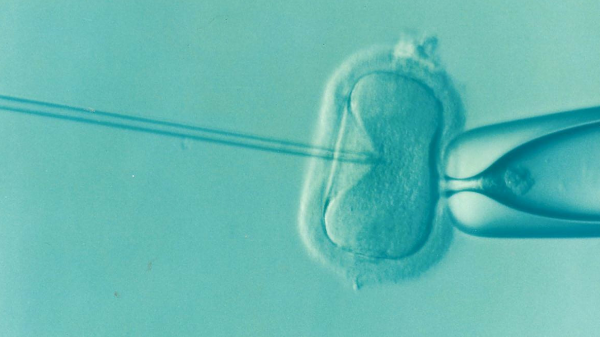
Researchers at the ARC Centre of Excellence for Nanoscale BioPhotonics (CNBP), led by the University of Adelaide, have successfully developed an advanced new imaging technique, which can help assess the quality of early-stage embryos.
The research, reported in the journal Human Reproduction has the potential to significantly benefit the IVF industry of the future, improving assisted reproduction outcomes for women.
“We use a special type of imaging to show differences in the metabolism and chemical make-up of embryos before they’ve been implanted,” says lead author Dr Mel Sutton-McDowall, from the University of Adelaide.
“This technique can give us an objective measure of which embryo to choose as part of the IVF process.”
This ‘hyperspectral imaging’ measures light that cells naturally produce during their normal activities. The light or ‘autoflorescence’ produced changes according to the chemical reactions or metabolism going on in the cell.
Being able to measure embryo metabolism is viewed by many researchers as one of the most important factors as to whether a particular IVF program will be successful.
However, says Dr Sutton-McDowall, fertility specialists take a largely subjective approach in deciding which embryos should be used.
“Pre-implantation screening of embryos generally takes place under a normal optical microscope. Although it’s quite easy to discern poor embryos (due to differences in uniformity), it is far harder for the clinician to determine objectively, the viability of the other embryos,” she says.
“The challenge is how to choose the single healthiest embryo out of this group to maximise the chances of pregnancy.”
Dr Sutton-McDowall sees the use of hyperspectral imaging as a new tool that can be combined with other diagnostic methods to provide a more accurate and objective embryo viability assessment.
“The benefit of hyperspectral imaging is that it can capture information-rich content of inspected objects. It analyses every pixel in an image for its light intensity at differing wavelengths,” she says
“This lets us drill down and analyse the hyperspectral signature of each individual embryo, looking for known or anomalous characteristics. It lets us discriminate between embryos, but also measuring metabolic differences within individual embryos. We predict that embryos that have cells with homogeneous (uniform) metabolic profiles are the healthier ones.”
To date, this imaging technology has only been tested on cattle embryos but Dr Sutton-McDowall notes that the technique is extremely promising.
“It offers benefits of being a non-invasive imaging approach that provides real-time information to the clinician,” she says.
The likely development of a specialised hyperspectral imaging tool for actual use in the IVF clinic is several years away but Sutton-McDowall believes that there is a strong surge of interest from IVF clinics to better predict embryo development outcomes through technology.
“I think we’ll see this innovative approach commercialised fairly quickly,” she says
“IVF is a costly and complex treatment. Any new method that can help improve the odds of women successfully having babies is of benefit to both clinicians and their patients.”
Not just limited to human IVF practice, Dr Sutton-McDowall also sees commercial opportunities for the hyperspectral technology across the farming, animal and livestock sectors as well.
“Many beef and dairy producers include advanced reproductive technology programs as a regular part of their farming practice,” she says
“Identifying and breeding from elite animals improves herd quality and maximises productivity. If we can enhance the IVF process and improve pregnancy outcomes, farmers will see better animals with healthier genetics and more desirable traits. I see a lot of potential for our imaging technology in this economically important area too.”
This research was funded by the ARC Centre of Excellence for Nanoscale BioPhotonics (CNBP) with researchers located at the University of Adelaide (Robinson Research Institute and Institute for Photonics and Advanced Sensing), Macquarie University and Quantitative Pty Ltd.