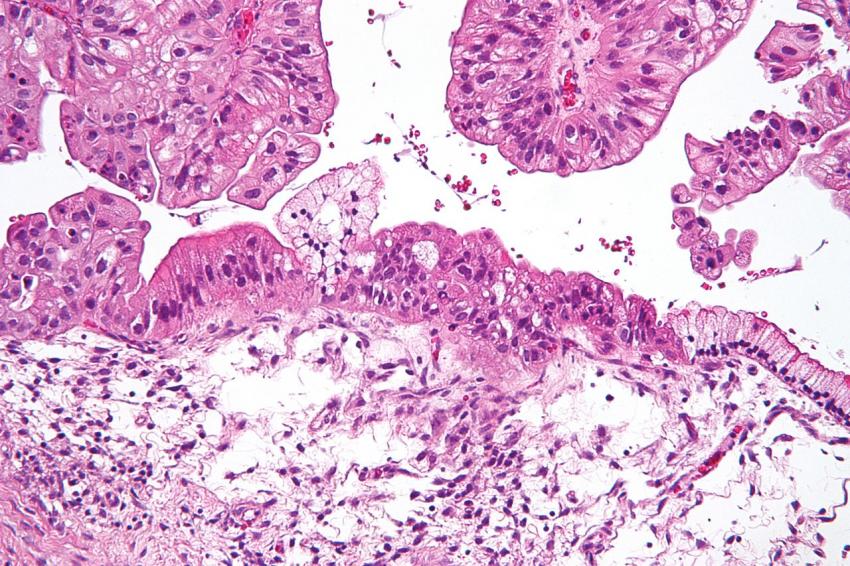
A potential new therapeutic strategy for a difficult-to-treat form of ovarian cancer has been discovered by Wistar scientists. The findings were published online in Nature Cell Biology.
Ovarian clear cell carcinoma accounts for approximately 5 to 10 percent of American ovarian cancer cases and about 20 percent of cases in Asia, ranking second as the cause of death from ovarian cancer. People with the clear cell subtype typically do not respond well to platinum-based chemotherapy, leaving limited therapeutic options for these patients.
Previous studies, including those conducted at The Wistar Institute, have revealed the role of ARID1A, a chromatin remodeling protein, in this ovarian cancer subtype. When functioning normally, ARID1A regulates expression of certain genes by altering the structure of chromatin – the complex of DNA and proteins in which DNA is packaged in our cells. This process dictates some of our cells’ behaviors and prevents them from becoming cancerous.
“Conventional chemotherapy treatments have proven an ineffective means of treating this group of ovarian cancer patients, meaning that alternative strategies based on a person’s genetic makeup must be explored,” said Rugang Zhang, Ph.D., professor and co-program leader in Wistar’s Gene Expression and Regulation Program and corresponding author of the study. “Therapeutic approaches based on the ARID1A mutation have the potential to revolutionize the way we treat these patients.”
Recent studies have shown that ARID1A is mutated in more than 50 percent of cases of ovarian clear cell carcinoma. Mutations of ARID1A and the tumor suppressor gene TP53 are mutually exclusive, meaning that patients with a mutation of ARID1A do not also carry a mutation of TP53. Despite this, the function of TP53, which protects the integrity of our genome and promotes programmed cell death, is clearly impaired as patients with the disease still have a poor prognosis.
In this study, Zhang and colleagues studied the connection between ARID1A and histone deacetylases (HDACs), a group of enzymes involved in key biological functions. They found that HDAC6 activity is essential in ARID1A-mutated ovarian cancers. They were able to show that HDAC6 is typically inhibited by ARID1A, whereas in the presence of mutated ARID1A, HDAC6 levels increase. Because HDAC6 suppresses the activity of TP53, therefore inhibiting its tumor suppressive functions, higher level of HDAC6 allow the tumor to grow and spread.
Using a small molecule drug called rocilinostat that selectively inhibits HDAC6, the Zhang lab found that by blocking the activity of the enzyme in ARID1A-mutated cancers, they were able to increase apoptosis, or programmed cell death, in only those tumor cells containing the ARID1A mutation. This correlated with a significant reduction in tumor growth, suppression of peritoneal dissemination and extension of survival of animal models carrying ARID1A-mutated ovarian tumors.
“We demonstrated that targeting HDAC6 activity using a selective inhibitor like rocilinostat represents a possible therapeutic strategy for treating ovarian clear cell carcinoma and other tumors impacted by mutated ARID1A,” said Shuai Wu, Ph.D., a postdoctoral fellow in the Zhang lab and co-first author of the study. “Inhibitors like the one we used in this study have been well-tolerated in clinical trials, so our findings may have far-reaching applications.”
This work was supported by the National Institutes of Health grants R01CA160331, R01CA163377, R01CA202919, K99CA194318, K99CA194309 and R01GM49758, the U.S. Department of Defense grants OC140632P1 and OC150446, an Ovarian Cancer Research Fund Alliance (OCRFA) program project grant, and The Jayne Koskinas-Ted Giovanis Breast Cancer Research Consortium at Wistar. Core support for The Wistar Institute was provided by the Cancer Center Support Grant (CCSG) CA010815.
Co-authors of this study from The Wistar Institute include Benjamin Bitler, Pyoung Hwa Park, Katherine Aird, Andrew Kossenkov, Ana Vara-Ailor, Frank J. Rauscher, III, David Speicher, and Jose Conejo-Garcia. Other co-authors include Yang Hai and David Christianson from the University of Pennsylvania, Yemin Wang and David Hunstsman from the University of British Columbia, and Yali Zhai, Weiping Zou, and Kathleen Cho from the University of Michigan Medical School.