Research & Development World

  • R&D World Home
  • Topics
    • Aerospace
    • Automotive
    • Biotech
    • Careers
    • Chemistry
    • Environment
    • Energy
    • Life Science
    • Material Science
    • R&D Management
    • Physics
  • Technology
    • 3D Printing
    • A.I./Robotics
    • Software
    • Battery Technology
    • Controlled Environments
      • Cleanrooms
      • Graphene
      • Lasers
      • Regulations/Standards
      • Sensors
    • Imaging
    • Nanotechnology
    • Scientific Computing
      • Big Data
      • HPC/Supercomputing
      • Informatics
      • Security
    • Semiconductors
  • R&D Market Pulse
  • R&D 100
    • 2026 R&D 100 Award Winners
    • 2026 Professional Award Winners
    • 2026 Special Recognition Winners
    • R&D 100 Awards Event
    • R&D 100 Submissions
    • Winner Archive
  • Resources
    • Research Reports
    • Digital Issues
    • Educational Assets
    • Subscribe
    • Video
    • Webinars
    • PharmSci360
    • Content submission guidelines for R&D World
  • Global Funding Forecast
  • Top Labs
  • Advertise
  • SUBSCRIBE

Microbes Survive Cleanrooms, Contaminate Spacecraft

By Cal Poly Pomona | June 5, 2018

Spacecraft assembly facilities harbor a low but persistent amount of biological contamination despite the use of cleanrooms.

Rakesh Mogul, a Cal Poly Pomona professor of biological chemistry, was the lead author of an article in the journal Astrobiology that offers the first biochemical evidence explaining the reason the contamination persists.

Chemistry professor Gregory A. Barding, Jr., was a collaborator and second author on the paper. The remaining 22 coauthors are all Cal Poly Pomona students — 14 undergraduates in chemistry, three chemistry graduate students, and five undergraduates in biological sciences.

“We designed the project to give students hands-on experience — and to support the learn-by-doing philosophy of Cal Poly Pomona. The students did the research, mostly as thesis projects in the areas of enzymology, molecular microbiology and analytical chemistry,” says Mogul.

In the cleanroom facilities, NASA implements a variety of planetary protection measures to minimize biological contamination of spacecraft. These steps are important because contamination by Earth-based microorganisms could compromise life-detection missions by providing false positive results.

Despite extensive cleaning procedures, however, molecular genetic analyses show that the cleanrooms harbor a diverse collection of microorganisms, or a spacecraft microbiome, that includes bacteria, archaea and fungi, explains Mogul. The Acinetobacter, a genus of bacteria, are among the dominant members of the spacecraft microbiome.
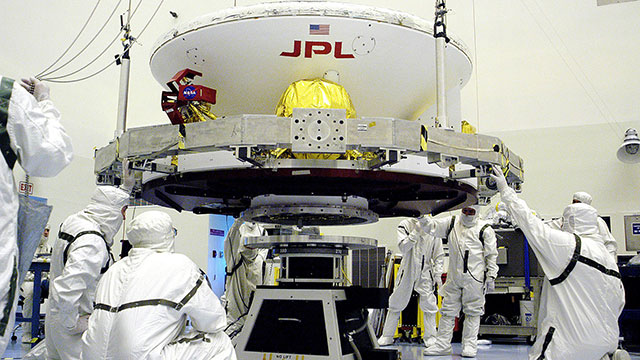
Engineers work on Opportunity (in its cruise configuration) in a cleanroom at Kennedy Space Center. A very important part of planetary protection is keeping contaminants from humans from riding aboard spacecraft. The pictured engineers are donning “bunny suits” that only allow their eyes to be exposed.

To figure out how the spacecraft microbiome survives in the cleanroom facilities, the research team analyzed several Acinetobacter strains that were originally isolated from the Mars Odyssey and Phoenix spacecraft facilities.

They found that under very nutrient-restricted conditions, most of the tested strains grew on and biodegraded the cleaning agents used during spacecraft assembly.  The work showed that cultures grew on ethyl alcohol as a sole carbon source while displaying reasonable tolerances towards oxidative stress. This is important since oxidative stress is associated with desiccating and high radiation environments similar to Mars.

The tested strains were also able to biodegrade isopropyl alcohol and Kleenol 30, two other cleaning agents commonly used, with these products potentially serving as energy sources for the microbiome.

“We’re giving the planetary protection community a baseline understanding of why these microorganisms remain in the cleanrooms,” says Mogul. “There’s always stuff coming into the cleanrooms, but one of the questions has been why do the microbes remain in the cleanrooms, and why is there a set of microorganisms that are common to the cleanrooms.”

For planetary protection, this indicates that more stringent cleaning steps may be needed for missions focused on life detection and highlights the potential need to use differing and rotating cleaning reagents that are compatible with the spacecraft to control the biological burden.

Source: Cal Poly Pomona
Related Articles Read More >

The UAE’s new space probe will crash into the asteroid it’s designed to study
Semiconductors, biomanufacturing and dual-use tech fill ISS National Lab’s startup cohort 
Eggshell-inspired shield cut projectile speed by 65% in simulation, but light-gas gun testing has not confirmed it 
The 100 most innovative companies of 2026: from NVIDIA and OpenAI to Eli Lilly and SpaceX
rd newsletter
EXPAND YOUR KNOWLEDGE AND STAY CONNECTED
Get the latest info on technologies, trends, and strategies in Research & Development.

R&D World Digital Issues

Fall 2025 issue

Browse the most current issue of R&D World and back issues in an easy to use high quality format. Clip, share and download with the leading R&D magazine today.

R&D 100 Awards
Research & Development World
  • Subscribe to R&D World Magazine
  • Sign up for R&D World’s newsletter
  • Contact Us
  • About Us
  • Drug Discovery & Development
  • Pharmaceutical Processing
  • Global Funding Forecast

Copyright © 2026 Arrowfly LLC. All Rights Reserved. The material on this site may not be reproduced, distributed, transmitted, cached or otherwise used, except with the prior written permission of Arrowfly
Privacy Policy | Advertising | About Us

Search R&D World

  • R&D World Home
  • Topics
    • Aerospace
    • Automotive
    • Biotech
    • Careers
    • Chemistry
    • Environment
    • Energy
    • Life Science
    • Material Science
    • R&D Management
    • Physics
  • Technology
    • 3D Printing
    • A.I./Robotics
    • Software
    • Battery Technology
    • Controlled Environments
      • Cleanrooms
      • Graphene
      • Lasers
      • Regulations/Standards
      • Sensors
    • Imaging
    • Nanotechnology
    • Scientific Computing
      • Big Data
      • HPC/Supercomputing
      • Informatics
      • Security
    • Semiconductors
  • R&D Market Pulse
  • R&D 100
    • 2026 R&D 100 Award Winners
    • 2026 Professional Award Winners
    • 2026 Special Recognition Winners
    • R&D 100 Awards Event
    • R&D 100 Submissions
    • Winner Archive
  • Resources
    • Research Reports
    • Digital Issues
    • Educational Assets
    • Subscribe
    • Video
    • Webinars
    • PharmSci360
    • Content submission guidelines for R&D World
  • Global Funding Forecast
  • Top Labs
  • Advertise
  • SUBSCRIBE