Research & Development World

  • R&D World Home
  • Topics
    • Aerospace
    • Automotive
    • Biotech
    • Careers
    • Chemistry
    • Environment
    • Energy
    • Life Science
    • Material Science
    • R&D Management
    • Physics
  • Technology
    • 3D Printing
    • A.I./Robotics
    • Software
    • Battery Technology
    • Controlled Environments
      • Cleanrooms
      • Graphene
      • Lasers
      • Regulations/Standards
      • Sensors
    • Imaging
    • Nanotechnology
    • Scientific Computing
      • Big Data
      • HPC/Supercomputing
      • Informatics
      • Security
    • Semiconductors
  • R&D Market Pulse
  • R&D 100
    • 2025 R&D 100 Award Winners
    • 2025 Professional Award Winners
    • 2025 Special Recognition Winners
    • R&D 100 Awards Event
    • R&D 100 Submissions
    • Winner Archive
  • Resources
    • Research Reports
    • Digital Issues
    • Educational Assets
    • Subscribe
    • Video
    • Webinars
    • PharmSci360
    • Content submission guidelines for R&D World
  • Global Funding Forecast
  • Top Labs
  • Advertise
  • SUBSCRIBE

Novel Nuclear Medicine Test Can Identify Kidney Transplant Infection

By Society of Nuclear Medicine and Molecular Imaging | November 9, 2017

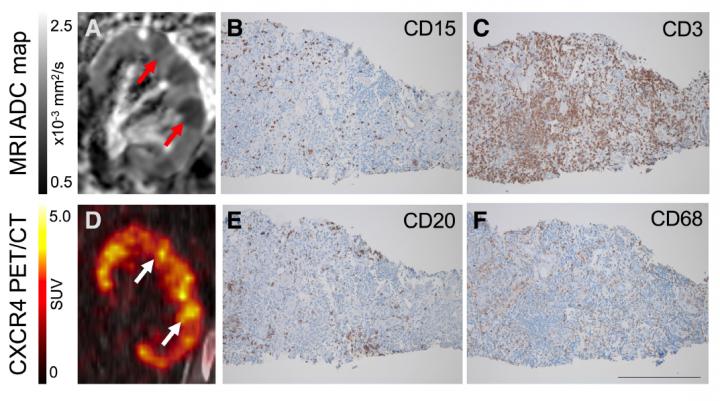
MRI showing focal restriction of diffusion (A, red arrows). Biopsy from a kidney allograft shows inflammatory cell infiltration typical for allograft infection (granulocytes (CD15, B), and T cells (CD3, C). Corresponding upregulated CXCR4 expression (D, white arrows). Additional markers of cell infiltration (B cells (CD20, E), and macrophages (CD68, F). Scale bar indicates 200 μm. Source: T Derlin et al., Hannover Medical School, Hannover, Germany

 German scientists have developed a novel nuclear medicine test that can determine whether a kidney transplant patient has developed infection in the transplanted tissue. The study, which utilizes positron emission tomography/magnetic resonance imaging (PET/MRI), is presented in the December issue of The Journal of Nuclear Medicine.

Complicated urinary tract infections (UTIs) occur frequently in patients after kidney transplantation due to suppression of the immune system and may lead to transplant failure or sepsis. Detecting the source and extent of infection–especially whether the transplanted kidney (allograft) is involved–without further invasive procedures can be challenging.

This study is the first application of highly-specific CXCR4-targeted PET using gallium-68 (68Ga)-Pentixafor for imaging infection. CXCR4 is a small receptor protein present on leukocytes (white blood cells) fighting infection, and CXCR4 orchestrates the recruitment of infiltrating leukocytes to the site of infection.

“Direct visualization of infiltrating leukocytes in renal allografts in the context of kidney infection has not been done before using PET,” explains Thorsten Derlin, MD, Department of Nuclear Medicine, Hannover Medical School, Hannover, Germany. “Other imaging methods have not been very useful in the past for diagnosing renal infection, and biopsy may have complications, including bleeding.”

For the study, 13 kidney transplant recipients with complicated UTIs underwent PET with the CXCR4-ligand 68Ga-Pentixafor and diffusion-weighted MRI. The combined PET/MRI detected acute infection in the transplanted kidneys of 9 patients and lower UTI/non-urological infections in the remaining 4 patients.

Combined CXCR4-targeted PET/MR imaging with 68Ga-Pentixafor, therefore, shows strong potential for noninvasive detection of leukocytes in kidney transplants. This novel methodology may also refine the characterization of infectious and inflammatory kidney diseases and may serve as a platform for future clinical studies targeting transplanted tissue (allograft) infection.

“This work establishes CXCR4-targeted PET as a novel approach for imaging of infection, and it strengthens the role of nuclear medicine for renal imaging,” Derlin states. “It demonstrates the potential of integrating state-of-the art imaging approaches–i.e., diffusion-weighted MRI and novel, highly specific PET tracers–for a comprehensive assessment of kidney disease and has the potential to be translated into other settings of difficult-to-diagnose infections, such as cholangitis in transplanted patients and bone infections.”

Related Articles Read More >

How a Duke-led HPC method brought cell-scale cancer simulation to a single cloud node 
As AI floods drug discovery with designs, Twist uses DNA chips to tackle the wet-lab bottleneck
Purple Glowing Spiral Fractal Background Image, Illustration - Vortex repeating spiral patterns, Symmetrical repeating geometric patterns. Abstract design, black background
Recursion says its Norstella-backed real-time simulation can expand trial eligibility by up to 40%
NIH employees warn of ‘institutionalized destruction’ one year after Bethesda Declaration
rd newsletter
EXPAND YOUR KNOWLEDGE AND STAY CONNECTED
Get the latest info on technologies, trends, and strategies in Research & Development.

R&D World Digital Issues

Fall 2025 issue

Browse the most current issue of R&D World and back issues in an easy to use high quality format. Clip, share and download with the leading R&D magazine today.

R&D 100 Awards
Research & Development World
  • Subscribe to R&D World Magazine
  • Sign up for R&D World’s newsletter
  • Contact Us
  • About Us
  • Drug Discovery & Development
  • Pharmaceutical Processing
  • Global Funding Forecast

Copyright © 2026 Arrowfly LLC. All Rights Reserved. The material on this site may not be reproduced, distributed, transmitted, cached or otherwise used, except with the prior written permission of Arrowfly
Privacy Policy | Advertising | About Us

Search R&D World

  • R&D World Home
  • Topics
    • Aerospace
    • Automotive
    • Biotech
    • Careers
    • Chemistry
    • Environment
    • Energy
    • Life Science
    • Material Science
    • R&D Management
    • Physics
  • Technology
    • 3D Printing
    • A.I./Robotics
    • Software
    • Battery Technology
    • Controlled Environments
      • Cleanrooms
      • Graphene
      • Lasers
      • Regulations/Standards
      • Sensors
    • Imaging
    • Nanotechnology
    • Scientific Computing
      • Big Data
      • HPC/Supercomputing
      • Informatics
      • Security
    • Semiconductors
  • R&D Market Pulse
  • R&D 100
    • 2025 R&D 100 Award Winners
    • 2025 Professional Award Winners
    • 2025 Special Recognition Winners
    • R&D 100 Awards Event
    • R&D 100 Submissions
    • Winner Archive
  • Resources
    • Research Reports
    • Digital Issues
    • Educational Assets
    • Subscribe
    • Video
    • Webinars
    • PharmSci360
    • Content submission guidelines for R&D World
  • Global Funding Forecast
  • Top Labs
  • Advertise
  • SUBSCRIBE