Research & Development World

  • R&D World Home
  • Topics
    • Aerospace
    • Automotive
    • Biotech
    • Careers
    • Chemistry
    • Environment
    • Energy
    • Life Science
    • Material Science
    • R&D Management
    • Physics
  • Technology
    • 3D Printing
    • A.I./Robotics
    • Software
    • Battery Technology
    • Controlled Environments
      • Cleanrooms
      • Graphene
      • Lasers
      • Regulations/Standards
      • Sensors
    • Imaging
    • Nanotechnology
    • Scientific Computing
      • Big Data
      • HPC/Supercomputing
      • Informatics
      • Security
    • Semiconductors
  • R&D Market Pulse
  • R&D 100
    • 2025 R&D 100 Award Winners
    • 2025 Professional Award Winners
    • 2025 Special Recognition Winners
    • R&D 100 Awards Event
    • R&D 100 Submissions
    • Winner Archive
  • Resources
    • Research Reports
    • Digital Issues
    • Educational Assets
    • R&D Index
    • Subscribe
    • Video
    • Webinars
    • Content submission guidelines for R&D World
  • Global Funding Forecast
  • Top Labs
  • Advertise
  • SUBSCRIBE

Novel Technology Aims to Improve Lithium Metal Battery Life, Safety

By Penn State | March 12, 2019

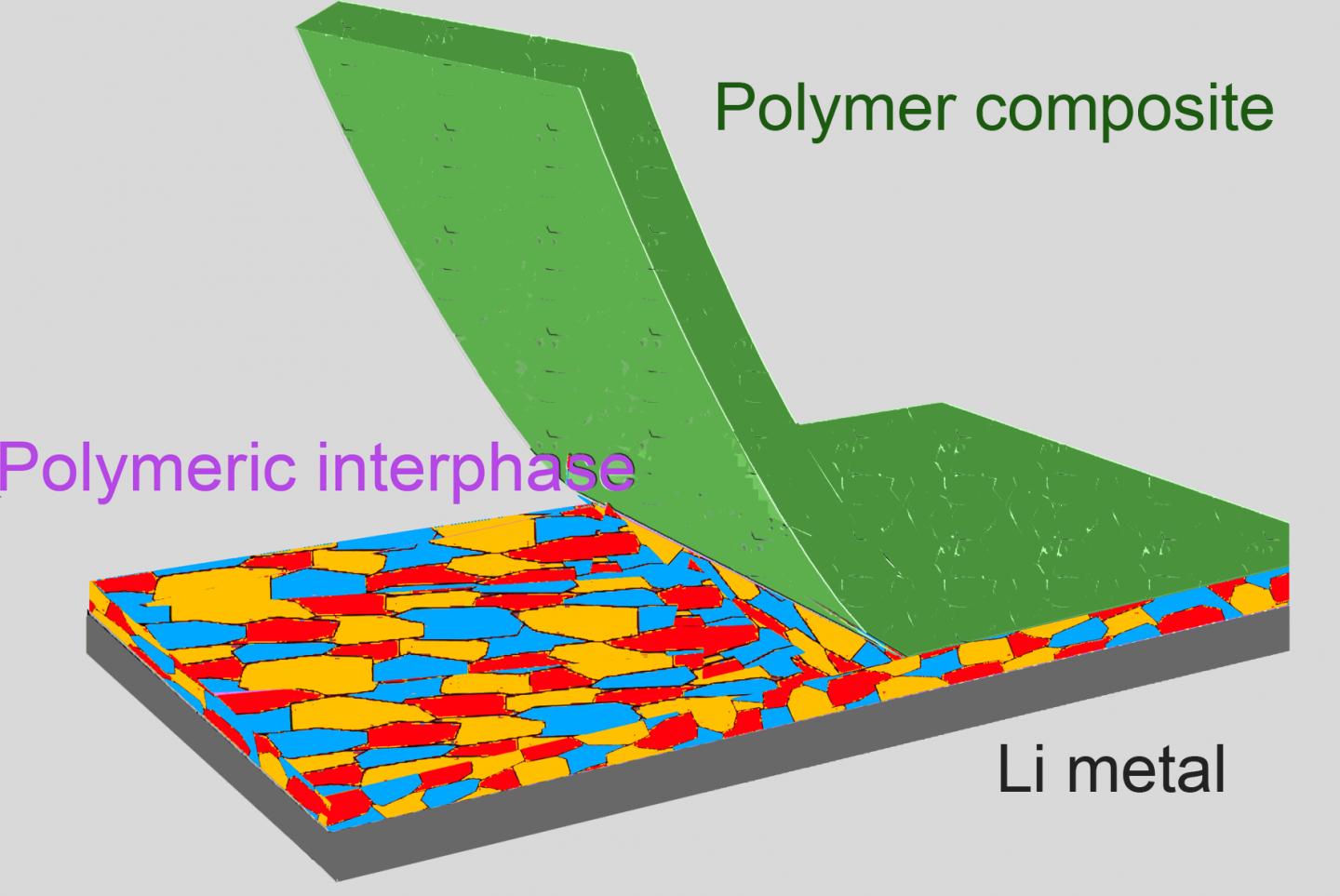
A reactive polymer composite, picturing the electrochemical interface between lithium metal anode and electrolyte is stabilized by the use of a reactive polymer composite, enabling high-performance rechargeable lithium metal batteries. Credit: Donghai Wang,Penn State

Rechargeable lithium metal batteries with increased energy density, performance, and safety may be possible with a newly-developed, solid-electrolyte interphase (SEI), according to Penn State researchers.

As the demand for higher-energy-density lithium metal batteries increases — for electric vehicles, smartphones, and drones — stability of the SEI has been a critical issue halting their advancement because a salt layer on the surface of the battery’s lithium electrode insulates it and conducts lithium ions.

“This layer is very important and is naturally formed by the reaction between the lithium and the electrolyte in the battery,” said Donghai Wang, professor of mechanical and chemical engineering. “But it doesn’t behave very well, which causes a lot of problems.”

One of the least-understood components of lithium metal batteries, the degradation of the SEI contributes to the development of dendrites, which are needle-like formations that grow from the lithium electrode of the battery and negatively affect performance and safety. The researchers published their approach to this problem today (Mar. 11) in Nature Materials.

“This is why lithium metal batteries don’t last longer — the interphase grows and it’s not stable,” Wang said. “In this project, we used a polymer composite to create a much better SEI.”

Led by chemistry doctoral student Yue Gao, the enhanced SEI is a reactive polymer composite consisting of polymeric lithium salt, lithium fluoride nanoparticles, and graphene oxide sheets. The novel construction of this battery component has thin layers of these materials, which is where Thomas E. Mallouk, Evan Pugh University Professor of Chemistry, lent his expertise.

“There is a lot of molecular-level control that is needed to achieve a stable lithium interface,” Mallouk said. “The polymer that Yue and Donghai designed reacts to make a claw-like bond to the lithium metal surface. It gives the lithium surface what it wants in a passive way so that it doesn’t react with the molecules in the electrolyte. The nanosheets in the composite act as a mechanical barrier to prevent dendrites from forming from the lithium metal.”

Using both chemistry and engineering design, the collaboration between fields enabled the technology to control the lithium surface at the atomic scale.

“When we engineer batteries, we don’t necessarily think like chemists, all the way down to the molecular level, but that’s what we needed to do here,” said Mallouk.

The reactive polymer also decreases the weight and manufacturing cost, further enhancing the future of lithium metal batteries.

“With a more stable SEI, it’s possible to double the energy density of current batteries, while making them last longer and be safer,” Wang said.
Related Articles Read More >

California microgrid pilots EV integration model for wildfire-prone regions
Solving the EV charger problem with streetlights
New scalable supercapacitors store more energy using graphene
Probiotics power a bioresorbable battery that can run from 4 to 100+ minutes
rd newsletter
EXPAND YOUR KNOWLEDGE AND STAY CONNECTED
Get the latest info on technologies, trends, and strategies in Research & Development.
RD 25 Power Index

R&D World Digital Issues

Fall 2025 issue

Browse the most current issue of R&D World and back issues in an easy to use high quality format. Clip, share and download with the leading R&D magazine today.

R&D 100 Awards
Research & Development World
  • Subscribe to R&D World Magazine
  • Sign up for R&D World’s newsletter
  • Contact Us
  • About Us
  • Drug Discovery & Development
  • Pharmaceutical Processing
  • Global Funding Forecast

Copyright © 2025 WTWH Media LLC. All Rights Reserved. The material on this site may not be reproduced, distributed, transmitted, cached or otherwise used, except with the prior written permission of WTWH Media
Privacy Policy | Advertising | About Us

Search R&D World

  • R&D World Home
  • Topics
    • Aerospace
    • Automotive
    • Biotech
    • Careers
    • Chemistry
    • Environment
    • Energy
    • Life Science
    • Material Science
    • R&D Management
    • Physics
  • Technology
    • 3D Printing
    • A.I./Robotics
    • Software
    • Battery Technology
    • Controlled Environments
      • Cleanrooms
      • Graphene
      • Lasers
      • Regulations/Standards
      • Sensors
    • Imaging
    • Nanotechnology
    • Scientific Computing
      • Big Data
      • HPC/Supercomputing
      • Informatics
      • Security
    • Semiconductors
  • R&D Market Pulse
  • R&D 100
    • 2025 R&D 100 Award Winners
    • 2025 Professional Award Winners
    • 2025 Special Recognition Winners
    • R&D 100 Awards Event
    • R&D 100 Submissions
    • Winner Archive
  • Resources
    • Research Reports
    • Digital Issues
    • Educational Assets
    • R&D Index
    • Subscribe
    • Video
    • Webinars
    • Content submission guidelines for R&D World
  • Global Funding Forecast
  • Top Labs
  • Advertise
  • SUBSCRIBE