 NVIDIA and Dassault Systèmes are building an industrial AI platform that combines NVIDIA’s AI infrastructure with Dassault’s virtual twin software. The partnership aims to speed materials discovery and drug development. The companies argue their “industry world models,” grounded in decades of engineering and scientific workflows rather than internet-scale text and video, can help predict real-world behavior earlier in R&D and beyond.
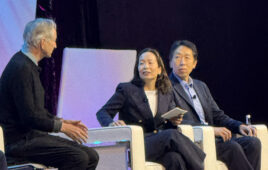
“When AI is grounded in science, physics and validated industrial knowledge, it becomes a force multiplier for human ingenuity,” said Pascal Daloz, CEO of Dassault Systèmes, announcing the partnership at 3DEXPERIENCE World in Houston on Feb. 3. NVIDIA founder and CEO Jensen Huang joined Daloz on stage, calling physical AI “the next frontier of artificial intelligence, grounded in the laws of the physical world.”
The companies say their approach differs from consumer-facing generative AI by grounding models in physics-based simulation and industrial engineering context, rather than relying mainly on observational data. “The world foundation models that are being trained are being trained on information about what we observe as consumers of the world outside,” said Rev Lebaredian, VP of Omniverse and Simulation Technology at NVIDIA, in a pre-brief call. “What’s missing is how the world is built.”
Materials science: 10,000x faster exploration
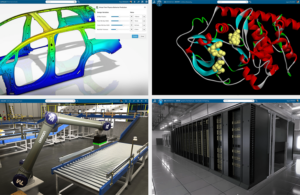
For materials research, Dassault Systèmes’ BIOVIA platform will combine with NVIDIA’s ALCHEMI generative AI services. The unification will enable atomistic and molecular simulations enhanced by machine learning. The companies claim scientists can explore the materials design space with “quantum-level accuracy” up to 10,000 times faster than traditional methods.
Bel Group, the French food company behind brands like Babybel and Laughing Cow, is an early adopter. “Through the NVIDIA-Dassault Systèmes collaboration, we gain the computational power to model and optimize our products at scale, accelerating innovation while delivering on our sustainability commitments,” said CEO Cécile Béliot in a statement. The company is using the virtual twin factory to improve nutritional profiles and sustainability of dairy formulations and packaging.
Industry world models go further. They embed the first principles of physics, engineering laws and system constraints. — Florence Hu-Aubigny, Dassault Systèmes
Life sciences: Earlier prediction of safety and efficacy and an aim of ‘no hallucination’
In drug discovery, BIOVIA will integrate with NVIDIA’s BioNeMo generative AI platform to create what Dassault calls a “virtual twin factory” supporting multiple therapeutic modalities. The combined solution aims to predict safety, efficacy, pharmacology and manufacturability earlier in development, potentially reducing costs and timelines.
“Our objective is clear: no hallucination, only industry proven, trustworthy, reproducible and explainable,” said Florence Hu-Aubigny, Executive VP of R&D at Dassault Systèmes. The company positions its “industry world models” as distinct from general-purpose AI by embedding physics, engineering laws, and four decades of accumulated industrial knowledge.
No pharmaceutical company was named as an early customer for the life sciences applications.
Engineering simulation for faster development cycles
The partnership also targets engineering design through SIMULIA’s integration with NVIDIA CUDA-X libraries and AI physics architectures. The goal: enable designers to predict real-world performance in near real-time without being simulation experts.
Lucid Motors is testing the approach for vehicle performance and safety applications. “Our exploration of multi-physics based Digital Twin simulation models, powered by NVIDIA’s open-source physics informed AI models, has the potential to help our teams move from concept to production faster than ever before, without sacrificing predictive accuracy,” said Vivek Attaluri, VP of Vehicle Engineering at Lucid.
For R&D organizations, this could help compress technology readiness level progression by allowing engineers to validate designs under real-world conditions earlier in the development process.
Virtual twins are more than a digital replica… a scientific, multidisciplinary, multiscale, virtual plus real representation, fully testable under any real condition before anything exists. — Florence Hu-Aubigny, Dassault Systèmes
Infrastructure: Digital twins for AI factories
In a recursive twist, NVIDIA is adopting Dassault Systèmes’ model-based systems engineering approach to design its own AI factories, starting with the NVIDIA Rubin platform. Dassault’s OUTSCALE cloud subsidiary will deploy NVIDIA AI infrastructure across three continents as part of the partnership.
“The complexity of building such AI factories is on par with aircraft or power plants,” Hu-Aubigny said. The virtual twin approach aims to validate commissioning, performance, and operations before physical implementation.
The partnership builds on a 25-year collaboration between the companies, starting with graphics optimization for CATIA and expanding through CUDA integration and RTX technologies. Dassault Systèmes says the integrated capabilities are already available to its customers.