
Optogenetics gives researchers a way to control selected nerve cells with light and study how brain circuits shape behavior. © The Nobel Committee for Physiology or Medicine. Ill. Mattias Karlén
German biophysicists Peter Hegemann and Georg Nagel and Stanford psychiatrist and bioengineer Karl Deisseroth won the 2026 Nobel Prize in Physiology or Medicine for their work in optogenetics, a technique to control neurons with light, the Nobel Assembly at Karolinska Institutet announced today.
Thomas Perlmann, the Nobel Assembly’s secretary-general, pointed to vision restoration as an excellent example of clinical promise but called optogenetics “primarily a tool for basic research.” Nagel told CNN he knows of only one patient who has benefited from it, and thought it was still too early for a medicine prize. But in September, the FDA accepted light activated optogenetic therapy specialst Nanoscope Therapeutics’ Biologics License Application (BLA) for Mogenry, its optogenetic gene therapy for retinitis pigmentosa, with a decision due in the first half of 2027. One of the three light-sensitive components in Mogenry is CatCh, an engineered version of channelrhodopsin-2 developed by Ernst Bamberg, Nagel’s longtime collaborator at the Max Planck Institute of Biophysics in Frankfurt, Germany. Nanoscope licensed CatCh from Max Planck Innovation in 2024.
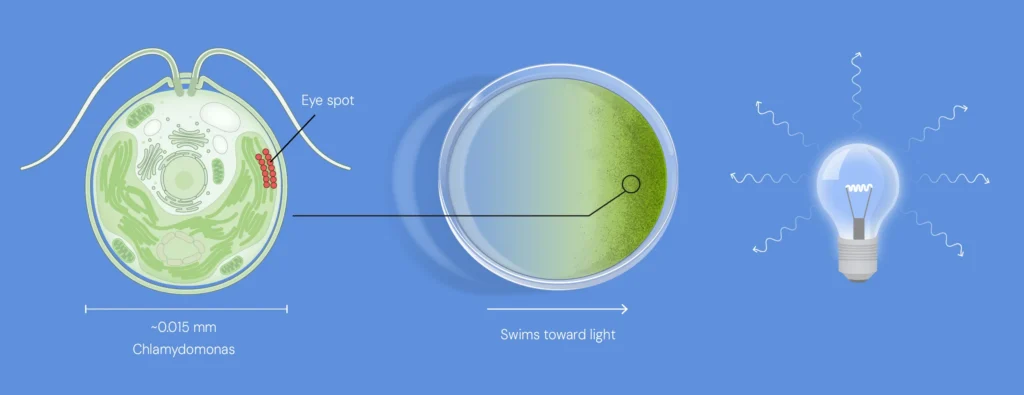
The single-celled alga Chlamydomonas swims toward light. Studies of its light-sensitive channelrhodopsins laid the groundwork for optogenetics. © The Nobel Committee for Physiology or Medicine. Ill. Mattias Karlén
In the early 2000s, Hegemann and Nagel discovered channelrhodopsin, a protein on the surface of a single-celled alga that lets it swim toward light. When blue light hits the protein, a channel opens and ions flow into the cell, creating an electrical impulse. The protein kept that ability when the researchers moved it into other cells, including frog eggs and mammalian cells.
In 2005, Deisseroth’s lab, working with Nagel and Bamberg, put channelrhodopsin into cultured rat neurons and showed that millisecond pulses of blue light made them fire on command. Deisseroth then developed ways to target the gene to specific cell types and deliver light deep into the brains of living animals through thin optical fibers. In 2007, working with Stanford colleagues, he showed that activating a small set of arousal neurons with light made sleeping mice wake up sooner.
The work turned optogenetics into a standard lab tool, and some researchers soon asked whether it could restore lost function in patients. Light reaches the retina without implanted fibers, and in retinitis pigmentosa the rods and cones die while the cells that carry their signals to the brain largely survive. In 2006, Zhuo-Hua Pan’s lab at Wayne State University showed that adding channelrhodopsin to those surviving cells restored visual responses in blind mice.
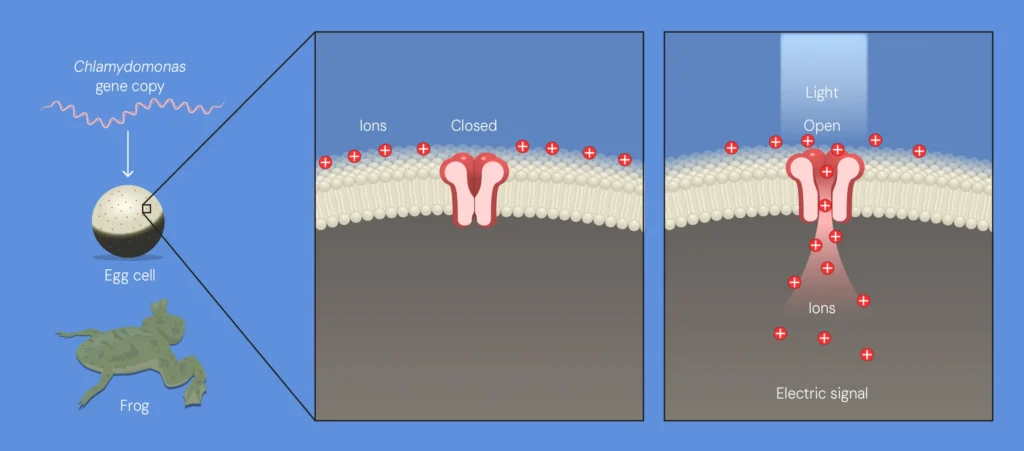
Researchers transferred a channelrhodopsin gene from Chlamydomonas into frog egg cells. Light opened the resulting channels, allowing positively charged ions to enter and generate an electrical signal. © The Nobel Committee for Physiology or Medicine. Ill. Mattias Karlén
Mogenry aims to restore vision by making surviving retinal cells sensitive to light after the rods and cones have died. A single injection into the eye delivers a gene for a synthetic light-sensitive protein, including the engineered channelrhodopsin, into the retina’s bipolar cells. Those cells can then respond directly to light and pass signals to the ganglion cells, whose fibers form the optic nerve.
According to Nanoscope, the protein responds across the visible spectrum at ordinary light levels, allowing patients to use the therapy without special goggles. The approach is also designed to work across the many genetic mutations that cause retinitis pigmentosa by acting on the surviving retinal circuitry.
Nanoscope’s application draws on RESTORE, a randomized, sham-controlled trial in adults with severe vision loss from retinitis pigmentosa, and REMAIN, its long-term follow-up study. In three-year follow-up results, treated patients maintained an average improvement equivalent to approximately three lines on a standard eye chart compared with their starting vision, according to the company.
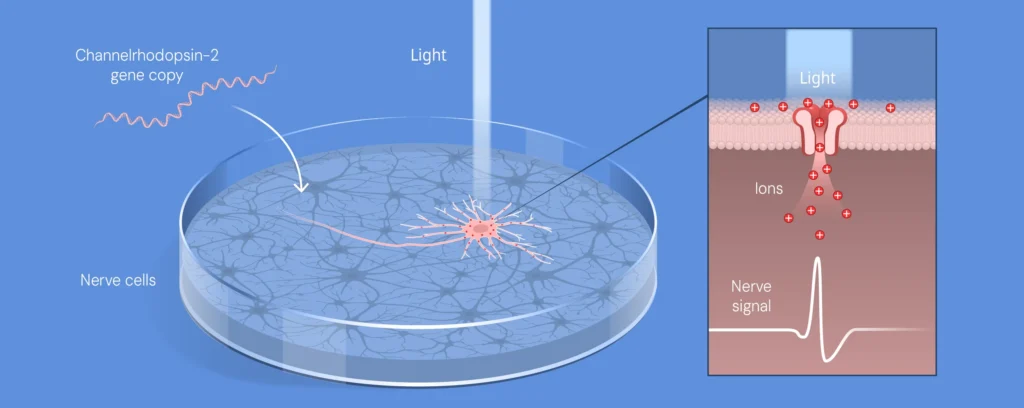
Adding the channelrhodopsin-2 gene to cultured neurons made them responsive to light. Illumination opened ion channels and triggered nerve signals. © The Nobel Committee for Physiology or Medicine. Ill. Mattias Karlén
Other developers are pursuing the same clinical goal. Berkeley, California-based Ray Therapeutics, which develops optogenetic treatments for retinal diseases, is testing RTx-015 in patients with retinitis pigmentosa. French gene-therapy developer GenSight Biologics combines its GS030 treatment with goggles that capture images and project light onto the treated retina. GenSight continues to follow patients in its Phase 1/2 PIONEER study.
Mogenry approval could make it the first FDA-approved optogenetic therapy




Tell Us What You Think!
You must be logged in to post a comment.