PacBio’s HiFi Solves Sub-fertility Consortium published a preprint of its first major study. The study focused on couples with unexplained subfertility or recurrent pregnancy loss after standard clinical evaluation had ruled out known causes.
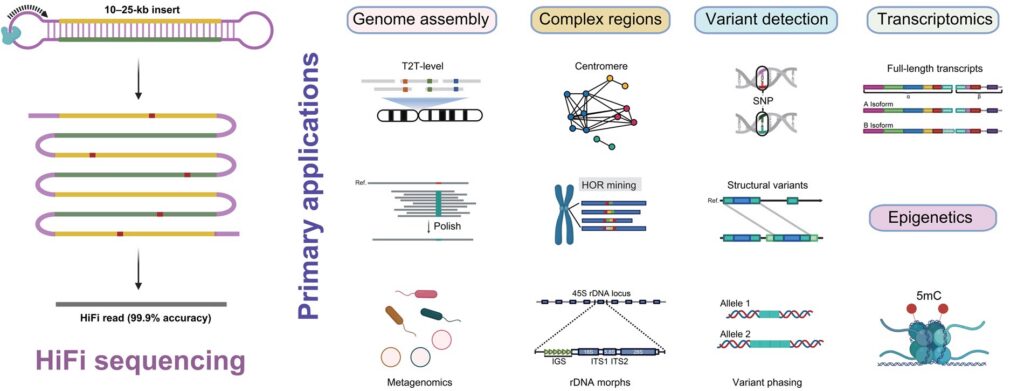
Credit: Genomics, Proteomics & Bioinformatics
Subfertility affects approximately one in six couples globally. Genetic evaluation often remains fragmented, requiring multiple sequential tests over months to years and can still leave patients without answers. These tests are often treated as a sequence of separate investigations, each looking at part of the genome. According to PacBio, HiFi sequencing offers a more comprehensive approach by assessing multiple variant types in a single workflow.
High fidelity sequencing
Short-read genome sequencing, while cost- and time-effective, often misses pertinent genetic information for rare disease diagnosis. This method sequences DNA fragments between 50 and 300 base pairs at a time and struggles with sequencing complex genomic regions and identifying large structural variations. It also requires an amplification process that can introduce errors or sequence bias.
High fidelity sequencing (HiFi) can read up to 25,000 base pairs with a median accuracy of 99.9%. It is also precise in difficult to read regions, accurately resolving over 99.5% of homopolymers that are five or more bases in length.
This high accuracy is achieved through circular consensus sequencing (CCS), where a polymerase makes multiple passes around a circularized DNA template. This process allows the system to build a consensus sequence that corrects errors from individual reads.
For longer stretches of DNA, ultra-long reads produced by Oxford Nanopore Technologies can exceed 100,000 bases, although with lower accuracy.
However, HiFi reads may struggle to resolve very long repeats or phase through homozygous regions exceeding 100 kb. HiFi is also highly sensitive to molecular damage during library preparation and requires high-quality, high-molecular-weight DNA.
The consortium’s fertility study
The study recruited 96 individuals, 47 couples and 2 individual participants, across five leading institutions in Singapore, South Korea, Thailand and Taiwan. Of these, 84 individuals underwent PacBio HiFi whole genome sequencing. This enabled improved resolution of complex and repetitive genomic regions that are difficult to assess using conventional approaches, while also allowing characterization of variants across both partners.
The consortium used DNAstack’s federated analysis framework to harmonize analysis while keeping data securely managed by participating sites. This allows researchers to query and compare data securely across institutions and borders without the data leaving its original site.
“Through the HiFi Solves Subfertility Consortium in Asia-Pacific, we were able to bring together multiple leading centers to apply a standardized long-read sequencing approach across diverse patient populations,” Saumya Jamuar, corresponding senior author of the study, said in a press release.
HiFi sequencing identified clinically relevant genomic findings in approximately one in 10 couples. Likely diagnostic genetic findings were identified in 4.8% of individuals.
The consortium plans to expand recruitment across additional Asia-Pacific centers, evaluate broader multi-omic approaches and explore scalable sequencing workflows that could improve accessibility and cost-efficiency for future reproductive genomic studies.
The HiFi solves global consortium
The HiFi Solves Global Consortium is a multinational effort to address the limitations of conventional genetic testing through high-fidelity long-read sequencing. By consolidating fragmented, sequential testing into a single workflow, the consortium aims to resolve complex genetic disorders that remain unexplained by traditional short-read methods.
The consortium is organized into several regional branches, each with specific research focuses. The Asia-Pacific consortium focuses on subfertility and reproductive health research. The Americas consortium prioritizes clinical implementation and genetic disease research, particularly in pediatrics, while the EMEA (Europe, Middle East and Africa) consortium is focused on clinical implementation and rare disease research.
The consortium works alongside the Consortium of Long Read Sequencing (CoLoRS), which maintains CoLoRSDB, a database that captures the frequency of variants identified through long-read sequencing, providing a resource to filter out common variations and identify pathogenic variants.
HiFi whole genome sequencing (WGS) has demonstrated the ability to detect more than four times as many rare coding structural variants (SVs) as short-read WGS, significantly improving solve rates in rare disease cohorts.