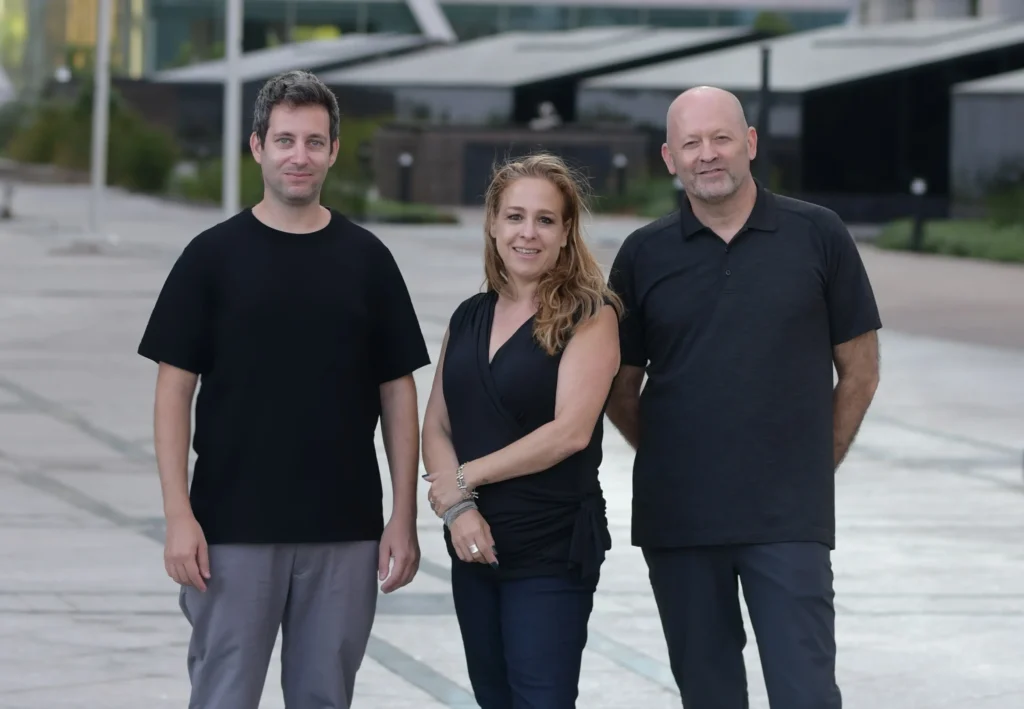
Promise Bio co-founders (from left): CEO Dr. Ronel Veksler, MD-PhD; scientific co-founder Prof. Yifat Merbl, Ph.D.; and CTO Dr. Assaf Kacen, Ph.D. [Promise Bio/Rotem Barak]
The Tel Aviv startup Promise Bio claims its “color-TV” epiproteomics could slash trial-and-error prescribing for autoimmune disease, an area that already drains more than $100 billion in U.S. health-care spending each year.
The company aims to bring a precision medicine approach, which has elevated oncology treatments, to immune-mediated diseases. CEO and co-founder Dr. Ronel Veksler, an MD/PhD-turned-entrepreneur with both medical and electrical engineering degrees, opines that for all its promise in oncology, precision medicine has overlooked many other areas of medicine.
The reason, he explains, is that while genomics works well for cancers that originate from DNA mutations, it falls short for complex chronic diseases where proteins are chemically modified after they’re made. That’s the domain of epiproteomics.
Big pharma bets on “color TV” for proteins
Promise Bio emerged from stealth in December 2024, though its seed round closed in April 2023 with most of the cash coming from Awz Ventures. Strategic minority tickets arrived via AION Labs, the Israeli AI-drug-discovery incubator whose members include Pfizer, AstraZeneca, Merck KGaA, Teva and Amazon Web Services.
Direct U.S. treatment costs for autoimmune disorders exceed $100 billion a year, NIH-cited estimates show, while only 30-40% of patients achieve significant remission on today’s biologics. “They’re staying on that medication for three to six months before the physicians can re-evaluate whether the treatment is working or not,” Veksler said.
If it doesn’t work, like in many of the cases, they have to either switch drug class or stay in the same drug class but switch medication or increase dose. It’s insane, and it’s very not sustainable.—Veksler said
Promise Bio thinks epiproteomics, the study of post-translational protein modifications (PTMs), is the missing data layer. Its cloud platform reads dozens of PTMs from a single blood sample, something Veksler says wasn’t possible before: “People have been working on looking at post-translational modifications on a very limited scope, between one to three simultaneously. We, with our technology, are now looking at dozens of modifications simultaneously without any extra lab work.”
The startup’s rapid rise signals big pharma’s belief in its mission. The $9 million seed included $8.3 million in diluted funds and $700,000 in non-diluted grants. “We were very fortunate to have Pfizer and AstraZeneca joining as early strategic investors,” Veksler said. “We have several types of collaboration with them, and it all revolves around the basic ability of just understanding biology better.”
The company’s edge lies in its epiproteomics platform, which analyzes post-translational modifications from a single blood sample, generating 2-10 gigabytes of data per run. This isn’t theoretical: PTMs like HbA1c for diabetes, anti-CCP for rheumatoid arthritis, and p-tau for Alzheimer’s are already clinical staples, proving the approach’s value.
Addressing a $100 billion trial-and-error system
Autoimmune diseases, affecting 4% of the global population, represent a $100 billion-plus market in direct U.S. treatment costs alone, according to NIH estimates. Yet, the current system is broken. “When you look at the number of therapeutic options that physicians have now, that number keeps increasing, but we don’t have a better way to help guide this clinical decision making,” Veksler said. Patients cycle through biologics or small molecules, waiting three to six months per attempt, only to see 60-70% fail to achieve significant remission.
Promise Bio’s platform aims to end this trial-and-error nightmare by identifying biomarkers for treatment response and stratifying patients for clinical trials. Its 2022 Nature Biotechnology publication validated the tech, and partnerships with academic institutions and proprietary studies are building what Veksler calls “the largest database of its kind focusing on post-translational modifications or epiproteomics.” This creates a “flywheel effect, where the more data we curate, the more we can advance our models,” sharpening predictions for responders versus non-responders. Pharma companies, eager to boost trial success rates, are already knocking. “We’ve been approached several times by companies looking to understand how their drug is affecting specific biological pathways,” Veksler noted.
The stakes are high. With precision medicine stalled outside oncology, Promise Bio’s approach could unlock data-driven decisions for immune-mediated diseases like rheumatoid arthritis, colitis, and lupus. “Precision medicine approaches, beyond just the buzzword, we will get there because that’s the only sustainable way,” Veksler said. “The interests should be aligned between the patients, the physicians, the insurance, the providers.” As Promise Bio eyes its next funding round in 2025, its $9 million head start and big pharma backing position it to reshape a $100 billion market and save billions in wasted healthcare spending.