Research & Development World

  • R&D World Home
  • Topics
    • Aerospace
    • Automotive
    • Biotech
    • Careers
    • Chemistry
    • Environment
    • Energy
    • Life Science
    • Material Science
    • R&D Management
    • Physics
  • Technology
    • 3D Printing
    • A.I./Robotics
    • Software
    • Battery Technology
    • Controlled Environments
      • Cleanrooms
      • Graphene
      • Lasers
      • Regulations/Standards
      • Sensors
    • Imaging
    • Nanotechnology
    • Scientific Computing
      • Big Data
      • HPC/Supercomputing
      • Informatics
      • Security
    • Semiconductors
  • R&D Market Pulse
  • R&D 100
    • 2025 R&D 100 Award Winners
    • 2025 Professional Award Winners
    • 2025 Special Recognition Winners
    • R&D 100 Awards Event
    • R&D 100 Submissions
    • Winner Archive
  • Resources
    • Research Reports
    • Digital Issues
    • Educational Assets
    • Subscribe
    • Video
    • Webinars
    • Content submission guidelines for R&D World
  • Global Funding Forecast
  • Top Labs
  • Advertise
  • SUBSCRIBE

Quantum Effects Observed in Photosynthesis

By University of Groningen | May 21, 2018

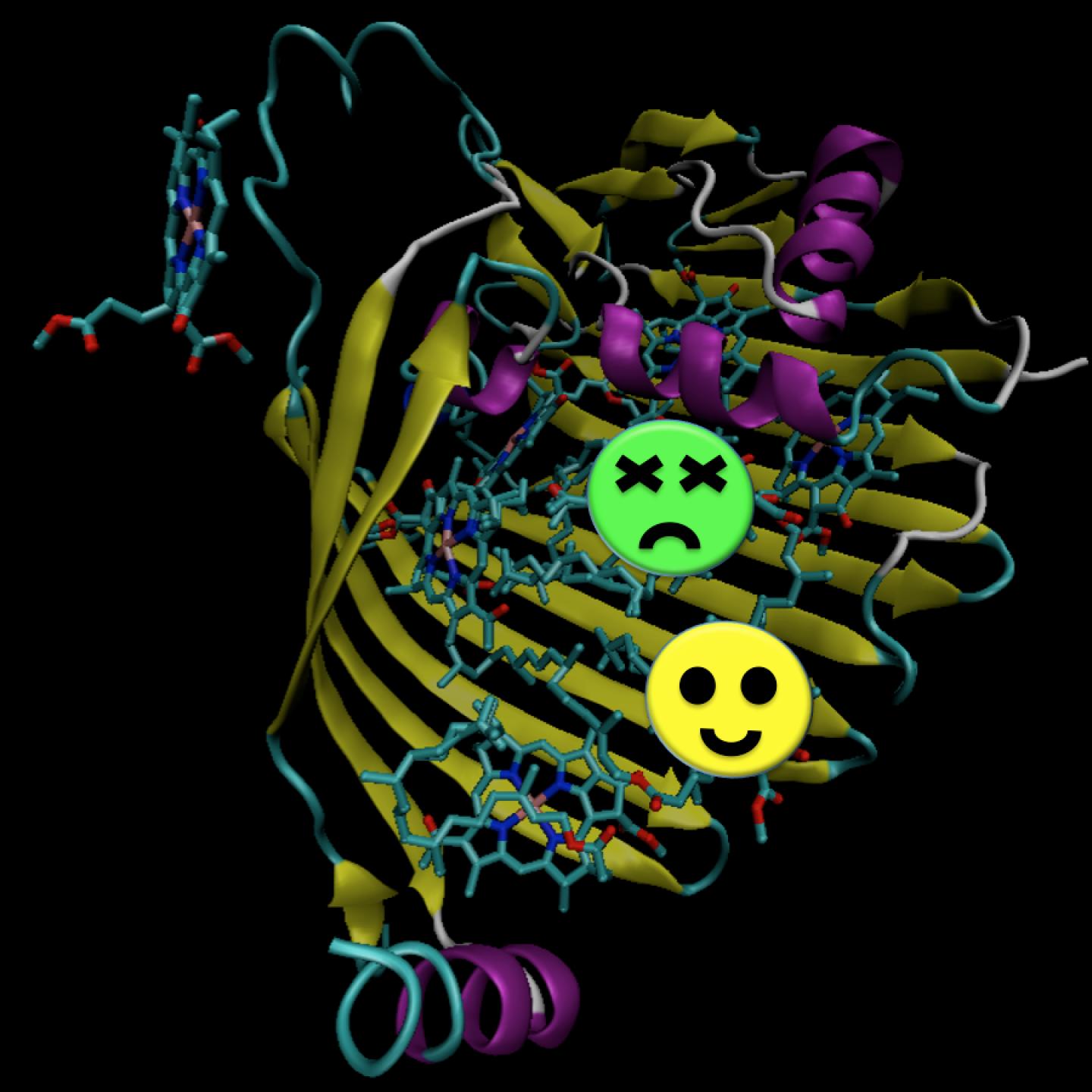
The figure shows the photosynthetic complex of light-harvesting green sulfur bacteria the green and yellow circles highlight the two molecules simultaneously excited. Credit: Dr. Thomas la Cour Jansen/University of Groningen

Molecules that are involved in photosynthesis exhibit the same quantum effects as non-living matter, concludes an international team of scientists including University of Groningen theoretical physicist Thomas la Cour Jansen. This is the first time that quantum mechanical behavior was proven to exist in biological systems that are involved in photosynthesis. The interpretation of these quantum effects in photosynthesis may help in the development of nature-inspired light-harvesting devices. The results were published in Nature Chemistry on 21 May.

For several years now, there has been a debate about quantum effects in biological systems. The basic idea is that electrons in can be in two states at once, until they are observed. This may be compared to the thought experiment known as “Schrödinger’s Cat.” The cat is locked in a box with a vial of a toxic substance. If the cap of the vial is locked with a quantum system, it may simultaneously be open or closed, so the cat is in a mixture of the states “dead” and “alive”, until we open the box and observe the system. This is precisely the apparent behavior of electrons.

Vibrations

In earlier research, scientists had already found signals suggesting that light-harvesting molecules in bacteria may be excited into two states simultaneously. In itself this proved the involvement of quantum mechanical effects, however in those experiments, that excited state supposedly lasted more than 1 picosecond (0.000 000 000 001 second). This is much longer than one would expect on the basis of quantum mechanical theory.

Jansen and his colleagues show in their publication that this earlier observation is wrong. “We have shown that the quantum effects they reported were simply regular vibrations of the molecules.” Therefore, the team continued the search. “We wondered if we might be able to observe that Schrödinger cat situation.”

Superposition

They used different polarizations of light to perform measurements in light-harvesting green sulfur bacteria. The bacteria have a photosynthetic complex, made up of seven light sensitive molecules. A photon will excite two of those molecules, but the energy is superimposed on both. So just like the cat is dead or alive, one or the other molecule is excited by the photon. “In the case of such a superposition, spectroscopy should show a specific oscillating signal”, explains Jansen. “And that is indeed what we saw. Furthermore, we found quantum effects that lasted precisely as long as one would expect based on theory and proved that these belong to energy superimposed on two molecules simultaneously.” Jansen concludes that biological systems exhibit the same quantum effects as non-biological systems.

The observation techniques developed for this research project may be applied to different systems, both biological and non-biological. Jansen is happy with the results. “This is an interesting observation for anyone who is interested in the fascinating world of quantum mechanics. Moreover, the results may play a role in the development of new systems, such as the storage of solar energy or the development of quantum computers.”
Related Articles Read More >

Elkem Silicones rebrands as Bluestar Silicones after ownership change
Martian chemistry: how the Curiosity rover detected organic compounds on Mars
Sandia scientists develop rapid PFAS test using desorption electrospray ionization 
MXenes, the family of 2D transition metal carbides, get a clean surface, and a 160-fold conductivity jump
rd newsletter
EXPAND YOUR KNOWLEDGE AND STAY CONNECTED
Get the latest info on technologies, trends, and strategies in Research & Development.

R&D World Digital Issues

Fall 2025 issue

Browse the most current issue of R&D World and back issues in an easy to use high quality format. Clip, share and download with the leading R&D magazine today.

R&D 100 Awards
Research & Development World
  • Subscribe to R&D World Magazine
  • Sign up for R&D World’s newsletter
  • Contact Us
  • About Us
  • Drug Discovery & Development
  • Pharmaceutical Processing
  • Global Funding Forecast

Copyright © 2026 WTWH Media LLC. All Rights Reserved. The material on this site may not be reproduced, distributed, transmitted, cached or otherwise used, except with the prior written permission of WTWH Media
Privacy Policy | Advertising | About Us

Search R&D World

  • R&D World Home
  • Topics
    • Aerospace
    • Automotive
    • Biotech
    • Careers
    • Chemistry
    • Environment
    • Energy
    • Life Science
    • Material Science
    • R&D Management
    • Physics
  • Technology
    • 3D Printing
    • A.I./Robotics
    • Software
    • Battery Technology
    • Controlled Environments
      • Cleanrooms
      • Graphene
      • Lasers
      • Regulations/Standards
      • Sensors
    • Imaging
    • Nanotechnology
    • Scientific Computing
      • Big Data
      • HPC/Supercomputing
      • Informatics
      • Security
    • Semiconductors
  • R&D Market Pulse
  • R&D 100
    • 2025 R&D 100 Award Winners
    • 2025 Professional Award Winners
    • 2025 Special Recognition Winners
    • R&D 100 Awards Event
    • R&D 100 Submissions
    • Winner Archive
  • Resources
    • Research Reports
    • Digital Issues
    • Educational Assets
    • Subscribe
    • Video
    • Webinars
    • Content submission guidelines for R&D World
  • Global Funding Forecast
  • Top Labs
  • Advertise
  • SUBSCRIBE