Advanced Moderator Module
Category: Mechanical/Materials
Developers: Argonne National Laboratory
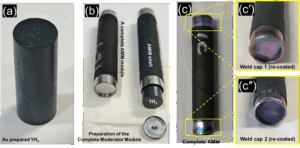
Product Description:The Advanced Moderator Module containment design reduces hydrogen loss in solid hydride systems by 105 orders of magnitude uncontained systems. It features a hermetic ultra-thin niobium liner with a hydrogen barrier coating, effective up to 700 °C. An optional silicon carbide composite shell extends temperature capability beyond 900 °C. It uses hydride metals, such as YH₂, to achieve optimal neutron moderation within a compact reactor design, which is combined with coating technology to limit H2 permeation at high temperature. This allows for higher fuel content and extended core lifetimes. Its enclosure design reduces thermal neutron absorption compared to traditional enclosure materials like stainless steel or Mo-based alloys. By lowering fissile enrichment requirements while maintaining high-temperature capabilities, the AMM technology can either extend reactor lifetimes or reduce overall size and weight. The AMM resulted from multi-discipline efforts that include materials science and advanced materials synthesis, reactor physics and nuclear engineering. All are combined to provide a product that can have an impact on the economics and deployment of nuclear reactors, especially microreactors.
Developers: Argonne National Laboratory
Product Description:The Advanced Moderator Module containment design reduces hydrogen loss in solid hydride systems by 105 orders of magnitude uncontained systems. It features a hermetic ultra-thin niobium liner with a hydrogen barrier coating, effective up to 700 °C. An optional silicon carbide composite shell extends temperature capability beyond 900 °C. It uses hydride metals, such as YH₂, to achieve optimal neutron moderation within a compact reactor design, which is combined with coating technology to limit H2 permeation at high temperature. This allows for higher fuel content and extended core lifetimes. Its enclosure design reduces thermal neutron absorption compared to traditional enclosure materials like stainless steel or Mo-based alloys. By lowering fissile enrichment requirements while maintaining high-temperature capabilities, the AMM technology can either extend reactor lifetimes or reduce overall size and weight. The AMM resulted from multi-discipline efforts that include materials science and advanced materials synthesis, reactor physics and nuclear engineering. All are combined to provide a product that can have an impact on the economics and deployment of nuclear reactors, especially microreactors.