Bleeding Materials and Enclosures product from Sandia
Category: Other
Developers: Sandia
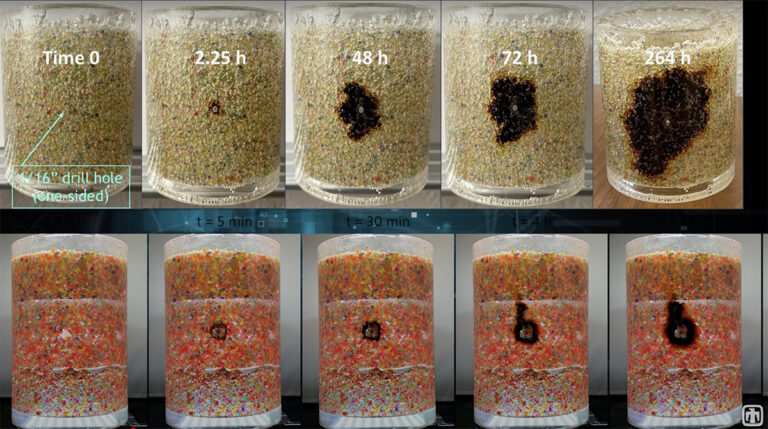
Product Description:The Bleeding Materials and Enclosures product from Sandia uses inexpensive commercial-off-the-shelf materials to construct a custom enclosure system that, upon tamper, irreversibly and dramatically changes color, with tamper becoming visually obvious. This system provides confidence that high-value assets have not been tampered, intercepted or altered. It uses ubiquitous, inexpensive commercial materials, including water beads, water, epoxy, silicone, and an oxygensensitive chemical to construct custom enclosure systems that, upon tampering, irreversibly and dramatically change color from multicolored to black. The color change is based on exposure of the bleeding materials to air. An abstract for the technology describes the method incorporating the use of "bleeding" materials (analogous to visually obvious, colorful bruised skin that doesn't heal) into the design of tamper-indicated enclosures (TIEs). It notes: “As designed, it will allow inspectors to use simple visual observation to detect attempts to penetrate the external surfaces of a TIE, without providing adversaries the ability to repair damage. A material of this type can enhance tamper indication of current TIEs used to support treaty verification regimes.” Advantages include the potential to avoid reliance on time-consuming subjective visual assessment by an inspector, equipment such as eddy current or camera devices, or approaches that may be limited due to the application environment.
Developers: Sandia
Product Description:The Bleeding Materials and Enclosures product from Sandia uses inexpensive commercial-off-the-shelf materials to construct a custom enclosure system that, upon tamper, irreversibly and dramatically changes color, with tamper becoming visually obvious. This system provides confidence that high-value assets have not been tampered, intercepted or altered. It uses ubiquitous, inexpensive commercial materials, including water beads, water, epoxy, silicone, and an oxygensensitive chemical to construct custom enclosure systems that, upon tampering, irreversibly and dramatically change color from multicolored to black. The color change is based on exposure of the bleeding materials to air. An abstract for the technology describes the method incorporating the use of "bleeding" materials (analogous to visually obvious, colorful bruised skin that doesn't heal) into the design of tamper-indicated enclosures (TIEs). It notes: “As designed, it will allow inspectors to use simple visual observation to detect attempts to penetrate the external surfaces of a TIE, without providing adversaries the ability to repair damage. A material of this type can enhance tamper indication of current TIEs used to support treaty verification regimes.” Advantages include the potential to avoid reliance on time-consuming subjective visual assessment by an inspector, equipment such as eddy current or camera devices, or approaches that may be limited due to the application environment.