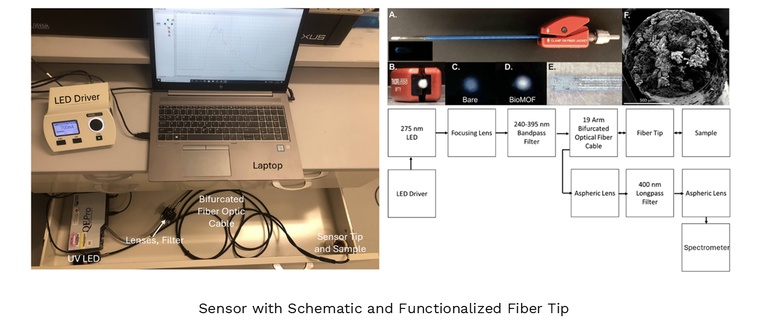
eMission Critical Sensor
Category: IT/Electrical
Developers: University of Pittsburgh
Product Description:The eMission Critical Sensor technology expedites the detection and enhances the processing of critical metals in liquids, including rare earth elements (REEs) and battery metals, via portable real-time monitoring at a cost >10x less than standard laboratory techniques. Compact, portable chemical and metal sensor devices held a 2023 global market value >$4 billion, with expected compounded annual growth rate of >14% from 2024-2032, according to 2024 Global Market Insights report, demonstrating robust demand. Rapid growth in portable sensors and critical minerals markets presents opportunities for synergy, where compact sensors for real-time monitoring target critical metal ions (and interfering species) reduce time and financial costs associated with critical mineral prospecting and processing. eMission Critical Sensor addresses the opportunity by combining state-of-the-art in optics and materials science for rapid, sensitive feedback on concentrations of various economically critical metals, including rare earth elements, cobalt, and aluminum. eMission Critical Sensor detects target metals at sensitivity levels (down to part-per-billion) at least one order of magnitude better then handheld x-ray fluorometers and laser-induced breakdown spectrometers, while overcoming cost and portability limitations of inductively-coupled plasma mass spectrometry, current state-of-the-art. The eMission Critical Sensor is a highly sensitive and selective probe for economically critical metals in liquid streams. The technology couples a compact, proven fiber optic excitation and detection platform with high performance luminescent materials that provide a selective optical response in the presence of target metals. As a result, critical metals including terbium, europium, dysprosium, samarium, cobalt, and aluminum can be detected at low part-per-million concentrations or better in complex systems, such as fly ash leachates and extraction process streams. The sensor is designed to directly prospect for target critical metals in the field from sources such as acid mine drainage, and for process monitoring during metal production.
Developers: University of Pittsburgh
Product Description:The eMission Critical Sensor technology expedites the detection and enhances the processing of critical metals in liquids, including rare earth elements (REEs) and battery metals, via portable real-time monitoring at a cost >10x less than standard laboratory techniques. Compact, portable chemical and metal sensor devices held a 2023 global market value >$4 billion, with expected compounded annual growth rate of >14% from 2024-2032, according to 2024 Global Market Insights report, demonstrating robust demand. Rapid growth in portable sensors and critical minerals markets presents opportunities for synergy, where compact sensors for real-time monitoring target critical metal ions (and interfering species) reduce time and financial costs associated with critical mineral prospecting and processing. eMission Critical Sensor addresses the opportunity by combining state-of-the-art in optics and materials science for rapid, sensitive feedback on concentrations of various economically critical metals, including rare earth elements, cobalt, and aluminum. eMission Critical Sensor detects target metals at sensitivity levels (down to part-per-billion) at least one order of magnitude better then handheld x-ray fluorometers and laser-induced breakdown spectrometers, while overcoming cost and portability limitations of inductively-coupled plasma mass spectrometry, current state-of-the-art. The eMission Critical Sensor is a highly sensitive and selective probe for economically critical metals in liquid streams. The technology couples a compact, proven fiber optic excitation and detection platform with high performance luminescent materials that provide a selective optical response in the presence of target metals. As a result, critical metals including terbium, europium, dysprosium, samarium, cobalt, and aluminum can be detected at low part-per-million concentrations or better in complex systems, such as fly ash leachates and extraction process streams. The sensor is designed to directly prospect for target critical metals in the field from sources such as acid mine drainage, and for process monitoring during metal production.