HyPoCap
Category: Mechanical/Materials
Developers: Oak Ridge National Laboratory
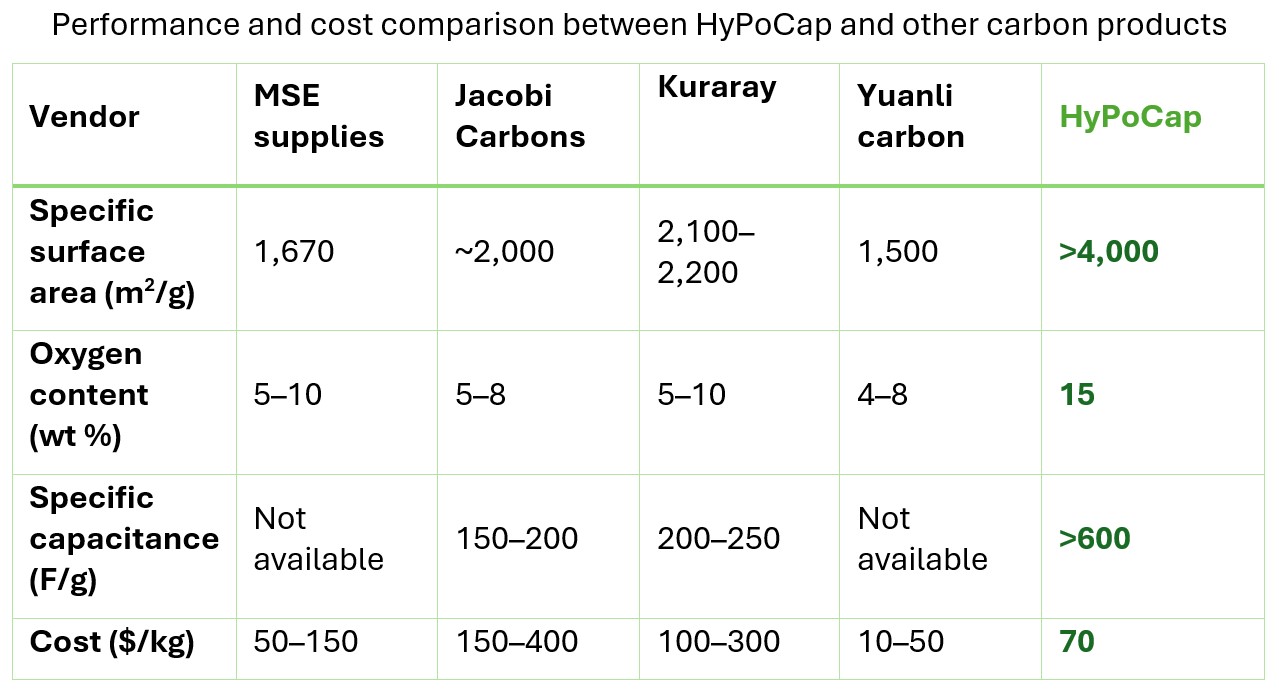
Product Description:Oak Ridge National Laboratory developed HyPoCap, which exhibits 3× higher energy density than that of state-of-the-art commercial carbon products. These hyperporous carbons were prepared under mild temperatures by using sodium amide as the activation agent. The supercapacitor industry can readily implement this material to improve product performance. Carbon-based supercapacitors, which are vital for high power density and rapid charge–discharge in electric vehicles, power supplies, and electronics, rely on porous carbons for efficient electrical double-layer capacitance. Whereas commercial ACs offer surface areas up to 2,000 m²/g and oxygen contents up to 10 wt%, the ORNL team’s hyperporous carbon achieves over 4,000 m²/g and 15 wt % oxygen content, thereby tripling the energy density compared with that of existing products. Enabled by a synthesis process that combines hypercrosslinked polymers and low-temperature NaNH2 activation, HyPoCap delivers up to 610 F/g capacitance. This performance meets the demand for sustainable, high-performance solutions. The tunable properties and scalability of HyPoCap could also enhance cycle stability and power delivery for supercapacitor applications.
Developers: Oak Ridge National Laboratory
Product Description:Oak Ridge National Laboratory developed HyPoCap, which exhibits 3× higher energy density than that of state-of-the-art commercial carbon products. These hyperporous carbons were prepared under mild temperatures by using sodium amide as the activation agent. The supercapacitor industry can readily implement this material to improve product performance. Carbon-based supercapacitors, which are vital for high power density and rapid charge–discharge in electric vehicles, power supplies, and electronics, rely on porous carbons for efficient electrical double-layer capacitance. Whereas commercial ACs offer surface areas up to 2,000 m²/g and oxygen contents up to 10 wt%, the ORNL team’s hyperporous carbon achieves over 4,000 m²/g and 15 wt % oxygen content, thereby tripling the energy density compared with that of existing products. Enabled by a synthesis process that combines hypercrosslinked polymers and low-temperature NaNH2 activation, HyPoCap delivers up to 610 F/g capacitance. This performance meets the demand for sustainable, high-performance solutions. The tunable properties and scalability of HyPoCap could also enhance cycle stability and power delivery for supercapacitor applications.