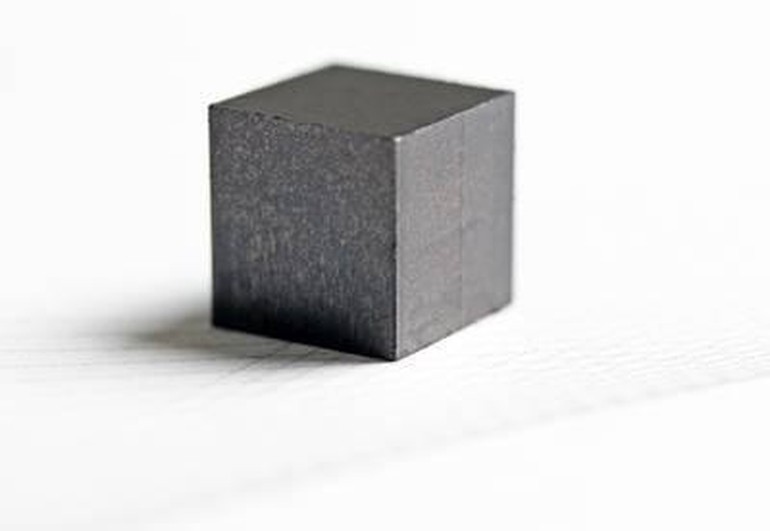
MnBi-based Rare-Earth-Free Permanent Magnet
Category: Mechanical/Materials
Developers: Ames National Laboratory
Product Description:The manganese-bismuth (MnBi) magnet is the only known material that increases its coercivity (resistance to demagnetization) with temperature—nearly doubling its room-temperature value at 120°C. This property makes MnBi well-suited for high-temperature applications, such as certain types of industrial pumps, where coercivity is more critical than magnetization. Despite its promise, producing high-purity MnBi has long been a challenge, and consolidating it into fully dense, anisotropic bulk magnets has proven even more difficult. We addressed these challenges by uncovering the fundamental principles behind MnBi’s thermal stability and developing a scalable process for magnet fabrication. A key breakthrough involves a specialized inorganic coating applied to the MnBi single crystal powder, which maintains magnetic isolation between grains even when densely compacted. This prevents magnetic domain reversal propagation, enabling the magnet to retain coercivity. As a result, MnBi magnets produced through this method offer superior thermal stability compared to conventional magnets, and more importantly, they are free of the critical rare earth elements that have been subjected to supply risk. MnBi magnet can operate at temperatures up to 200°C. Its coercivity (i.e., resistance to demagnetization) increases with temperature, in contrast to most magnets that rapidly lose coercivity at higher temperature. This makes MnBi well-suited for high-temperature applications with strong demagnetizing fields. MnBi (manganese bismuth) magnet is a critical-material-free permanent magnet with an ability to resist demagnetization at high temperature. The main application for MnBi magnet is in electrical machines, such as traction motors in electrical vehicles and industrial motors for fans, pumps and compressors.
Developers: Ames National Laboratory
Product Description:The manganese-bismuth (MnBi) magnet is the only known material that increases its coercivity (resistance to demagnetization) with temperature—nearly doubling its room-temperature value at 120°C. This property makes MnBi well-suited for high-temperature applications, such as certain types of industrial pumps, where coercivity is more critical than magnetization. Despite its promise, producing high-purity MnBi has long been a challenge, and consolidating it into fully dense, anisotropic bulk magnets has proven even more difficult. We addressed these challenges by uncovering the fundamental principles behind MnBi’s thermal stability and developing a scalable process for magnet fabrication. A key breakthrough involves a specialized inorganic coating applied to the MnBi single crystal powder, which maintains magnetic isolation between grains even when densely compacted. This prevents magnetic domain reversal propagation, enabling the magnet to retain coercivity. As a result, MnBi magnets produced through this method offer superior thermal stability compared to conventional magnets, and more importantly, they are free of the critical rare earth elements that have been subjected to supply risk. MnBi magnet can operate at temperatures up to 200°C. Its coercivity (i.e., resistance to demagnetization) increases with temperature, in contrast to most magnets that rapidly lose coercivity at higher temperature. This makes MnBi well-suited for high-temperature applications with strong demagnetizing fields. MnBi (manganese bismuth) magnet is a critical-material-free permanent magnet with an ability to resist demagnetization at high temperature. The main application for MnBi magnet is in electrical machines, such as traction motors in electrical vehicles and industrial motors for fans, pumps and compressors.