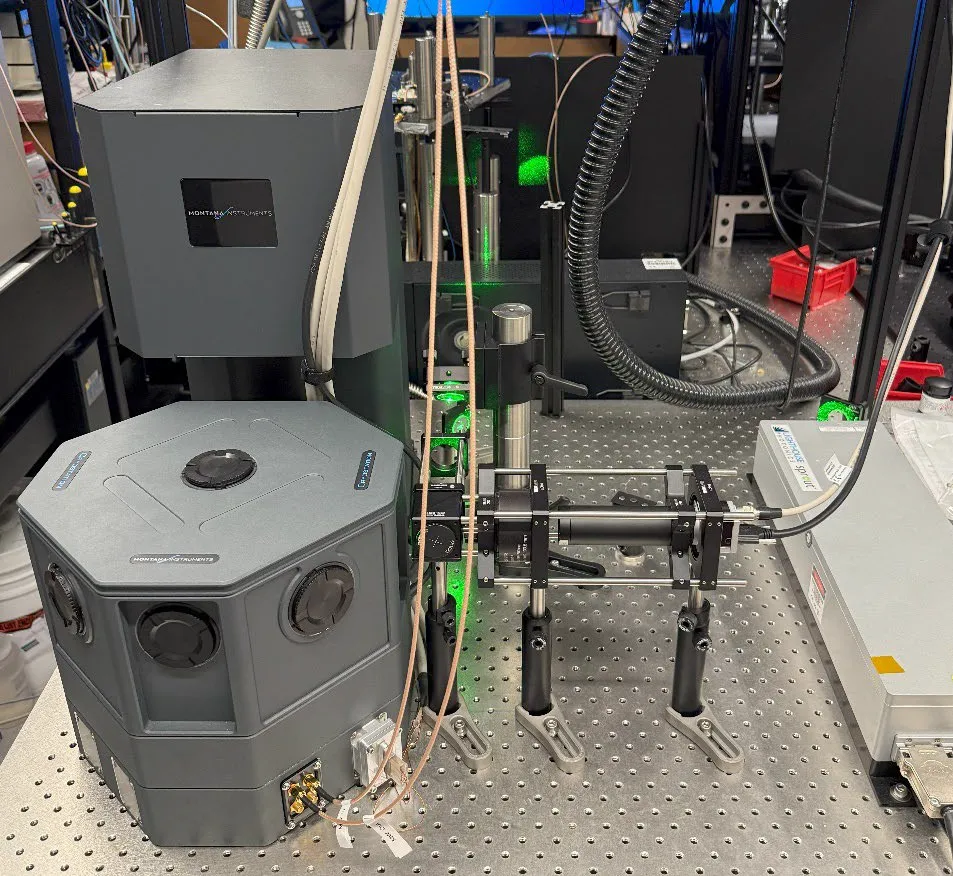
Quantum Diamond Magnetic Cryomicroscope
Category: Analytical/Test
Developers: MIT Lincoln Laboratory
Product Description:The Quantum Diamond Magnetic Cryomicroscope is a wide-field, high-resolution instrument that images electric currents, trapped magnetic flux and magnetic materials across a range of temperatures. Its magnetic imaging capability is driving breakthroughs in next-generation high-performance computing and the study of exotic magnetic nanomaterials. Superconducting computing presents an alternative to conventional complementary metal-oxide semiconductor (CMOS) technology by offering significantly higher clock speeds and superior power efficiency, even when accounting for the power required for cryogenic cooling. This computing architecture leverages superconducting materials such as niobium, niobium nitride, and niobium titanium nitride, which operate at temperatures as low as 4 kelvin (K). The instrument operates from 4 K to room temperature, has single-micron resolution over a 600 μm × 360 μm field of view and isolates the device under test (DUT) from stray magnetic fields, microwaves, and light with shielding and microwave engineering. The instrument can record an image in seconds to minutes, and can scan and tile images to interrogate a 3 mm × 4 mm chip area. This technological breakthrough informs new SCE designs, closing the feedback loop to effectively solve the flux-trapping problem and enable SCE VLSI. Furthermore, the technology can be applied more broadly to problems beyond flux trapping in SCE. Diagnostics possible with a quantum diamond magnetic cryomicroscope include active SCE devices, novel 2D magnetic materials, and even superconducting qubit circuits.
Developers: MIT Lincoln Laboratory
Product Description:The Quantum Diamond Magnetic Cryomicroscope is a wide-field, high-resolution instrument that images electric currents, trapped magnetic flux and magnetic materials across a range of temperatures. Its magnetic imaging capability is driving breakthroughs in next-generation high-performance computing and the study of exotic magnetic nanomaterials. Superconducting computing presents an alternative to conventional complementary metal-oxide semiconductor (CMOS) technology by offering significantly higher clock speeds and superior power efficiency, even when accounting for the power required for cryogenic cooling. This computing architecture leverages superconducting materials such as niobium, niobium nitride, and niobium titanium nitride, which operate at temperatures as low as 4 kelvin (K). The instrument operates from 4 K to room temperature, has single-micron resolution over a 600 μm × 360 μm field of view and isolates the device under test (DUT) from stray magnetic fields, microwaves, and light with shielding and microwave engineering. The instrument can record an image in seconds to minutes, and can scan and tile images to interrogate a 3 mm × 4 mm chip area. This technological breakthrough informs new SCE designs, closing the feedback loop to effectively solve the flux-trapping problem and enable SCE VLSI. Furthermore, the technology can be applied more broadly to problems beyond flux trapping in SCE. Diagnostics possible with a quantum diamond magnetic cryomicroscope include active SCE devices, novel 2D magnetic materials, and even superconducting qubit circuits.