Thermal Energy Storage Systems Including Anisotropic Thermal Conductive Carbon Fibers for Enhancing Thermal Efficiency of Phase Change Materials
Category: Mechanical/Materials
Developers: Oak Ridge National Laboratory
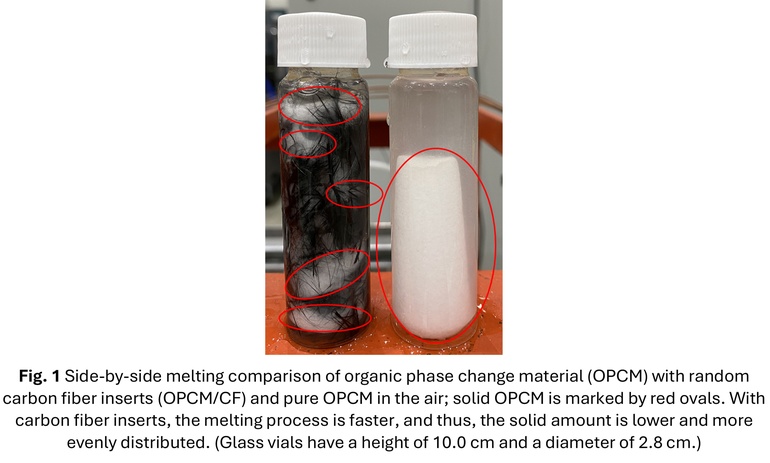
Product Description:Maintaining the temperature of buildings accounts for about 13% of the total electricity consumed each year in the United States. Integrated thermal management systems can incorporate distributed assets (such as solar panels and wind turbines) to manage energy demand when they need to use thermal storage systems to allow overproduced renewable power to be stored for later use. Previous research has identified that phase change material (PCM) with a high ratio of latent heat to sensible heat within a specific temperature range can provide efficient storage of thermal energy, making PCMs useful for applications like building temperature regulation. However, because of the low thermal conductivities of PCMs, a large temperature difference between the heat carrier fluid and the PCM is required to enable phase change at the desired speed, and a long time period is needed for the phase change to be completed. Long anisotropic thermal conductive carbon fiber (CF) inserts in PCMs accelerate the phase change with the large surface area (>1 m2/g) and act as numerous fast tunnels to improve the thermal transfer, thus increasing the thermal storage and release rates by 2.5 times in thermal energy systems with only 1 wt % CF in PCMs. Phase change materials are widely used for thermal energy management. Their low thermal conductivities result in very low thermal release rates. The experimental results are based on the new heat transfer mechanism of CFs in PCMs as numerous fast heat distributing tunnels and enlarged surface areas for phase transition. This innovation can make the thermal storage systems widely applied in US residential, industrial and commercial buildings for better energy efficiency at about 30% lower costs.
Developers: Oak Ridge National Laboratory
Product Description:Maintaining the temperature of buildings accounts for about 13% of the total electricity consumed each year in the United States. Integrated thermal management systems can incorporate distributed assets (such as solar panels and wind turbines) to manage energy demand when they need to use thermal storage systems to allow overproduced renewable power to be stored for later use. Previous research has identified that phase change material (PCM) with a high ratio of latent heat to sensible heat within a specific temperature range can provide efficient storage of thermal energy, making PCMs useful for applications like building temperature regulation. However, because of the low thermal conductivities of PCMs, a large temperature difference between the heat carrier fluid and the PCM is required to enable phase change at the desired speed, and a long time period is needed for the phase change to be completed. Long anisotropic thermal conductive carbon fiber (CF) inserts in PCMs accelerate the phase change with the large surface area (>1 m2/g) and act as numerous fast tunnels to improve the thermal transfer, thus increasing the thermal storage and release rates by 2.5 times in thermal energy systems with only 1 wt % CF in PCMs. Phase change materials are widely used for thermal energy management. Their low thermal conductivities result in very low thermal release rates. The experimental results are based on the new heat transfer mechanism of CFs in PCMs as numerous fast heat distributing tunnels and enlarged surface areas for phase transition. This innovation can make the thermal storage systems widely applied in US residential, industrial and commercial buildings for better energy efficiency at about 30% lower costs.