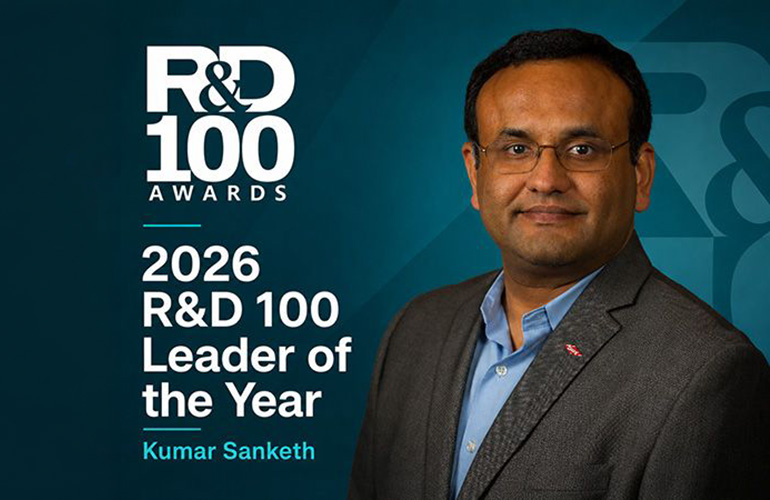
 Around 2000, Kumar Sanketh was building polymer light-emitting diodes and phototransistors in a Bengaluru laboratory. More than two decades later, after helping commercialize photovoltaic materials and leading a global R&D organization, he is again working at the intersection of polymers and light.
As a Dow Inc. R&D director and the 2026 R&D 100 Leader of the Year, Kumar has built a career by moving between scientific disciplines, businesses and stages of commercialization. “Connecting the dots” is how he describes that pattern: understanding a device, identifying the material limitation and assembling the technical and commercial case needed to move an idea beyond the laboratory.
From polymer electronics to industrial R&D
Kumar’s interest in engineering began with childhood curiosity. “I was always curious and tinkering with things,” he said. “I was deeply interested in electronics and anything engineering-related.” That interest led him to conductive and semiconducting polymers, then an emerging field in India, and to K.S. Narayan’s polymer-electronics laboratory at the Jawaharlal Nehru Centre for Advanced Scientific Research. Chemists synthesized molecules; Kumar built devices to test how those materials performed.
The work placed him within the broader rise of organic electronics, as researchers explored polymer-based light-emitting diodes, phototransistors and other devices that could offer new form factors and potentially simpler processing than conventional silicon-based manufacturing. A subsequent role at GE’s John F. Welch Technology Centre added experience in polymer testing, compounding and industrial-scale problem-solving.
A funded position at the University of Akron brought Kumar to Ohio shortly before Sept. 11, 2001. After earning a master’s degree in polymer engineering and a doctorate in polymer science, he joined Dow in 2007 as a senior research specialist in the coatings business.
Making the case for longer-lasting solar modules
By 2010, Kumar was working on a problem that again joined materials science and electronics: how to protect photovoltaic cells through decades of outdoor service. Ethylene-vinyl acetate (EVA) dominated solar encapsulation, while polyolefin-based alternatives had only a limited market presence. Convincing module manufacturers to change required more than showing a favorable property on a data sheet. The team had to demonstrate a meaningful advantage across the life of the installation.
“When you consider the value chain for grid-tied solar, the value is in selling power, not simply in the wattage installed, but in how much power you can supply and for how long with the same capital investment,” he said. Project developers, banks, insurers and asset owners therefore needed evidence that a new encapsulant could protect module performance over time.
Kumar’s team combined materials testing, device knowledge and modeling to answer those concerns. Accelerated testing and performance modeling indicated that modules using the material could meet a 30-year service-life target, beyond the 20- to 25-year benchmarks commonly discussed at the time. His earlier work in polymer devices helped him frame the problem at the application level. “It helped me understand what the application needed,” he said.
Dow initially produced encapsulant film on its own lines, but adding enough converting capacity to serve the growing solar market required repeated capital investment. When market conditions shifted, the business changed its model: rather than expanding downstream film production, Dow supplied resin pellets and helped established film manufacturers adapt their EVA lines to process the polyolefin material.
Polyolefin elastomers have since become an important high-performance encapsulant option, particularly for module designs that demand greater resistance to moisture and potential-induced degradation. ENGAGE PV Polyolefin Resins received an R&D 100 Award in 2018.
Turning a commercialization lesson into a leadership model
The solar program reinforced a lesson Kumar carried into leadership: technical evidence alone does not move a market. Researchers also have to understand customer risk, capital constraints, manufacturing capability and the wider value chain. The same systems view shaped how he later led R&D teams.
From May 2022 through the summer of 2026, Kumar led a product R&D organization of more than 110 people across six sites in the Americas, Europe and China. One of the clearest differences among teams, he found, was their tolerance for ambiguity. Some researchers began experimenting as soon as an idea surfaced; others preferred to discuss it first or define requirements in writing. “It’s about how much gray space people can tolerate,” he said.
Leading through others also required him to stay connected without micromanaging. He encouraged researchers to bring problems directly to him and tried to “lower the temperature” of the relationship between employee and boss. When a project fell behind, his approach was to go after the problem rather than the person. “There’s a reason,” he said. “Nobody leaves something undone just because they weren’t interested in working.”
He also created room for ideas outside formal project plans through an initiative to expand into new areas. Researchers were encouraged to devote a portion of their capacity beyond immediate deliverables to proposing and testing unconventional concepts. Ideas could be screened for technical feasibility and business value later. According to his nomination materials, the effort launched two programs and advanced four additional concepts into development.
Kumar credits mentors with encouraging him to make changes before a role became comfortable. He has tried to do the same for others, including reshaping assignments so emerging leaders could gain strategy experience. The aim, he said, is to create enough trust for people to take a chance and enough discipline to turn that chance into a learning cycle.
Getting light closer to the chip
In the summer of 2026, Kumar made another cross-business move, leaving plastics after 12 years to join Dow’s silicones business in a technical service and development role. Working with strategic marketing, he now helps identify where the business should place its next technology bets, including materials that could enable artificial intelligence and data-center infrastructure.
As data rates rise, moving optics closer to computing can shorten high-speed electrical paths and reduce power loss while increasing bandwidth. That proximity creates demanding packaging problems: optical components must be attached and protected, micron-scale alignment must remain stable across temperature changes, and heat must be managed without compromising optical performance.
For Kumar, the next opportunity is not a departure from his earlier career but another iteration of the same method: understand the application, identify the material limitation and build the technical and commercial coalition required to move an idea off the bench. “We’ve been talking about photonics using polymeric materials for a couple of decades,” he said. The question now is how to bring that knowledge forward, and once again connect the dots.



Tell Us What You Think!
You must be logged in to post a comment.