Research & Development World

  • R&D World Home
  • Topics
    • Aerospace
    • Automotive
    • Biotech
    • Careers
    • Chemistry
    • Environment
    • Energy
    • Life Science
    • Material Science
    • R&D Management
    • Physics
  • Technology
    • 3D Printing
    • A.I./Robotics
    • Software
    • Battery Technology
    • Controlled Environments
      • Cleanrooms
      • Graphene
      • Lasers
      • Regulations/Standards
      • Sensors
    • Imaging
    • Nanotechnology
    • Scientific Computing
      • Big Data
      • HPC/Supercomputing
      • Informatics
      • Security
    • Semiconductors
  • R&D Market Pulse
  • R&D 100
    • 2025 R&D 100 Award Winners
    • 2025 Professional Award Winners
    • 2025 Special Recognition Winners
    • R&D 100 Awards Event
    • R&D 100 Submissions
    • Winner Archive
  • Resources
    • Research Reports
    • Digital Issues
    • Educational Assets
    • R&D Index
    • Subscribe
    • Video
    • Webinars
    • Content submission guidelines for R&D World
  • Global Funding Forecast
  • Top Labs
  • Advertise
  • SUBSCRIBE

Research Shows First Land Plants Were Parasitized by Microbes

By University of Cambridge | April 4, 2018

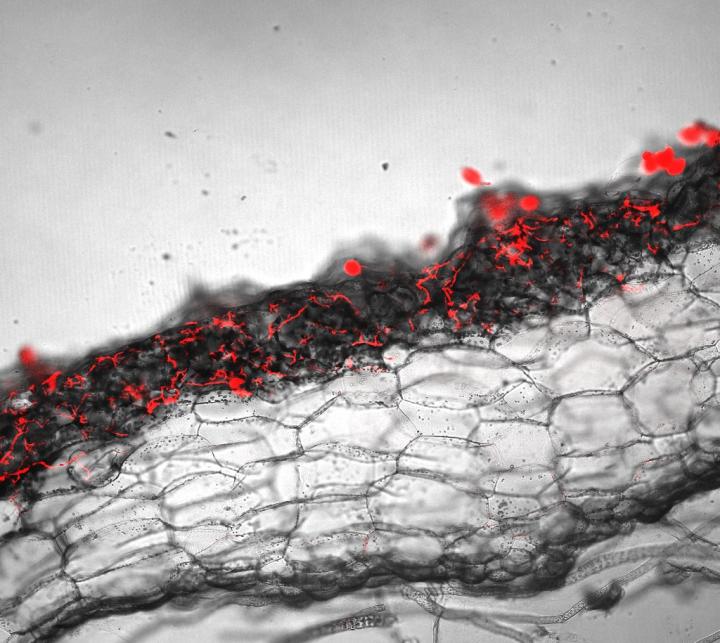
This is a microscopy image of a cross-section of a Marchantia polymorpha thallus showing the Phytophthora infection (red) in the upper photosynthetic layer of the liverwort plant.

By studying liverworts – which diverged from other land plants early in the history of plant evolution – researchers from the Sainsbury Laboratory at the University of Cambridge have found that the relationship between plants and filamentous microbes not only dates back millions of years, but that modern plants have maintained this ancient mechanism to accommodate and respond to microbial invaders.

Published in the journal Proceedings of the National Academy of Sciences, a new study shows that aggressive filamentous microbial (fungi-like) pathogens can invade liverworts and that some elements of the liverwort’s response are shared with distantly related plants.

The first author of the paper, Dr Philip Carella, said the research showed that liverworts could be infected by the common and devastating microorganism Phytophthora: “We know a great deal about microbial infections of modern flowering plants, but until now we haven’t known how distantly related plant lineages dealt with an invasion by an aggressive microbe. To test this, we first wanted to see if Phytophthora could infect and complete its life cycle in a liverwort. We found that Phytophthora palmivora can colonise the photosynthetic tissues of the liverwort Marchantia polymorpha by invading living cells. Marchantia responds to this by deploying proteins around the invading Phytophthora hyphal structures. These proteins are similar to those that are produced in flowering plants such as tobacco, legumes or Arabidopsis in response to infections by both symbiont and pathogenic microbes.”

These lineages share a common ancestor that lived over 400 million years ago, and fossils from this time period show evidence that plants were already forming beneficial relationships with filamentous microbes. Dr Carella added: “These findings raise interesting questions about how plants and microbes have interacted and evolved pathogenic and symbiotic relationships. Which mechanisms evolved early in a common ancestor before the plant groups diverged and which evolved independently?”

Dr Sebastian Schornack, who led the research team, says the study indicates that early land plants were already genetically equipped to respond to microbial infections: “This discovery reveals that certain response mechanisms were already in place very early on in plant evolution.”

“Finding that pathogenic filamentous microbes can invade living liverwort cells and that liverworts respond using similar proteins as in flowering plants suggests that the relationship between filamentous pathogens and plants can be considered ancient. We will continue to study whether pathogens are exploiting mechanisms evolved to support symbionts and, hopefully, this will allow us to establish future crop plants that both benefit from symbionts whilst remaining more resistant to pathogens.

“Liverworts are showing great promise as a model plant system and this discovery that they can be colonised by pathogens of flowering plants makes them a valuable model plant to continue research into plant-microbe interactions.”


Related Articles Read More >

Nature’s 2024 Method of the Year has become $100M market and a lawsuit magnet
New study finds gene that can help repair the heart after failure
Verily integrates NVIDIA AI tools into precision health platform
Are AI agents skipping the trough? Early evidence from life sciences
rd newsletter
EXPAND YOUR KNOWLEDGE AND STAY CONNECTED
Get the latest info on technologies, trends, and strategies in Research & Development.
RD 25 Power Index

R&D World Digital Issues

Fall 2024 issue

Browse the most current issue of R&D World and back issues in an easy to use high quality format. Clip, share and download with the leading R&D magazine today.

Research & Development World
  • Subscribe to R&D World Magazine
  • Sign up for R&D World’s newsletter
  • Contact Us
  • About Us
  • Drug Discovery & Development
  • Pharmaceutical Processing
  • Global Funding Forecast

Copyright © 2025 WTWH Media LLC. All Rights Reserved. The material on this site may not be reproduced, distributed, transmitted, cached or otherwise used, except with the prior written permission of WTWH Media
Privacy Policy | Advertising | About Us

Search R&D World

  • R&D World Home
  • Topics
    • Aerospace
    • Automotive
    • Biotech
    • Careers
    • Chemistry
    • Environment
    • Energy
    • Life Science
    • Material Science
    • R&D Management
    • Physics
  • Technology
    • 3D Printing
    • A.I./Robotics
    • Software
    • Battery Technology
    • Controlled Environments
      • Cleanrooms
      • Graphene
      • Lasers
      • Regulations/Standards
      • Sensors
    • Imaging
    • Nanotechnology
    • Scientific Computing
      • Big Data
      • HPC/Supercomputing
      • Informatics
      • Security
    • Semiconductors
  • R&D Market Pulse
  • R&D 100
    • 2025 R&D 100 Award Winners
    • 2025 Professional Award Winners
    • 2025 Special Recognition Winners
    • R&D 100 Awards Event
    • R&D 100 Submissions
    • Winner Archive
  • Resources
    • Research Reports
    • Digital Issues
    • Educational Assets
    • R&D Index
    • Subscribe
    • Video
    • Webinars
    • Content submission guidelines for R&D World
  • Global Funding Forecast
  • Top Labs
  • Advertise
  • SUBSCRIBE