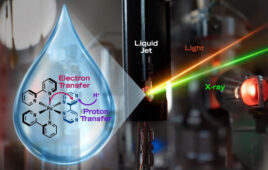
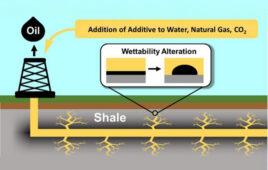
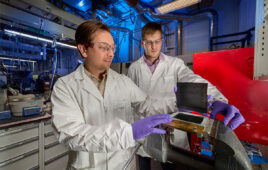
An international team of researchers developed a method to convert the carbon dioxide emitted from factories into fuel feedstock without cleaning or purifying the gas.
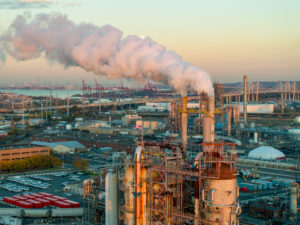
Adobe
Traditionally, carbon capture requires costly, energy-intensive purification steps. A paper published in Science estimates that separating carbon dioxide from coal flue gas and compressing it to 150 bar requires at least 0.11 megawatt-hours per ton, or about 0.4 GJ. The U.S. Department of Energy’s National Energy Technology Laboratory estimates the average cost of carbon dioxide capture for four processes with CO₂ less than 50% is $61.80 per ton.
The researchers say the new approach could help avoid these costly, inefficient purification steps, potentially making carbon capture and conversion more economical, though the technology has not yet been tested at industrial scale.
The new method uses an organic solvent mixture, dimethyl sulfide (DMS) and acetonitrile (ACN), to convert carbon dioxide from industrial emissions into carbon monoxide, which is used to manufacture fuels and chemicals. The researchers published their findings in Nature Communications.
Industrial flue gases are mostly made up of nitrogen, with 10% to 25% carbon dioxide, which has made efforts to convert captured carbon challenging as oxygen triggers competing reactions.
In most carbon capture methods, the carbon dioxide needs to be separated and purified before it is converted.
The team’s organic solvent mixture weakens hydrogen bonding, which suppresses unwanted side reactions and favors the carbon conversion.
“The key is controlling the solvent environment around the electrochemical reaction,” Xiaowan Bai, who worked on the research, said in an email to R&D World. ” This allows CO2 to be selectively converted into carbon monoxide (CO) even when the gas contains large amounts of oxygen, meaning the CO2 does not need to be extensively separated and purified first.”
Using a simulated industrial flue gas containing 15% CO₂ and 8% oxygen, the researchers achieved CO Faradaic efficiency exceeding 95% at 20 bar. The direct reactive capture (DRC) process consumed 30.7 gigajoules of energy per ton of CO produced. At 1% CO₂ and 15% oxygen, the system maintained CO Faradaic efficiency above 90%.
The technology operated continuously for over 100 hours while maintaining high performance.
The team coupled the system with a high-efficiency solar cell, achieving solar-to-fuel efficiency of approximately 5.5%.
“Actual flue gas is more complex than the simulated mixture used in the laboratory, so the system will need to tolerate additional impurities and operate reliably at much larger current densities and production rates,” Bai said.
“The next milestone is to move from laboratory-scale proof of concept towards larger electrolyzers and testing with real industrial flue gas. We also aim to further improve the energy efficiency and operating lifetime, while exploring integration with renewable electricity. Beyond CO production, an important future direction is the direct conversion of captured CO2 into higher-value multicarbon products,” she added.