Research & Development World

  • R&D World Home
  • Topics
    • Aerospace
    • Automotive
    • Biotech
    • Careers
    • Chemistry
    • Environment
    • Energy
    • Life Science
    • Material Science
    • R&D Management
    • Physics
  • Technology
    • 3D Printing
    • A.I./Robotics
    • Software
    • Battery Technology
    • Controlled Environments
      • Cleanrooms
      • Graphene
      • Lasers
      • Regulations/Standards
      • Sensors
    • Imaging
    • Nanotechnology
    • Scientific Computing
      • Big Data
      • HPC/Supercomputing
      • Informatics
      • Security
    • Semiconductors
  • R&D Market Pulse
  • R&D 100
    • 2025 R&D 100 Award Winners
    • 2025 Professional Award Winners
    • 2025 Special Recognition Winners
    • R&D 100 Awards Event
    • R&D 100 Submissions
    • Winner Archive
  • Resources
    • Research Reports
    • Digital Issues
    • Educational Assets
    • Subscribe
    • Video
    • Webinars
    • PharmSci360
    • Content submission guidelines for R&D World
  • Global Funding Forecast
  • Top Labs
  • Advertise
  • SUBSCRIBE

Researchers Develop Waterproof Graphene Electronic Circuits

By Plataforma SINC | January 31, 2019

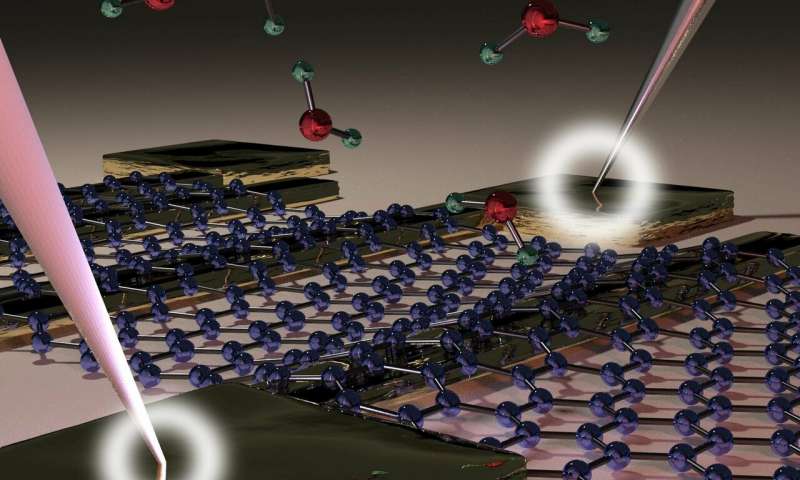
Schematic of a graphene device with a contact resistance that is not altered by the water molecules adsorbed on its surface. Image: Anderson D. Smith

Water molecules distort the electrical resistance of graphene, but a team of European researchers has discovered that when this two-dimensional material is integrated with the metal of a circuit, contact resistance is not impaired by humidity. This finding will help to develop new sensors with a significant cost reduction.

The many applications of graphene, an atomically thin sheet of carbon atoms with extraordinary conductivity and mechanical properties, include the manufacture of sensors. These transform environmental parameters into electrical signals that can be processed and measured with a computer.

Due to their two-dimensional structure, graphene-based sensors are extremely sensitive and promise good performance at low manufacturing cost in the next years.

To achieve this, graphene needs to make efficient electrical contacts when integrated with a conventional electronic circuit. Such proper contacts are crucial in any sensor and significantly affect its performance.

But a problem arises: graphene is sensitive to humidity, to the water molecules in the surrounding air that are adsorbed onto its surface. H2O molecules change the electrical resistance of this carbon material, which introduces a false signal into the sensor.

However, Swedish scientists have found that when graphene binds to the metal of electronic circuits, the contact resistance (the part of a material’s total resistance due to imperfect contact at the interface) is not affected by moisture.

“This will make life easier for sensor designers, since they won’t have to worry about humidity influencing the contacts, just the influence on the graphene itself,” explains Arne Quellmalz, a Ph.D. student at KTH Royal Institute of Technology (Sweden) and the main researcher of the research.

The study, published in the journal ACS Applied Materials & Interfaces, has been carried out experimentally using graphene together with gold metallization and silica substrates in transmission line model test structures, as well as computer simulations.

“By combining graphene with conventional electronics, you can take advantage of both the unique properties of graphene and the low cost of conventional integrated circuits,” says Quellmalz, “One way of combining these two technologies is to place the graphene on top of finished electronics, rather than depositing the metal on top the graphene sheet.”

As part of the European CO2-DETECT project, the authors are applying this new approach to create the first prototypes of graphene-based sensors. More specifically, the purpose is to measure carbon dioxide (CO2), the main greenhouse gas, by means of optical detection of mid-infrared light and at lower costs than with other technologies.
Related Articles Read More >

The emerging materials shaping next-generation semiconductor electronics
24 R&D trends that redefined 2024
Graphene-based flowmeter sensor measures nano-rate fluid flows, Part 3: The sensor
Graphene-based flowmeter sensor measures nano-rate fluid flows, Part 2: The graphene context
rd newsletter
EXPAND YOUR KNOWLEDGE AND STAY CONNECTED
Get the latest info on technologies, trends, and strategies in Research & Development.

R&D World Digital Issues

Fall 2025 issue

Browse the most current issue of R&D World and back issues in an easy to use high quality format. Clip, share and download with the leading R&D magazine today.

R&D 100 Awards
Research & Development World
  • Subscribe to R&D World Magazine
  • Sign up for R&D World’s newsletter
  • Contact Us
  • About Us
  • Drug Discovery & Development
  • Pharmaceutical Processing
  • Global Funding Forecast

Copyright © 2026 Arrowfly LLC. All Rights Reserved. The material on this site may not be reproduced, distributed, transmitted, cached or otherwise used, except with the prior written permission of Arrowfly
Privacy Policy | Advertising | About Us

Search R&D World

  • R&D World Home
  • Topics
    • Aerospace
    • Automotive
    • Biotech
    • Careers
    • Chemistry
    • Environment
    • Energy
    • Life Science
    • Material Science
    • R&D Management
    • Physics
  • Technology
    • 3D Printing
    • A.I./Robotics
    • Software
    • Battery Technology
    • Controlled Environments
      • Cleanrooms
      • Graphene
      • Lasers
      • Regulations/Standards
      • Sensors
    • Imaging
    • Nanotechnology
    • Scientific Computing
      • Big Data
      • HPC/Supercomputing
      • Informatics
      • Security
    • Semiconductors
  • R&D Market Pulse
  • R&D 100
    • 2025 R&D 100 Award Winners
    • 2025 Professional Award Winners
    • 2025 Special Recognition Winners
    • R&D 100 Awards Event
    • R&D 100 Submissions
    • Winner Archive
  • Resources
    • Research Reports
    • Digital Issues
    • Educational Assets
    • Subscribe
    • Video
    • Webinars
    • PharmSci360
    • Content submission guidelines for R&D World
  • Global Funding Forecast
  • Top Labs
  • Advertise
  • SUBSCRIBE