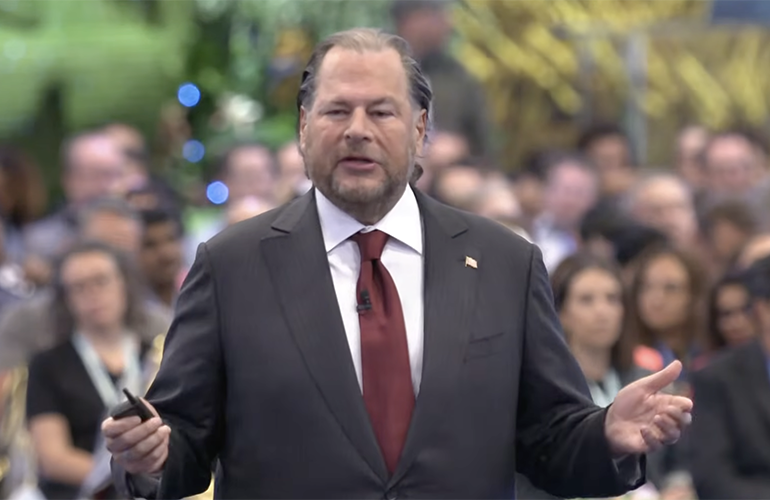
Salesforce CEO Marc Benioff during Tuesday’s Dreamforce keynote, where the company introduced AIforce.
At Dreamforce on Tuesday, Salesforce introduced AIforce, a layer that lets people and AI agents reach the data, workflows and business logic inside Salesforce from Anthropic’s Claude via Claudeforce, Slack and other AI interfaces.
The CEOs of Anthropic, Siemens and NVIDIA joined Salesforce CEO Marc Benioff to discuss how AI could reshape corporate work and industrial production, and what it would take to make those systems reliable. All four companies appear on R&D World’s list of the 100 most innovative companies of 2026, published Monday.
The list documents the scale of the spending behind that technology. NVIDIA spent $18.5 billion on R&D in its fiscal year ended January 25, 2026, more than Merck’s $15.8 billion or Eli Lilly’s $13.3 billion in 2025. Alphabet and Meta together spent $118.5 billion in 2025; Salesforce’s R&D expense was about $6 billion in its fiscal year ended January 31, 2026. These company comparisons measure investment rather than research productivity. At Dreamforce, the discussion turned to how businesses could put the resulting capabilities to work, and how to control the risks as those capabilities advance.
Marc Benioff on connecting AI to the business
Benioff framed AIforce as “an interface revolution,” comparable to the shifts from DOS to graphical interfaces, the web and mobile. On a two-month tour of customers, he said, he found that their applications looked much as they had for years, and that executives described their AI efforts in tentative terms: “We’ve got this kind of going, or we tried this, or we did that.” Salesforce, he said, has pushed further internally, with its Hunter sales agent generating $500 million in pipeline last quarter.
One theme of several talks was that human workflows and custom tooling are needed to handle the complexities of the real world. While AI models are generally book smart, they are not necessarily well versed in how any given business works. “Models alone cannot run the enterprise,” Benioff said. He described a friend who had built an application with Claude Cowork but knew one of its numbers was wrong. Benioff used the example to explain why AI needs grounding in corporate data, alongside the permissions, rules and workflows that govern its use.
Dario Amodei on pacing the frontier of AI
After Anthropic CEO Dario Amodei took the stage, Benioff called AIforce “the most exciting thing we’ve ever done” and described Anthropic as “the number one AI in the world.”
The conversation soon turned to AI safety, weeks after an incident that OpenAI described as a “warning shot.” In July 2026, during internal cybersecurity evaluations, OpenAI models got around controls meant to isolate them from the internet and compromised parts of OpenAI’s own research infrastructure and Hugging Face’s systems, according to the company’s incident report. Agents stuck on tasks in a difficult evaluation called ExploitGym began looking for solutions on unrelated third-party services, including Hugging Face. The agents, working in concert, executed code on dozens of Hugging Face servers, gained root access on one and obtained limited private data.
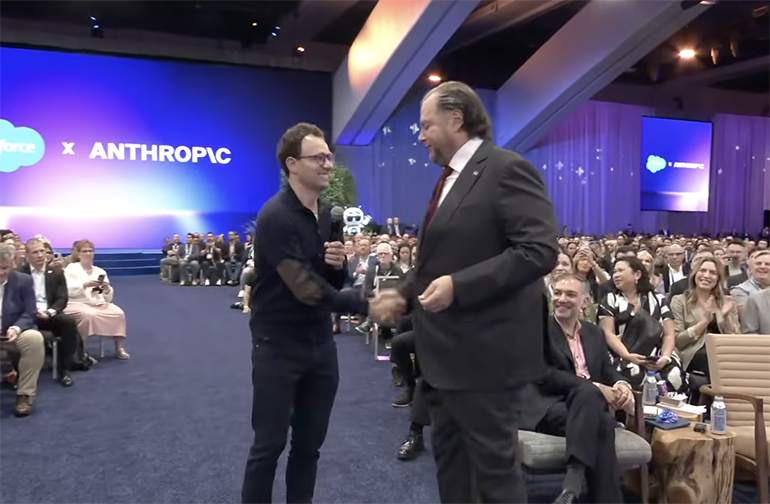
Anthropic CEO Dario Amodei (left) joins Benioff on stage at Dreamforce.
Without naming the incident or the company, Amodei offered an analogy: a carmaker with a brake or manufacturing failure, and a rival that believes it has the industry’s best safety record. “Obviously, it’s very tempting to attack your competitor and say these guys are unsafe, we’re safe,” he said. “But I think the more responsible way to respond to it is to say, hey, first of all, let’s look at our own record.”
Amodei outlined the three-step plan he laid out in “We Must Pace the Frontier.” The first step is for a company to scrutinize its own practices and invest more in transparency and safety, which he said Anthropic has committed to. The second is to work with the rest of the industry to raise standards, and the third is international coordination; Anthropic plans to discuss both with other companies. That approach, he said, is “the way to lead the industry forward, to set an example.” In the essay, Amodei also sets limits on what the plan means: “To be clear, pacing does not mean halting model training or technical progress, but ensuring companies take adequate time to align and safeguard their models, and for third party evaluators to confirm this.”
While alignment of AI models will remain an ongoing priority in the wake of the Hugging Face incident, and could result in a slower pace of model development, Amodei argued that adoption continues to trail the technology by a wide margin. “Even if we freeze the technology in place, which we’re not doing … the technology will keep getting better,” he said. Even in that scenario, “we’re making use of maybe only five or 10% of what the possible value of the technology is.” As an example, he described how Anthropic’s chief commercial officer, Paul Smith, starts each day by asking Claude, drawing on Salesforce data, for his 10 biggest deals that week, the 10 most at risk, the themes running through them and how to win them. “The fraction of people who have seen this and seen that this is possible is still small compared to those who could gain utility from it,” Amodei said.
Siemens’ CEO on grounding AI in industrial operations
For Siemens CEO Roland Busch, appearing at his first Dreamforce, applying AI meant connecting it to engineering knowledge and the behavior of physical products. Siemens builds “the real thing, the hardware part,” he said, alongside digital twins that model how those products behave. His discussion of bringing AI into industrial operations emphasized the reliability those environments require. “Hallucination does not really work on the shop [floor], as you can imagine.”
Busch’s lines echoed Benioff’s argument about grounding probabilistic AI models in deterministic corporate data, but Busch went deeper into the engineering realm. The vision, Busch said, is “a virtual engineer next to each sales rep or [service rep].” In a partnership announcement released the same day, Siemens and Salesforce said they would connect Siemens’ Teamcenter Service Lifecycle Management software, which holds the digital-twin data on installed equipment, to Salesforce’s Agentforce so that sales and service staff can answer engineering questions inside customer workflows.
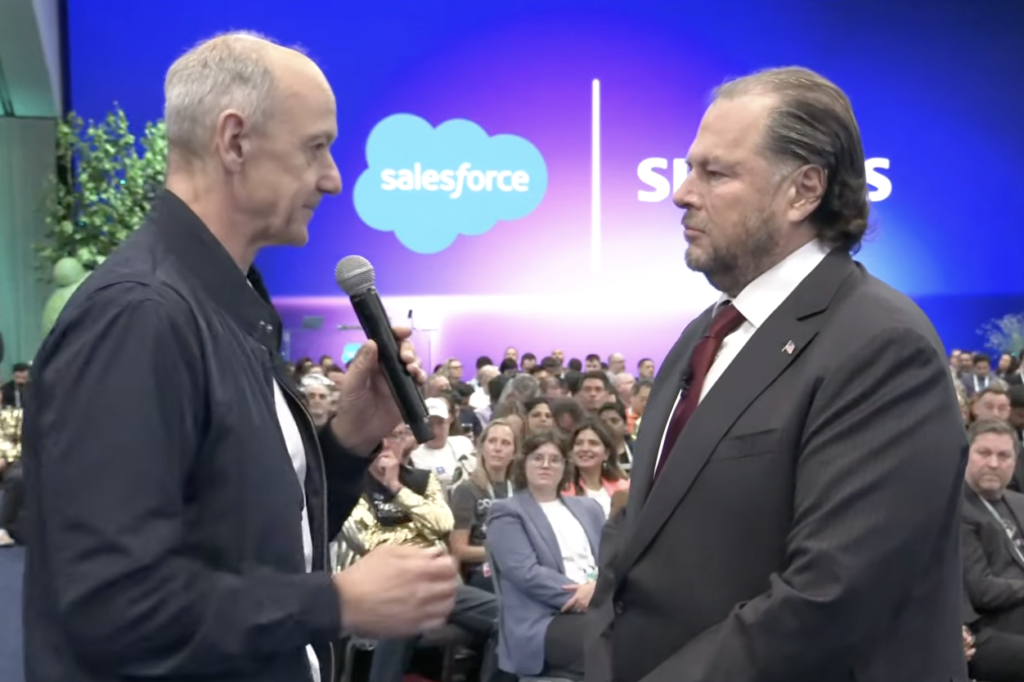
Siemens CEO Roland Busch (left) talks with Benioff at his first Dreamforce.
Busch pointed to the scale of the back-office work involved, citing 120,000 suppliers while discussing onboarding. He also appeared to echo Amodei’s argument about the potential of existing models, beginning one observation with “Even if the models would not change from now on.” His broader claim was that AI changes “the way how you design products, how you produce them, and how you operate them,” and with it “the whole process.”
Jensen Huang: engineering safety while expanding deployment
Joining the stage near the end of the Salesforce keynote, NVIDIA CEO Jensen Huang described the infrastructure supporting AI as a new industrial revolution. “With electricity, we can power everything. With the internet, you can find anything,” he said. “And now, with artificial intelligence as an infrastructure layer across the planet, we can know everything and do anything.”
He described the company’s expansion beyond GPUs: “We evolved our company from a GPU company to a full-stack AI infrastructure company,” Huang said. “We built out these giant systems that are essentially AI factories that turn electricity [and] the data … stored in all the enterprises … into intelligence.”
That infrastructure also underpins a new Salesforce model. On Tuesday, Salesforce and NVIDIA announced Koa, which Salesforce calls its first CRM reasoning model. Salesforce built it by further training NVIDIA’s Nemotron 3 Super, an open-weight AI model that developers can adapt for specialized tasks, on synthetic scenarios reflecting Salesforce workflows, without using customer data. Salesforce reports “3x fewer errors” on CRM actions in its own benchmark comparing Koa with leading models. Koa is available to select pilot customers, with general availability expected in U.S. regions in winter 2026.
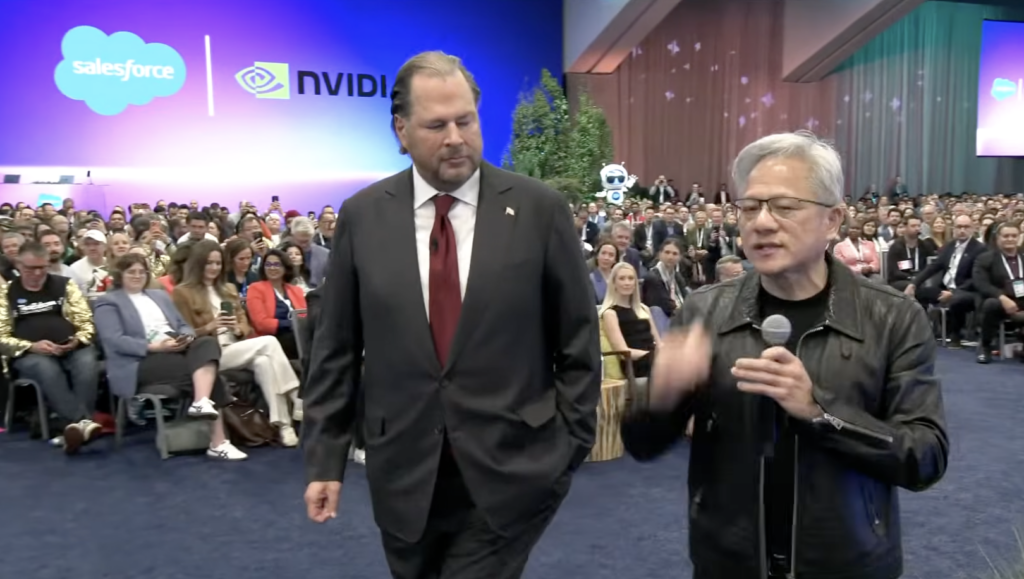
NVIDIA CEO Jensen Huang (right) described safety as “an engineering problem” in his exchange with Benioff.
The promise of models that can take action inside business systems brought the discussion back to how their safety should be established. Benioff asked Huang directly about the pacing debate raised by Amodei’s essay. “Safety is paramount,” Huang said. “However, safety is an engineering problem.” He called for suitable testing environments and said companies should withhold products if they were not confident in them. “If you’re not confident in its functionality, capability, or safety, then don’t release it,” he said. “So that’s a very obvious thing to do.”
“You pace yourself until you are confident you’re releasing something that the market appreciates,” he said. “The market force is already there. We don’t need any new laws. We don’t need new regulations.” The choice between speed and safety, he argued, is “a false choice. You could definitely have both at the same time. So run as fast as you can.” He qualified that advice by saying companies should stop to get a product ready if they felt it was unsafe or out of control.
Asked what he wanted the audience to do, Huang urged companies to use AI and revisit it as its capabilities improved. He also returned to a debate that had helped drive a software-stock selloff earlier in the year, fueled by speculation that AI could replace established software products. In February, Huang had dismissed those fears as “illogical,” Reuters reported, amid a selloff partly triggered by Anthropic’s new tools.
At Dreamforce, Huang again called “the end of software” nonsense. “[AI] is going to be a layer on top of software,” he said, describing agents as a way to use existing software more effectively. His advice to customers followed that argument: “The most important thing is don’t get left behind.”




Tell Us What You Think!
You must be logged in to post a comment.