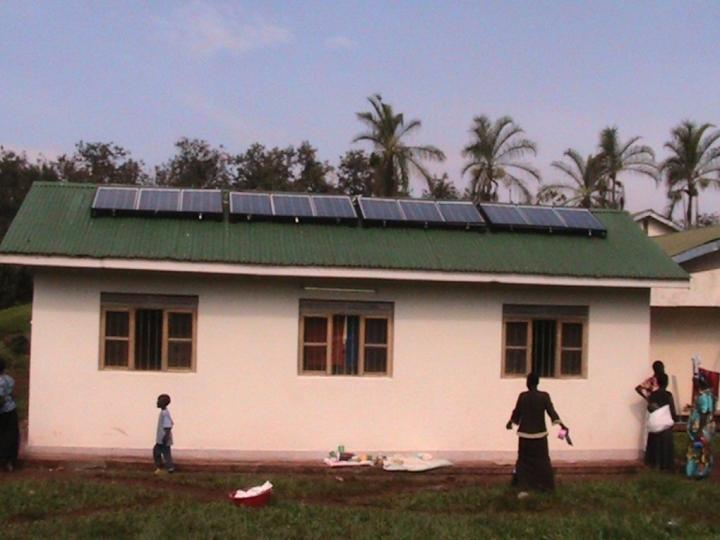
Solar panels on the roof of a medical facility in Uganda. Source: Michael Hawkes
A new twist on the use of renewable energy is saving children’s lives in Africa. The innovation–a solar powered oxygen delivery system–is providing concentrated oxygen in hospital for children suffering from severe pneumonia.
The device created by Dr. Michael Hawkes, an assistant professor in the University of Alberta’s Division of Pediatric Infectious Diseases, is the focus of a recently published study in The International Journal of Tuberculosis and Lung Disease and is already in use in two hospitals in Uganda.
“Solar-powered oxygen is using freely available resources–the sun and air–to treat children with pneumonia in the most remote settings,” said Hawkes. “It’s very gratifying for a pediatrician doing research in a lower-resource setting to fill a clinical gap and save lives. It’s what our work is all about.”
Each year, 900,000 children die of pneumonia worldwide with most deaths taking place in Africa and Asia. Vaccinations and medications exist, but are being rolled out slowly in Africa where diagnostics are poor and chest x-rays are not readily available.
Children with severe pneumonia have infected lungs that need concentrated oxygen until antibiotics begin to work. The concentrated oxygen helps overcome a problem with oxygen exchange caused by the lung infection. In Canada, it is available at the bedside in every hospital room. In developing countries like Uganda, it’s harder to come by reliably.
Hawkes worked in Ugandan hospitals in the communities of Kambuga and Jinja for over two years where he quickly recognized a need for a more reliable oxygen source. In low-resource settings, oxygen can be delivered using cylinders, which are often in short supply, or concentrators, which depend on electricity. In Kambuga there were multiple power outages each day, some lasting for up to 48 hours.
“In the hospital you often didn’t have access to oxygen cylinders. So the power goes out and you’re out of luck. We had children that died in front of our eyes,” said Hawkes.
To establish a reliable oxygen source, he and his colleagues came up with the idea of using solar energy. During the day, solar panels supply power to an oxygen concentrator that strips oxygen out of the air. At night, charged batteries from the panels supply the power to the concentrator.
To fund the idea, they received a Grand Challenges Canada grant, a Government of Canada initiative that supports global health research. The funds were used to set up the systems at the Kambuga and Jinja hospitals. “We piloted it on a group of 28 children and it showed that you could use the solar panels and batteries to run the concentrator 24/7. We treated children with pneumonia and the system worked,” he said.
Next they conducted a larger randomized controlled trial and showed that solar powered oxygen delivery works just as well as the conventional method of oxygen delivery using cylinders. The trial officially ended in 2015, but after seeing such strong results, the hospitals continue to use the solar powered systems.
Hawkes and his team are now working with the Clinton Health Access Initiative (CHAI) in hopes of soon expanding the system’s use to 80 hospitals across Uganda.
“If we could expand it, could you imagine how many children would have access to lifesaving oxygen therapy?” Hawkes wonders. “The challenges are different in these areas of the world, and the innovations need to be different as well.”
Source: University of Alberta