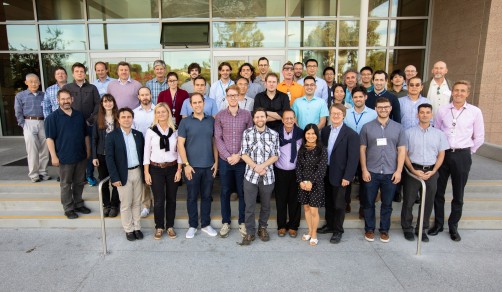
Attendees at the Oct. 9-12 FACET-II Program Advisory Committee meeting at SLAC. Credit: Andy Freeberg/SLAC National Accelerator Laboratory
When the FACET-II facility at the Department of Energy’s SLAC National Accelerator Laboratory opens its doors to scientists from around the world in early 2020, it’ll offer exceptional conditions for experiments that aim to revolutionize the field of accelerator physics. With powerful beams of electrons 100 to 1,000 times brighter than its predecessor, the upgrade to the Facility for Advanced Accelerator Experimental Tests (FACET) promises technological breakthroughs that could lead to a new generation of smaller, more affordable particle accelerators for research in particle physics, X-ray science, medicine and other fields.
In addition to diving into new concepts of particle acceleration, science at FACET-II will explore the physics of extremely intense beams to develop methods for enhancing capabilities at existing accelerator-based facilities.
Prospective users of FACET-II have now presented their ideas for a first round of experiments to a program advisory committee that will evaluate the merit and feasibility of the proposals.
“The exciting part is that FACET-II has garnered enormous interest among the user community, and the number of proposals is clearly larger than the number of experiments that can possibly be scheduled for the facility’s first run,” says Chan Joshi from the University of California, Los Angeles, a veteran FACET user and one of the presenters at the Oct. 9-12 meeting at SLAC. “This is a very positive development for the fledgling user facility, and the review committee has the unenviable task to prioritize the proposals for experimental time.”
Just days before the meeting, the upgrade project hit a major milestone when a newly installed electron source produced its first electrons. Once the upgrade is completed, the new facility will further advance research that was done at its predecessor, a DOE Office of Science user facility that operated from 2011 to 2016.
The main goal of FACET-II is to develop beam-driven plasma accelerators, in which a bunch of electrons gains tremendous amounts of energy over short distances by “riding” a plasma wave created by another electron bunch. The technology could potentially make future accelerators up to 1,000 times shorter and still achieve the same or higher energies. Most of the 35 proposed experiments presented at the meeting are closely tied to challenges that need to be addressed before the technology can be used in real-world applications, including the creation of beams with unprecedented brightness from within the plasma, the preservation of the beams’ quality as they traverse the plasma, and the development of concepts that would allow lining up several plasma stages for high-energy particle accelerators.
Other proposals focus on the development of new hardware, machine learning and other tools to control, monitor and analyze FACET-II’s extremely bright beams. Other scientists want to explore ideas for novel electron sources that would make future X-ray lasers more powerful. Yet another set of suggested experiments would use the facility for studies of fundamental physics, such as the quantum theory of electromagnetism.
Years of discussing and planning future science at FACET-II with the user community are coming to fruition now and have materialized into an impressive set of actual proposals that are well aligned with high-level priorities defined in DOE’s roadmap for advanced accelerator concepts research, says SLAC’s Mark Hogan, FACET-II project scientist: “We’re now looking forward to the advisory committee’s response, which will guide us in allocating experimental time for the best science possible.”
The 10-member committee of experts in fields relevant to the submitted proposals is expected to provide its feedback in a few weeks.